
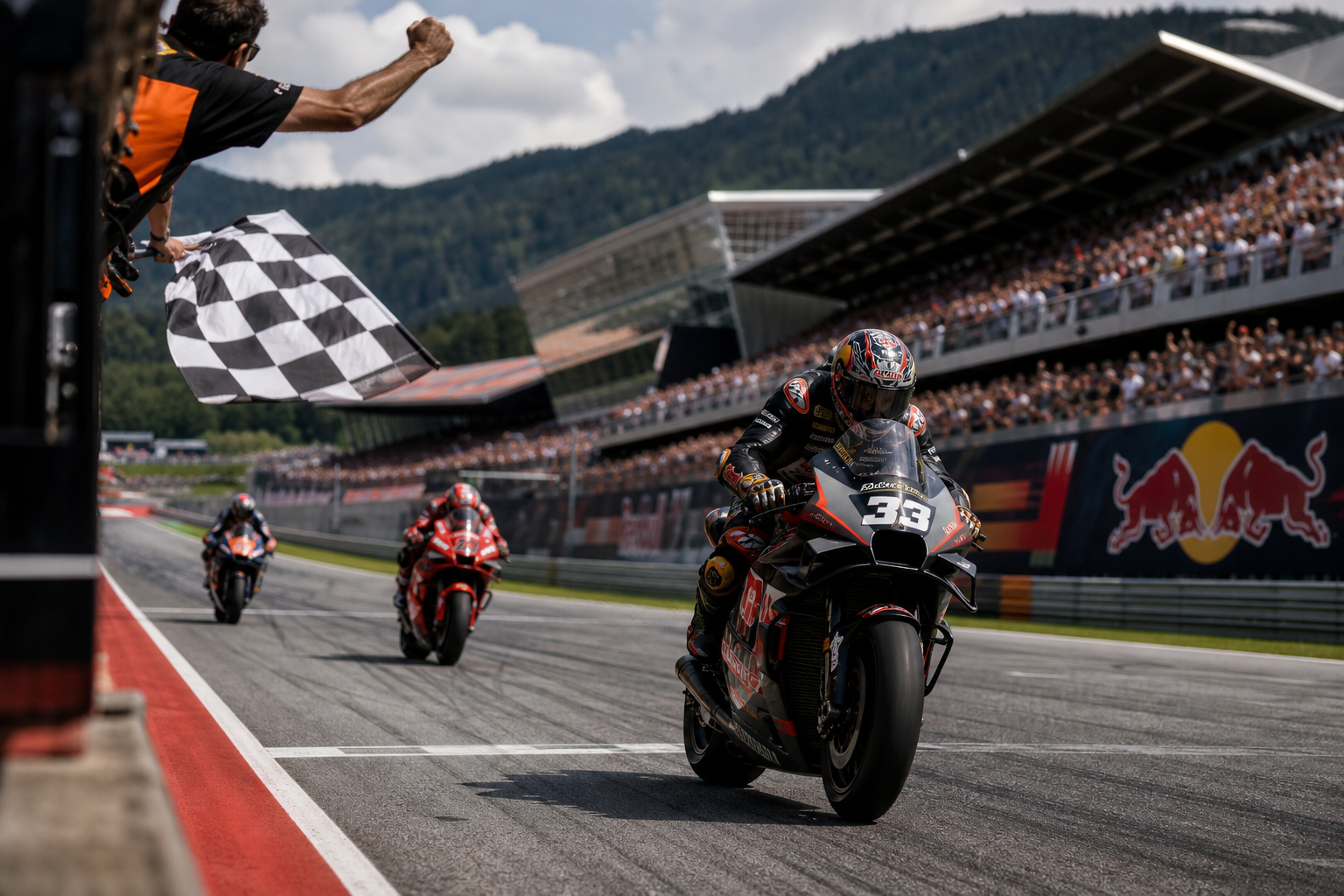

The Austrian Grand Prix produced the sort of MotoGP weekend that makes championship spreadsheets look briefly embarrassed. A manufacturer written off as being in a fight for survival only 18 months ago claimed a thoroughly deserved victory, the championship lead changed hands again, and tire behavior proved just as influential as outright speed.
That is a fair amount of disorder for one race weekend. Ducati and Aprilia, both accustomed to being central figures in the modern MotoGP conversation, were left to regret opportunities that slipped away while the circuit’s unusual demands shuffled the competitive order.
A Race Won by Reading the Track
The Red Bull Ring is not a circuit that politely rewards every strength a MotoGP bike possesses. It is compact, fast, and dominated by heavy braking zones, short bursts of acceleration, and long stretches where engine performance matters enormously. There is little room for a rider or crew to hide a weakness.
A motorcycle can be superb through the corners and still lose ground if it cannot launch cleanly out of the slow turns. It can have a mighty engine and still struggle if the rear tire overheats while the rider tries to exploit that advantage lap after lap. The Austrian layout is a rather efficient way of exposing both problems at once.
That explains why the weekend did not simply follow the form book. The fastest bike on paper was not automatically the easiest bike to race, and the rider with the strongest qualifying performance was not guaranteed to have the best package when the tires began to move around beneath him.
Tires Became the Second Race
MotoGP races are often described as battles between riders, but the Austrian Grand Prix was also a long negotiation with tire temperature and degradation. Those factors can remain invisible during the opening laps, when a rider is able to attack aggressively and the grip level still feels generous. Later, the bill arrives.
On a circuit with repeated hard acceleration zones, the rear tire is asked to do several jobs at once. It must provide traction while the bike is still leaned over, survive the force of acceleration when the motorcycle stands up, and remain stable under the electronic systems managing wheelspin. A setup that produces a fast first half of the race can become a liability when the rubber begins to fade.
The front tire presents a different problem. Heavy braking into the Red Bull Ring’s slower corners puts substantial load through the front end, particularly when riders try to make up positions at the end of a straight. A rider who asks too much too early may gain a place, but he can also compromise tire performance for the laps that matter later.
That is where the unusual result began to make sense. The winning manufacturer did not merely produce a bike capable of one quick lap. It delivered a package that remained effective as conditions changed, which is rather more valuable than looking heroic for six corners before the tires begin filing complaints.
The Manufacturer Nobody Could Ignore
The most striking element of the weekend was the victory for a manufacturer that had been fighting for its survival only a year and a half earlier. That is a substantial turnaround in MotoGP, where recovery is rarely a matter of finding a few tenths of a second and adjusting a winglet.
Manufacturers need money, staff, technical direction, development time, and a functioning racing operation. When any of those begin to disappear, the damage spreads quickly. A team loses testing capacity, development stalls, riders lose confidence, and the gap to the front grows large enough to become psychologically as well as technically difficult to close.
A win under those circumstances carries more weight than the trophy itself. It suggests that the manufacturer’s recovery has reached the track, not merely the boardroom. It also gives the team evidence that its engineering decisions are working in race conditions, where tire wear, fuel load, pressure management, and rider confidence expose weaknesses that a laboratory or simulator can politely ignore.
One victory does not erase the previous problems, nor does it guarantee that the same result will appear at the next circuit. MotoGP is brutally specialized. A motorcycle that thrives under Austria’s braking-and-acceleration demands may discover that another track asks entirely different questions. Still, this was the kind of result that changes how rivals assess a manufacturer. It is no longer enough to assume that the old hierarchy will reappear on schedule.
Ducati and Aprilia Left With Questions
Ducati’s presence near the sharp end has become so familiar that any weekend in which it fails to control the story feels unusual. Its recent success has been built on a remarkably complete MotoGP package: strong braking stability, effective corner exits, excellent acceleration, and a deep understanding of how to make the tires work over race distance.
But dominance creates its own problem. When a rival breaks through, every missed opportunity becomes more visible. Ducati was left to rue a weekend in which its strengths were not enough to settle the outcome, while the championship lead changed hands once again.
That change matters because MotoGP championships are rarely decided by one dramatic failure alone. They are shaped by small losses accumulated over several rounds: a poor tire choice, a qualifying lap that falls short, a compromised opening lap, or a rider forced to manage a machine instead of attacking with it. The Austrian race added another such twist to an already fluid title fight.
Aprilia had a different reason to be frustrated. Its recent progress has made it a credible front-running manufacturer, but credibility is not the same as converting every strong weekend into a maximum result. The Austrian Grand Prix offered an opportunity, and the team was left looking back at what might have been.
That is the slightly cruel nature of MotoGP. A rider can be fast enough to win and still finish the weekend feeling that victory was available but not properly secured. The stopwatch is not interested in potential.
Why the Result Matters Beyond Austria
The immediate championship effect is obvious: the lead changed hands. The more interesting consequence is the damage done to assumptions. Ducati remains a major force, and Aprilia remains a serious contender, but the Austrian Grand Prix demonstrated that the competitive picture cannot be reduced to a single manufacturer’s advantage.
For the championship leader, the result creates pressure rather than comfort. A new leader may have the points, but rivals now have fresh evidence that the standings can move quickly when a circuit, tire behavior, and race execution line up in an unexpected way.
For the manufacturer that won, the victory is a statement of engineering recovery. It proves that survival stories in racing are not always sentimental exercises dressed up in team colors. Sometimes a manufacturer really can drag itself back into contention through development, organization, and the stubborn refusal to accept that its best days are behind it.
And for MotoGP, that is exactly the sort of result the series needs. Dominant teams produce impressive numbers, but an unsettled competitive order produces tension. The Austrian Grand Prix supplied plenty of it: a surprise winner, another change at the top of the standings, and a reminder that tires can overturn a hierarchy more efficiently than any marketing department ever could.
0 Comments