
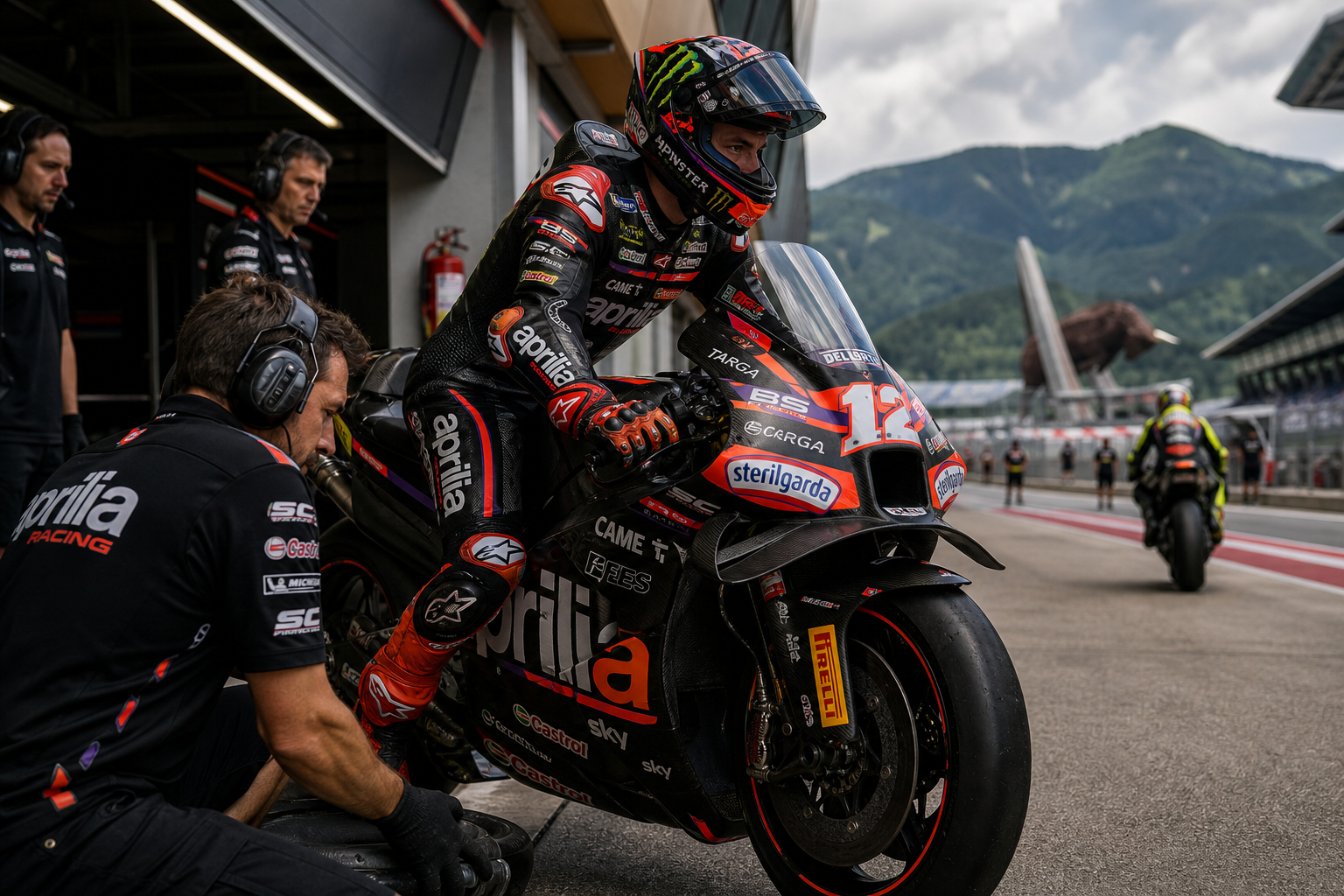

The most important detail about MotoGP’s final Pirelli tire test in Austria is also the one that remains frustratingly unclear: the event is scheduled for race riders, but the complete list of participating names has not been officially published.
That may sound like a small administrative gap. It isn’t. This is the second and final scheduled opportunity for MotoGP’s regular competitors to try the tires that will replace the championship’s current Michelin supply in 2027. Every lap will feed into a decision that could influence tire behavior, race strategy, setup philosophy, and the pecking order for an entire season.
A Two-Test Introduction to MotoGP’s Pirelli Future
The 2026 MotoGP testing calendar includes two dates for race riders to make their first direct assessment of Pirelli’s tires. That distinction matters because private development work can be carried out by manufacturers’ dedicated test riders, but the people who actually compete on Sunday bring a different perspective.
Factory test riders can produce valuable mileage and technical feedback. Regular riders, however, understand how a tire behaves when they are attacking qualifying laps, managing a long race stint, following another motorcycle through dirty air, or trying to preserve grip while the track changes. They also know precisely which habits they have built around the current tire supplier.
The first scheduled race-rider test took place on Monday, June 22, immediately after the Czech Republic Grand Prix. No official results were released from that session, so there was no published classification for readers to pore over or teams to argue about in carefully worded press statements.
The second session, held in Austria, is the final scheduled chance for race riders to evaluate Pirelli equipment before the championship moves closer to the 2027 changeover.
So, Who Is Taking Part?
The confirmed information currently establishes that race riders are expected to take part, rather than the session being limited to private test specialists. It does not, however, provide a complete official rider-by-rider entry list.
That means it would be wrong to publish a roll call of factory stars, satellite riders, or individual teams as though their participation had been confirmed. The same applies to assumptions based on which manufacturers are most interested in tire development. A rider may be present because of team scheduling, testing priorities, championship circumstances, or simple contractual planning, but none of those possibilities creates a confirmed entry.
For now, the useful answer is therefore slightly less satisfying than a neat list of names: the Austria test is intended for MotoGP’s active race riders, while the final published participation details remain limited. Motorcycle racing, like the rest of the automotive world, occasionally asks us to survive without a spreadsheet.
Why the Austria Session Matters
The test is not a ceremonial preview. Changing tire suppliers in a prototype racing championship can alter the way teams approach almost everything from suspension settings to electronic calibration and race strategy.
A tire is not merely a round black component attached to the wheel. Its construction, compound behavior, operating window, warm-up characteristics, and performance drop-off shape the motorcycle around it. A rider who can brake later but struggles to generate confidence on corner entry may prefer a different setup from one who prioritizes rear grip on corner exit. Engineers then have to translate those impressions into measurable changes in geometry, damping, electronics, and tire pressure management.
The Austria session should give teams another chance to compare Pirelli’s behavior against the expectations built through the first test. That second exposure is particularly valuable because one day of running can be distorted by weather, track temperature, traffic, or the unusual demands of a single circuit. Repeating the exercise at another venue helps separate a genuine tire characteristic from a track-specific quirk.
It also gives riders more time to identify the things that are difficult to describe in a technical report. Does the front tire communicate clearly as the limit approaches? How predictable is the rear when the rider picks up the motorcycle and applies power? Does grip remain consistent over a full stint, or does performance fall away sharply after the initial attack? Those answers are not always visible in a lap-time chart.
The Michelin-to-Pirelli Change Is a Major Technical Reset
Pirelli is scheduled to replace Michelin as MotoGP’s tire supplier in 2027. That change will affect every manufacturer and every rider, regardless of where a team sits in the championship.
Teams cannot simply carry over a successful 2026 setup and expect it to work with the new tires. The tire becomes part of the motorcycle’s dynamic platform, so even a machine that is fundamentally competitive may need a different approach to chassis stiffness, suspension control, braking stability, and electronic intervention.
The shift may also shuffle the competitive order. A manufacturer that has struggled to exploit the current tire could discover that Pirelli’s characteristics suit its existing concept better. Conversely, a team that has built a finely optimized package around Michelin’s behavior may face an unwelcome period of adjustment. Racing engineers tend to describe such problems as “areas for development,” which is the polite way of saying that the garage has just acquired several new headaches.
That is why the involvement of current race riders is so important. Their feedback helps manufacturers understand not only whether the tire is fast, but whether it is usable across different riding styles and race conditions. A tire that produces a spectacular qualifying lap but becomes difficult to manage in a race would create a very different championship from one that rewards consistency and controlled degradation.
Why No Official Results Were Published From the First Test
The June session after the Czech Republic Grand Prix produced no official results. Without a published classification, it is impossible to draw credible conclusions about which rider or manufacturer made the most progress.
That restraint is sensible. Testing lap times are notoriously easy to misunderstand. One rider may be working through a tire comparison, another may be running a different fuel load, and a third may be focused on long-run consistency rather than a single fast lap. Without the test program, a timing sheet can be less informative than it looks.
The absence of results also prevents the session from becoming an unofficial competitive event. Teams can concentrate on collecting data rather than chasing headlines, while manufacturers avoid revealing more about their development direction than they intend to show.
What to Watch for in Austria
The most useful information from the Austrian test may not be a headline lap time. Watch instead for whether riders and teams begin to identify consistent patterns between the two sessions.
- Whether riders report predictable front-end feel and braking behavior.
- How quickly the tires reach their working temperature.
- Whether rear grip remains stable over a longer run.
- How much setup work is required to adapt current motorcycles to Pirelli’s characteristics.
- Which manufacturers devote the greatest amount of track time to tire evaluation.
The published rider list will also matter when it arrives. A broad spread of factory and satellite competitors would give Pirelli more varied feedback, while a narrower group would leave more of the grid relying on manufacturer testing and later development work.
What is already clear is that Austria represents the last scheduled race-rider checkpoint before MotoGP’s 2027 tire era becomes a much more immediate engineering problem. The names involved still need to be confirmed, but the purpose of the test is not mysterious: learn as much as possible now, before every team discovers that a familiar motorcycle suddenly has rather different footwear.

0 Comments