
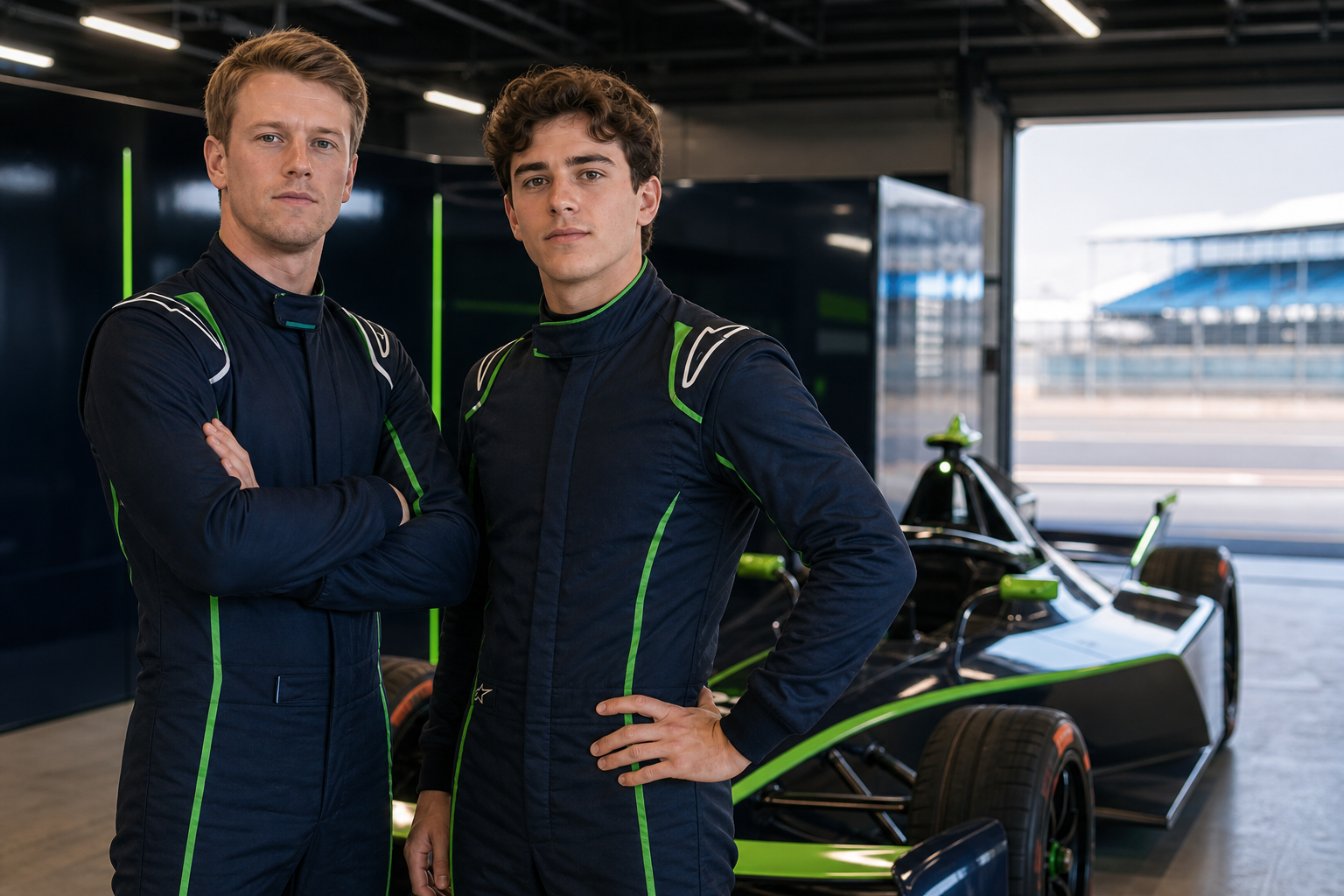

Formula E teams love a reset button. New car, new regulations, new pecking order, and, if you are Envision, apparently a new pair of drivers as well. The Silverstone-based squad has torn up its current arrangement and signed Maximilian Guenther and Zak O’Sullivan for Season 13 and beyond, a clear signal that it is treating the incoming GEN4 era as a proper fresh start rather than a gentle evolution.
That matters because GEN4 is not just another cosmetic update with a shinier number on the side. Formula E’s next-generation car is expected to arrive quicker and with all-wheel drive, which will change the rhythm of the championship quite a bit. In a series where aerodynamic efficiency, energy management, and racecraft are already a rather peculiar form of wizardry, a faster and more capable machine will reward drivers who can adapt quickly and think at full tilt for the entire race distance. Envision has decided it wants exactly that sort of combination.
Guenther Brings Winning Pedigree
Guenther arrives with a decent amount of credibility already in the bank. The German has seven Formula E victories to his name, which is the sort of CV that tends to get a team principal’s attention. He is not a speculative punt or a hopeful name from the junior ladder; he is an established front-runner who has seen enough of Formula E’s odd little corners to know where the traps are hidden.
That experience should be valuable when the category moves into GEN4. New machinery tends to do two things at once: it resets the competitive order and makes everyone sound very certain about things they cannot yet know. Drivers who have already lived through the usual Formula E chaos — energy targets, tactical games, changing grip, and the annual temptation to believe the next regulation package will magically solve every problem — tend to be worth their weight in carbon fiber.
For Envision, Guenther gives the team an immediate benchmark. He is the sort of driver who can tell engineers, without too much diplomatic nonsense, whether the car is genuinely quick or merely wearing a hopeful face.
O’Sullivan Gets His Formula E Break
The more eye-catching half of the announcement is O’Sullivan, the British youngster whose name has been circling the wider motorsport conversation for a while. Formula E has never been short of interesting career pivots, but this is still a notable one: a rising talent moving into a world championship that demands patience, precision, and an ability to cope with energy-saving tactics that can make the occasional fuel-saving grand prix seem positively straightforward.
His signing gives Envision a driver pairing with a sensible mix of proven race-winning experience and raw upside. That’s the sort of balance teams usually claim to want, of course, but rarely manage without compromising one side or the other. Here, the logic is easier to see. Guenther can anchor the project. O’Sullivan can grow with it. If the GEN4 car behaves anything like Formula E’s previous technical resets, there will be plenty of learning for everyone anyway, so a young driver with room to develop is no bad thing.
For O’Sullivan, the move is also a statement of intent from Envision. Teams do not hand out seats in a new technical era because they enjoy a pleasant facial expression and a tidy lap time on a Monday. They do it because they think a driver can be part of the long-term package. That is a useful vote of confidence in a championship that can chew through reputations if the fit is wrong.
Why GEN4 Changes the Equation
Formula E’s next phase is important because the series has always relied on its technical rules to keep the competition interesting. The cars are part-spec, part-development platform, and part-test of whether everyone involved can stay awake while energy strategy and race pace fight each other in the cockpit. GEN4 is expected to make the cars faster and add all-wheel drive, which should make them more capable and, one would hope, more demanding in the right ways.
That kind of shift tends to expose weaknesses quickly. Driver lineups become less about simply having someone competent and more about finding people who can cope with a fresh technical brief, help shape the car, and extract performance while the engineers are still arguing over the details. If you are setting up for a new era, you’d rather not discover in February that your driver pairing has the adaptability of a garden wall.
Envision’s decision suggests the team wants to be proactive rather than reactive. It is choosing a lineup that can face uncertainty with some confidence, and in Formula E uncertainty is basically part of the package. The championship has made a habit of rewarding teams that adapt quickly when the rules move the furniture around.
A Clean Break at Silverstone
The other notable element here is the scale of the change. This is not a minor adjustment or a mid-cycle shuffle. It is a full overhaul. Envision has effectively decided that the GEN4 transition is the moment to reset its sporting direction entirely, which is a bold move but not an unreasonable one. New machinery often gives teams permission to rethink everything from driver feedback priorities to the kind of personality mix they want in the garage.
Silverstone has become something of a Formula E production line for teams trying to punch above their weight, and Envision’s approach fits that mold. It is not chasing headlines for the sake of it. It is trying to assemble a driver lineup that can actually deal with the sort of technical and strategic complexity that will come with the next generation of cars. Sensible, really. Not glamorous, perhaps, but motorsport is rarely won by being glamorous in the first place.
There is also a neat bit of timing in all this. By announcing the pair now, Envision gives itself maximum runway before GEN4 arrives in earnest. That means the drivers and engineers can build familiarity well before the first meaningful points are on the table, which sounds obvious until you remember how often teams in motorsport manage to make obvious things look surprisingly difficult.
What This Says About Formula E’s Next Chapter
The driver market always tells you something about where a championship thinks it is going. In this case, Envision’s move hints at a paddock preparing for a less forgiving, more technically demanding era. Faster cars, all-wheel drive, and a fresh competitive landscape will not reward hesitation. They will reward the teams that bring the right mix of speed, technical feel, and the ability to learn quickly when the real-world version of the theory is a bit less elegant.
Guenther and O’Sullivan are an interesting pairing because they cover two useful bases at once. One is a known quantity with a winning record. The other is a younger prospect with room to become something rather useful. If Envision gets the car right, the lineup should give it a decent foundation for the chaos to come. And if Formula E has taught us anything over the years, it is that chaos is rarely in short supply.
So this is more than a driver announcement with a couple of names attached. It is Envision choosing its shape for the next era of the championship. Whether that proves inspired or merely sensible will depend on the usual Formula E mix of engineering, strategy, and the sort of race-day unpredictability that keeps everyone honest. But on paper, at least, it looks like a team preparing properly instead of just hoping the universe will be nice to it for once.


0 Comments