
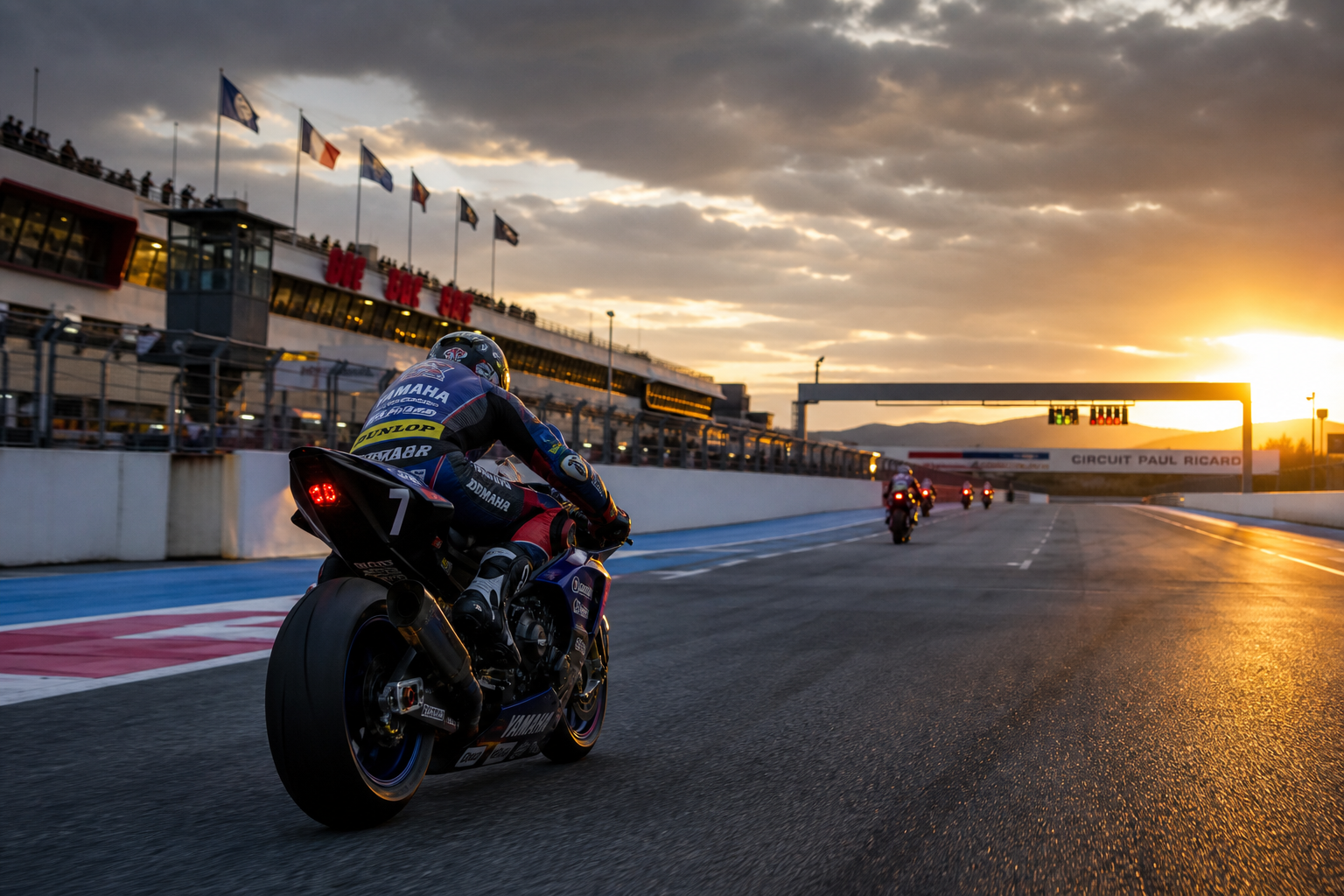

The season always seems to arrive at the Bol d’Or with a slightly unhinged sort of dignity. One minute you’ve got a championship politely pretending to be under control, and the next you’re at Circuit Paul Ricard for a 24-hour scrap that can decide the entire FIM Endurance World Championship. No pressure, then.
The 89th running of the race takes place from September 17 to 20 at the French circuit, and as ever the attraction is not just the length of the thing, but the sheer number of ways it can go wrong. Endurance racing is glorious like that. You can be quick, clever, and beautifully prepared, and still have your afternoon ruined by weather, a mechanical gremlin, a safety car period, or a pit stop that turns into a minor public inquiry.
Why The Bol d’Or Still Matters
The Bol d’Or is not merely the season finale. It is the race that tends to reveal whether a championship leader has been genuinely strong all year or merely well behaved while everyone else was busy falling over each other. A 24-hour race has an awkward habit of exposing the truth. Speed is useful, naturally, but endurance racing is really about discipline, reliability, and not doing anything daft at 3 a.m. when the brain has turned to soup.
Circuit Paul Ricard is a fitting stage for that sort of contest. Fast, technical in its own way, and famous enough that it needs no introduction, it has long been one of the spiritual homes of European motorsport. The track’s long straights and demanding rhythm place a premium on machine efficiency, rider consistency, and the kind of pit-wall calm that only exists until it abruptly doesn’t.
When The Race Runs
The event spans four days, with the main race running across the weekend into Sunday. The key date for most viewers is the start of the 24-hour contest, with the full finale unfolding from September 17 through September 20.
As with most endurance events, the precise broadcast timetable depends on where you are watching from and which coverage partner you’re using. That’s the mildly annoying modern reality: the race is global, the timing is local, and somewhere a television producer is earnestly explaining why your favorite session is hidden three menus deep in an app designed by a committee. Still, the headline is simple enough — if you want the championship decider, this is the weekend to clear.
What Makes This Finale So Volatile
Endurance racing has a way of humbling people. A team can dominate for hours and still lose everything to one bad stint, one dropped bike, or one tiny error that snowballs into an expensive chain reaction. That is exactly why the Bol d’Or tends to feel so dramatic even before the chequered flag appears.
The FIM Endurance World Championship has spent the season building toward this final round, and the Bol d’Or traditionally rewards the outfit that manages the least drama rather than the most heroics. Which, in a sport built around screaming motorcycles, tyre changes, fuel strategy, and sleep deprivation, is a fairly elegant contradiction.
And yes, the race is a 24-hour event, which means the final result can hinge on decisions taken in darkness, when visibility is poor and common sense is often the first casualty. That’s endurance racing in a nutshell: a long, noisy test of mechanical durability and human patience, with the occasional burst of breathtaking speed when somebody decides subtlety is for other people.
Circuit Paul Ricard: A Proper Endurance Stage
Paul Ricard is a particularly appropriate venue for the Bol d’Or because it punishes indecision. The circuit rewards smoothness and efficiency, but it also punishes the tiniest lapses in concentration. For teams, that means the usual cocktail of race prep becomes even more important: fuel consumption, tyre wear, rider rotation, traffic management, night running, and the kind of pit work that needs to be clean, fast, and absolutely free of improv comedy.
That is part of the charm. Endurance racing at its best is not just about the bikes themselves, but about how every piece of the operation fits together. The machine, the riders, the engineers, the strategists, the mechanics — they all have to behave like adults for a very long time. A deeply unnatural concept in motorsport, admittedly, but there we are.
How To Approach The Weekend
If you’re following the Bol d’Or 2026, the sensible plan is to treat the event as more than a single start time and finish time. The build-up matters. Qualifying matters. The early hours matter. The quiet middle of the night, when everyone looks briefly calm and professional, matters too, because that is usually the stage before the whole business gets properly interesting.
The final round of a championship often has a peculiar atmosphere. Some riders attack with the desperation of people who know a title is within reach. Others drive — or in this case ride — with the tight-lipped caution of a squad trying not to trip over its own shoelaces at the last possible moment. That tension is half the appeal. The other half is watching a 24-hour race remind everyone that motorsport is rarely won by the loudest people in the room.
So if you’re planning to tune in, the message is straightforward: the Bol d’Or 2026 runs from September 17 to 20 at Circuit Paul Ricard, and it is the deciding round of the FIM Endurance World Championship. In other words, this is the one where the polite pretense ends and the championship really gets sorted. Or not, if the race decides it has other ideas. Which it often does.


0 Comments