
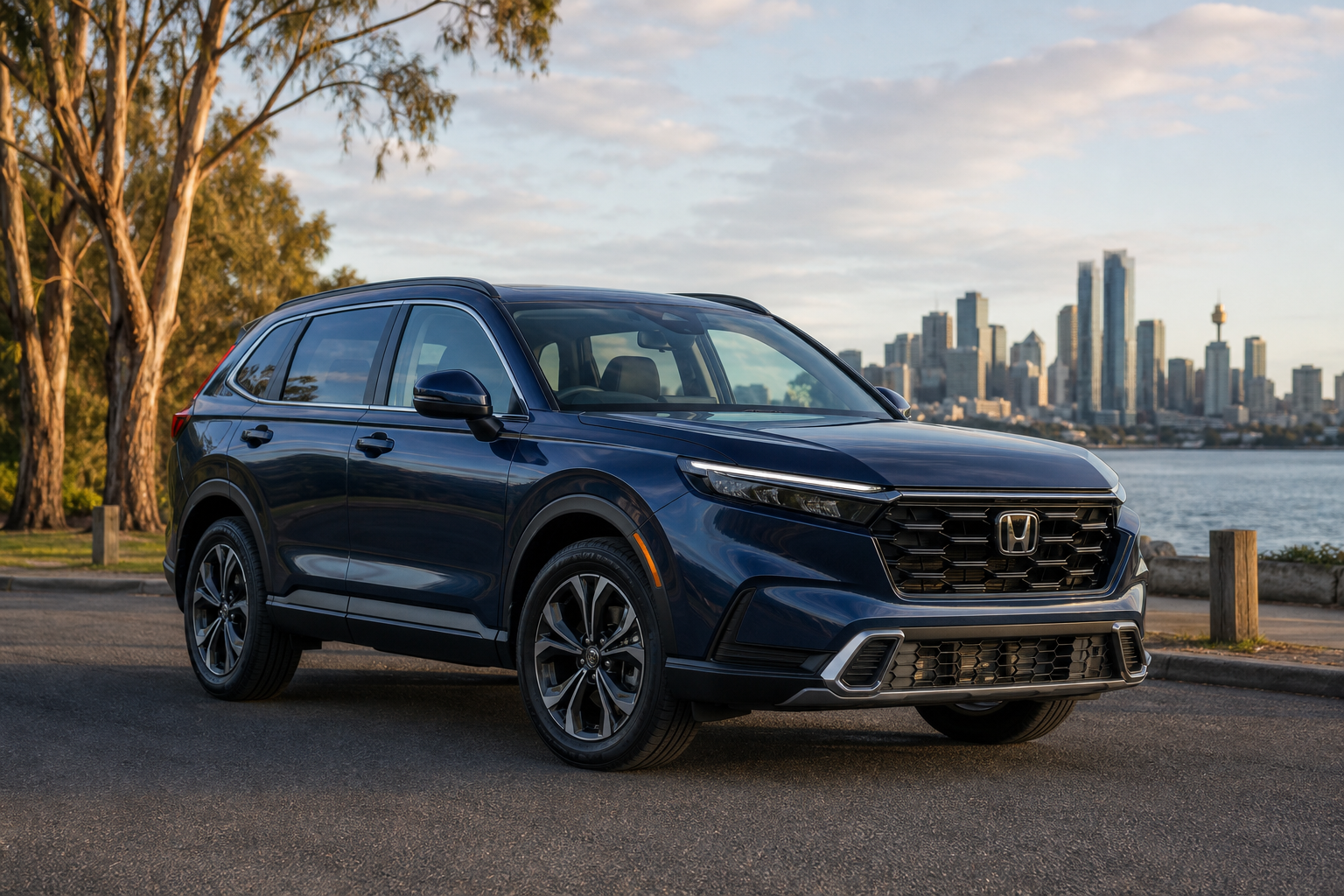

The Honda CR-V has spent decades building a reputation as one of the most sensible choices in the medium SUV segment, and the 2026 e:HEV X continues that theme with a hybrid powertrain, a practical cabin and a specification that focuses on everyday usability rather than headline-grabbing numbers. In long-term use, that’s exactly where the CR-V makes its case: it’s a family SUV designed to be lived with rather than admired from afar.
Honda’s current CR-V lineup in Australia sits in a particularly interesting place. The brand has shifted the model further upmarket than previous generations, and the e:HEV X is an important part of that strategy. It combines the efficiency benefits of Honda’s hybrid system with the size and equipment level expected of a modern mid-size SUV, while still staying true to the CR-V’s long-standing role as a straightforward, easy-to-use family car.
What the e:HEV X brings to the CR-V range
The e:HEV X sits in the middle of the current Australian CR-V hybrid lineup, positioned as a better-equipped alternative to the base model without moving all the way to the most expensive grades. That’s a sensible place for a car like this. It gives buyers access to the hybrid system that defines the range while keeping the packaging and price logic relatively grounded.
Honda’s hybrid setup is one of the more interesting elements of the CR-V. Rather than behaving like a conventional turbocharged petrol SUV with an electric assist layer, the system is designed to deliver a more electric-like driving experience in everyday use. In practical terms, that means smooth take-up from a standstill, quiet low-speed progress and the kind of efficiency benefits that make sense for suburban commuting and family duties.
For buyers cross-shopping the segment, that hybrid-first approach gives the CR-V a different flavour from many rivals. Some competitors concentrate on outright value, others on visual impact or a long feature list. Honda has taken a more restrained route, leaning on refinement, usability and the sort of engineering consistency that has long defined the nameplate.
Cabin design and daily usability
The CR-V has always been judged heavily on its interior, and that remains the right lens. This is a car that is supposed to cope with school runs, shopping trips, highway commuting and family travel without making any of those tasks feel like work. The cabin layout reflects that brief clearly, with straightforward controls, a sensible driving position and the kind of space-efficient packaging that buyers expect from a serious SUV.
Honda’s recent interior design direction is cleaner and more mature than the more ornate layouts seen in some rivals. That suits the CR-V well. The driver’s area feels deliberately arranged rather than styled for effect, and the overall execution is aimed at long-term livability. Good visibility, clear ergonomics and a practical approach to storage all matter more here than dramatic trim shapes or flashy screen integration.
As a family SUV, the CR-V also depends on rear-seat space and load-carrying flexibility, two areas where the model has traditionally performed strongly. That has always been part of its appeal: the CR-V doesn’t just need to look useful, it has to function as a genuinely easy car to own when life gets busy. The long-term perspective makes that especially important, because small annoyances in day-to-day use become far more obvious over time than they do on a short test drive.
Why the hybrid matters in this segment
Hybrid SUVs are no longer niche products. In the Australian market, they have become a mainstream answer to fuel consumption concerns, and the CR-V e:HEV X arrives in a segment where buyers increasingly expect electrified powertrains to be part of the conversation. The Honda’s approach is notable because it is not trying to overwhelm the class with performance figures or a complicated tech story. Its appeal is in the way the system supports ordinary use.
That suits the CR-V’s character. This is not a model that needs to chase sports-sedan acceleration or off-road bravado. Its role is to be efficient, calm and predictable in traffic while remaining capable of covering longer trips without feeling strained. In that context, a hybrid system that feels natural in stop-start driving and relaxed on the open road is more valuable than one that merely looks good on a spec sheet.
Honda has also used the CR-V to reinforce its broader hybrid strategy. As traditional combustion SUVs face mounting pressure from electrified alternatives, a car like this helps the company stay relevant in the mainstream family segment while avoiding the complexity and cost of full battery-electric packaging. For buyers who want a familiar format with lower fuel use, that middle ground remains compelling.
Living with the CR-V over time
Long-term updates are where a car like the CR-V can separate itself from flashier rivals. Day-to-day use reveals whether the controls are intuitive, whether the cabin is genuinely comfortable and whether the hybrid system remains a benefit in mixed driving rather than only in ideal urban conditions. The Honda’s appeal is built around those fundamentals.
There’s also value in the CR-V’s consistency. It does not rely on constant drama to hold attention. Instead, it aims to be the kind of vehicle that quietly becomes part of a household routine. That can be easy to overlook in a market where styling and technology often dominate first impressions, but it is one of the reasons the CR-V nameplate has remained relevant for so long.
For buyers considering a medium SUV, that’s often the real question: not whether the car is exciting on paper, but whether it will remain agreeable after months and years of use. The CR-V e:HEV X’s proposition is built around that long-term logic. If it continues to deliver the expected mix of space, efficiency and ease of use, it will have done exactly what Honda intended.
Where it fits among modern family SUVs
The medium SUV segment is crowded with strong contenders, and buyers now have more choice than ever across petrol, hybrid and plug-in hybrid formats. In that environment, the CR-V has to offer more than just a familiar badge. The e:HEV X does that by packaging Honda’s hybrid know-how into a vehicle that remains practical and approachable rather than technical or intimidating.
That balance is important. A lot of contemporary SUVs are trying to be all things at once: sporty, premium, rugged, efficient and tech-laden. The CR-V is more focused than that. Its strongest qualities are the ones many buyers actually use every day, and the hybrid system adds relevance without changing the vehicle’s fundamental purpose.
As the long-term story develops, the most interesting part won’t necessarily be a single standout statistic or a dramatic revelation. It will be whether the CR-V continues to justify its place as one of the most rational choices in Honda’s line-up and in the wider SUV market. Based on its formula, that seems to be exactly what it is built to do.

0 Comments