
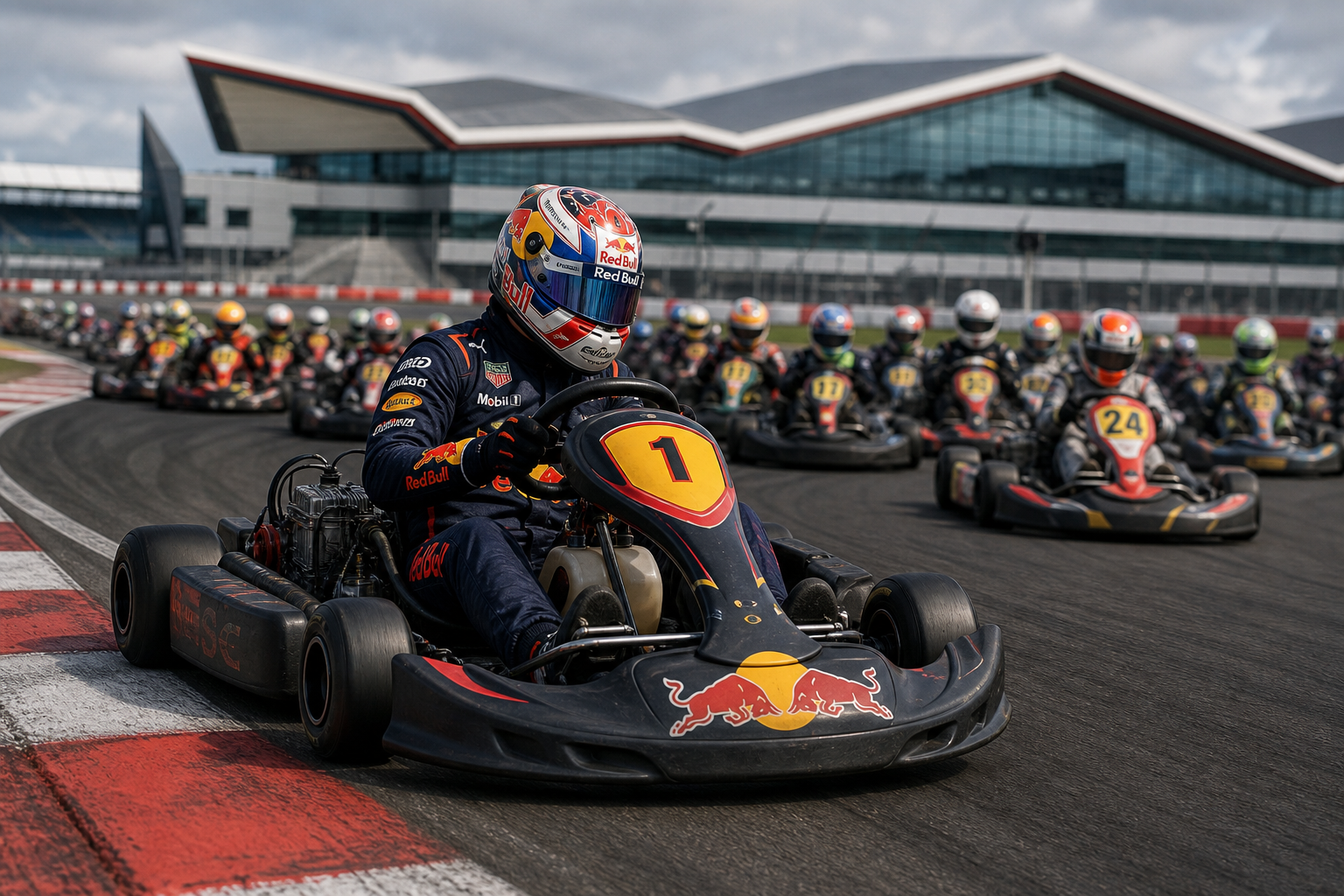

Max Verstappen turned a novelty Red Bull promotion into something closer to a demonstration of raw speed, completing his Silverstone karting challenge quicker than even he expected. The four-time Formula 1 world champion took on 100 amateur karters in the ‘Max vs 100’ event and came away with a result that underlined just how much pace he still carries when the format changes from grand prix machinery to something far simpler and more immediate.
Held on Wednesday at Silverstone, the event brought together a mix of content creators, motorsport personnel and athletes for a one-off competition against Verstappen. The concept was straightforward: place one of the fastest drivers in the world against a large field of non-professionals and see whether the numbers and the skill gap make for a lopsided show or a genuinely entertaining contest. In Verstappen’s case, it ended up being the former on the stopwatch and the latter in terms of spectacle.
A world champion in a very different arena
Verstappen is best known for extracting every last fraction from a current-generation Formula 1 car, but karting remains the foundation of his racing identity. Like so many elite single-seater drivers, he built his early reputation in karts, where speed depends on precision, momentum and an instinctive feel for grip rather than the aerodynamic complexity and energy management of modern F1. That background made the Silverstone challenge a natural fit.
The attraction of an event like this is obvious. A kart strips away the layers of performance engineering that define Formula 1 and puts the driver back in a comparatively raw environment. There’s no hybrid system to manage, no elaborate set-up window and no telemetry-driven strategy game. What remains is the most basic racing equation: braking points, rotation, throttle timing and confidence under pressure. Verstappen has built an entire career on those fundamentals.
The format: one driver, 100 challengers
Red Bull’s ‘Max vs 100’ setup placed Verstappen against a field made up of 100 amateur karters, including creators and athletes as well as people from motorsport circles. That blend matters, because it meant the event wasn’t purely a celebrity exhibition. The group likely varied widely in experience, which made Verstappen’s benchmark performance even more telling. Against a field like that, the world champion’s edge was never going to be subtle.
Still, large-format challenges can be more revealing than they first appear. With so many participants on track, traffic, timing and consistency become part of the puzzle. The leading driver can’t simply disappear into the distance without also navigating the chaos created by a crowded field. In that respect, Verstappen’s result suggests more than just outright speed; it points to an ability to manage a race environment efficiently, even when the opposition is broad and uneven.
Why Silverstone suits an event like this
Silverstone is one of the most appropriate venues for a stunt of this kind. The circuit’s place in British and global motorsport gives the event instant credibility, and the track’s long association with grassroots and top-tier racing makes it a fitting backdrop for karting. Even though karting isn’t run on the full Grand Prix layout, the Silverstone name gives the challenge a clear motorsport identity rather than making it feel like a marketing exercise detached from racing culture.
That context matters for Red Bull as well. The team has long been adept at turning its drivers into central characters in fan-facing content, and Verstappen is a particularly strong draw because his reputation is built on performance rather than theatrics. An event that asks him to race against 100 people is designed to be approachable and shareable, but it also works because he remains credible in the role of the benchmark driver.
What the result says about Verstappen
The most interesting part of the story is not simply that Verstappen won a karting challenge. It’s that he apparently exceeded his own expectations while doing it. That detail is easy to overlook, but it hints at the difference between being fast in theory and translating that speed into a live, multi-runner event with variable conditions and traffic.
For a driver at Verstappen’s level, the surprise likely wasn’t that he could be quick. It was probably how effectively that speed showed up in a setting so far removed from Formula 1. Elite drivers often speak about karting as the place where instincts are sharpened and reflexes stay honest, and this sort of event is a reminder that those skills don’t vanish just because the equipment changes.
It also helps explain why karting still holds such a strong place in motorsport culture. The equipment is simpler, but the competition is unforgiving. A driver with Verstappen’s background can still expose the gap between professional reflexes and amateur pace almost immediately. The difference becomes visible not through data traces or engineering briefings, but in how decisively one driver can control the shape of the race.
A promotional event with genuine competitive value
Automotive and motorsport brands frequently stage events that are designed first and foremost for content. Many of them rely on novelty alone. This one worked because the premise had a clear competitive logic: a world champion, a basic racing format and a large enough field to create unpredictability. The entertainment value came from watching whether 100 competitors could collectively turn the tables on a single elite driver. They could not.
For Red Bull, the result reinforces a long-running marketing advantage. The team’s drivers are not presented only as polished ambassadors but as active competitors who can still make ordinary racing formats look easy. Verstappen’s performance at Silverstone fits that image neatly. He didn’t just participate in the challenge; he set a pace that apparently outstripped even his own expectations, which is exactly the kind of detail that turns a promotional event into a talking point.
And for anyone who has ever followed karting closely, the outcome makes perfect sense. Strip racing down to its essentials and the best drivers tend to separate themselves very quickly. Verstappen did exactly that at Silverstone, even in the middle of a field of 100 challengers.
0 Comments