
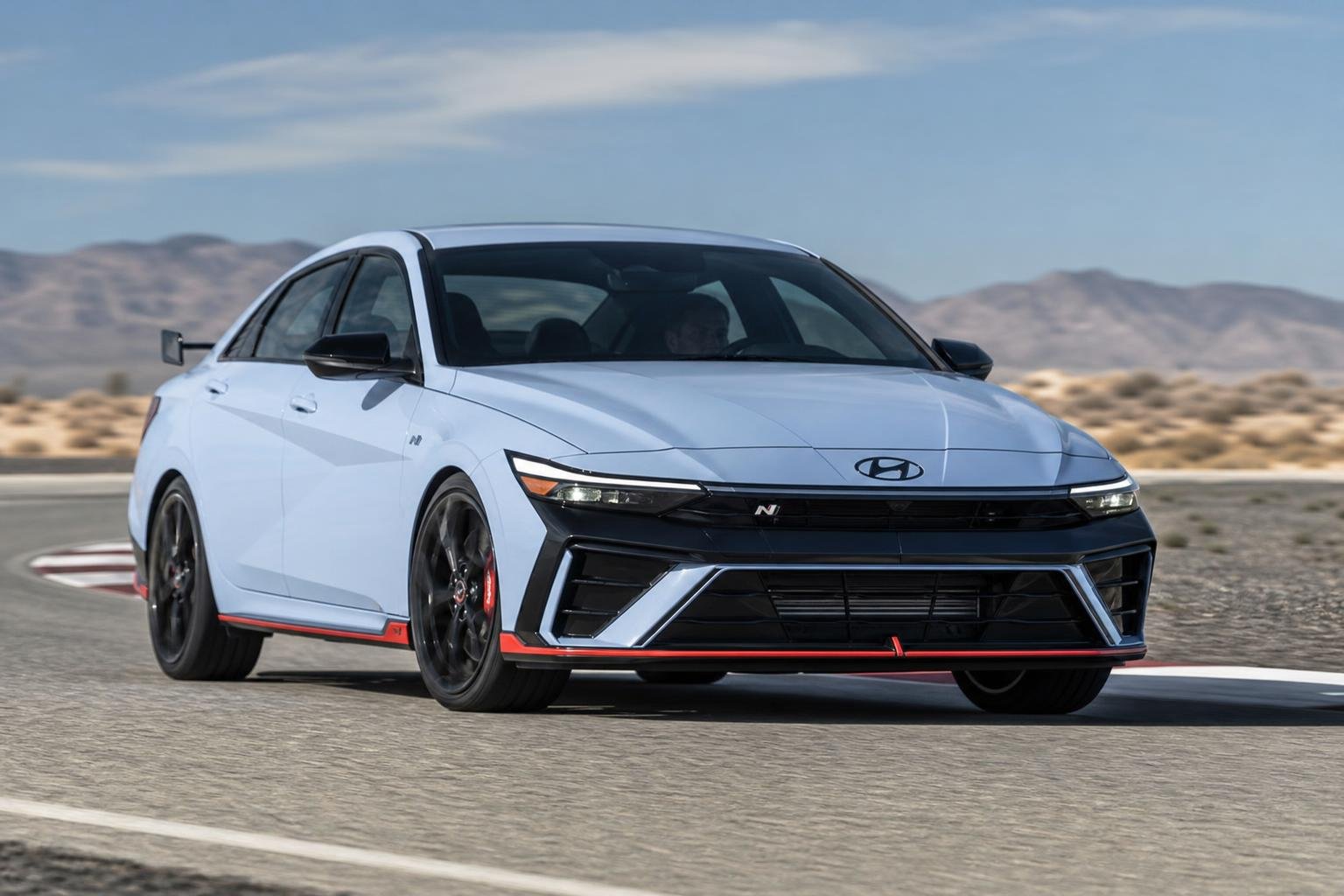

Hyundai has not officially confirmed a next-generation Elantra N, but the company’s product-planning team is making the idea sound less like wishful thinking and more like an obvious business decision.
Speaking with Motor1, Hyundai Senior Group Manager for Product Planning John Simmons said the current Elantra N performs strongly in both sales volume and media coverage. More importantly, he described its combination of performance, affordability and driving enjoyment as a successful formula Hyundai is unlikely to abandon.
“We love [Elantra N] in product planning; it does great for us in terms of volume. It gets great press for us because it’s fun to drive and affordable. Can you see a company going away from a successful formula like that? I can’t.”
That is not a formal product announcement. Simmons also made clear that he could not confirm the model’s future. Still, it is a revealing statement from a company that has increasingly used its N performance division to give Hyundai a sharper personality.
The Elantra N’s appeal is more than horsepower
The Elantra N has succeeded because it does not ask buyers to choose between an entertaining car and a relatively attainable one. Hyundai’s performance sedan offers a distinctly aggressive alternative to the growing number of compact cars that have become more expensive, more isolated and less mechanically interesting.
That positioning matters. The Elantra N is not simply another high-output version of a compact sedan. Its value comes from the contrast between ordinary practicality and deliberately theatrical design and performance intent. It is the sort of car that can look excessive in a parking lot while still making a case for itself on an engaging road.
Its styling has always been part of the argument. The current car’s appearance is polarizing, but that has not necessarily worked against it. In a segment filled with restrained shapes and cautious detailing, the Elantra N has never struggled to announce what it is. Some buyers will find that appealing; others will find it exhausting. Hyundai appears comfortable with that divide.
The next Elantra could make the N version even more dramatic
Hyundai’s newly revealed standard Elantra is said to draw design inspiration from the N74 concept, particularly through its boxier forms. Simmons told Motor1 that Hyundai’s product team is enthusiastic about the connection, describing the new Elantra’s shape as influenced by the concept’s retro-futuristic design language.
That creates an intriguing design problem for the next Elantra N. The N treatment traditionally adds visual aggression, but the standard car may already be moving toward a stronger and more distinctive shape. Hyundai will need to decide whether the performance model should become even more extreme or use carefully chosen details to avoid turning the design into visual noise.
The N74 influence could give Hyundai useful material to work with. A lower stance, sharper aerodynamic elements and more technical detailing could reinforce the performance model without simply covering the sedan in oversized trim. The challenge is preserving the concept’s disciplined geometric character while making the N version look functional rather than decorated.
That distinction matters because performance styling can quickly become a collection of signals instead of a coherent design. Hyundai has earned attention by being bolder than many competitors, but boldness alone is not the same thing as good design.
Electrification complicates the formula
The next Elantra N’s powertrain is the largest unanswered question. Hyundai is expanding its electrified lineup, while the standard Elantra is available with internal-combustion power and a hybrid option. Simmons indicated that the gasoline model remains important for affordability, a consideration that applies directly to the N sedan’s identity.
Hyundai already has electric performance models in the Ioniq 5 N and Ioniq 6 N. That gives the company room to position those vehicles as its high-performance electric offerings while allowing a future Elantra N to retain a combustion engine and focus on accessible performance.
That approach would not make the Elantra N technologically backward. It would give Hyundai’s performance lineup clearer separation. The larger Ioniq N models can demonstrate what electric performance is capable of, while the Elantra N can serve buyers who value a lower price, a lighter-feeling compact sedan and the character of a gasoline powertrain.
Reports cited by Motor1 have pointed to a new turbocharged 2.5-liter engine, but Hyundai has not confirmed that application or provided specifications. At this stage, the engine rumor should be treated as a possibility rather than a product fact. The same caution applies to transmission, output, chassis hardware and launch timing.
A familiar recipe may be Hyundai’s smartest choice
The temptation with a new generation would be to make the Elantra N more powerful, more technologically elaborate and more visually aggressive. That would be easy to understand, but it could also undermine the qualities that made the current model compelling.
Affordability is not a decorative feature of the Elantra N formula. It is central to the car’s reason for existing. As performance vehicles move upward in price and electric drivetrains add complexity, a compact gasoline-powered sedan can occupy a valuable space for enthusiasts who want something exciting without entering a luxury-car budget.
Hyundai therefore has a relatively narrow path ahead. The next Elantra N must feel meaningfully new, especially in its design, while resisting the industry’s habit of equating progress with size, power and price. It should be sharper where that improves the driving experience, not merely louder in the specification sheet.
For now, Hyundai is offering confidence rather than confirmation. But Simmons’ comments suggest the company understands what the Elantra N contributes: not just another sporty model, but a conspicuous demonstration that performance, personality and value can still coexist in a compact sedan. Abandoning that formula would be possible. Pretending it has failed would be much harder.
Sources: Motor1
0 Comments