
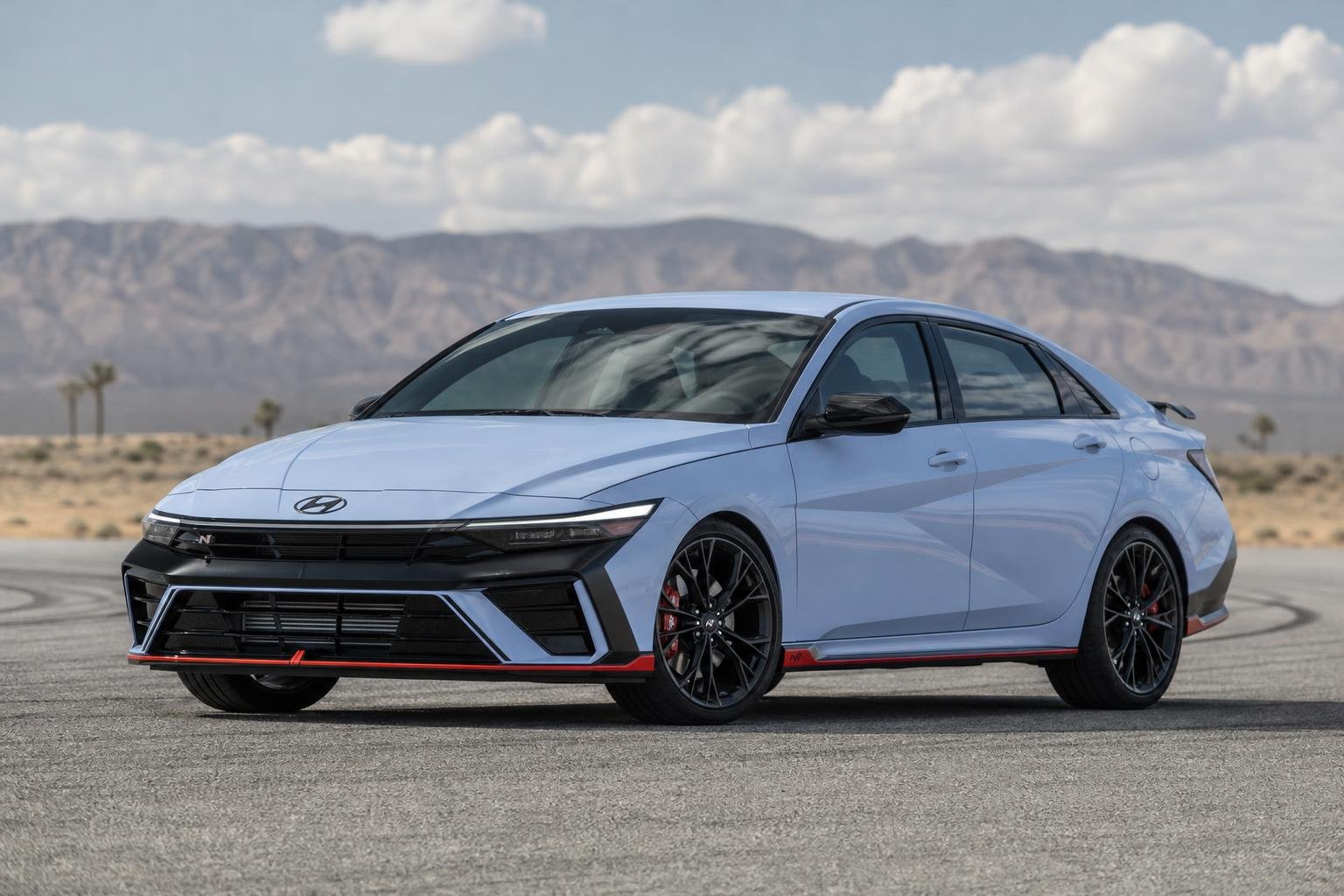

Hyundai has not officially announced a next-generation Elantra N, but the company is making it increasingly difficult to believe the performance sedan is headed for the exit. John Simmons, Hyundai’s senior group manager for product planning, says the current car delivers strong volume, positive press and the kind of affordable driving excitement that is becoming harder to find.
“Can you see a company going away from a successful formula like that? I can’t,” Simmons told Motor1.
That is not a confirmation of a new Elantra N. It is, however, a remarkably unsubtle statement of intent from a product planner. Hyundai has invested heavily in the N brand, and the Elantra N remains one of its clearest arguments that performance cars do not need six-figure prices, rear-wheel drive or an exotic badge to be entertaining.
The Elantra N’s formula is unusually straightforward
The current Elantra N was revealed in late 2020 and launched in 2021. Its recipe is familiar but increasingly unusual: a practical compact sedan, a turbocharged gasoline engine, serious chassis hardware and a choice of manual or dual-clutch transmissions.
Hyundai’s published specifications list a 2.0-liter turbocharged four-cylinder producing 276 hp and 289 lb-ft of torque. Buyers can choose a six-speed manual transmission with rev matching or an eight-speed wet dual-clutch transmission. The company also emphasizes performance-focused braking, track-oriented drive modes and a suspension tuned to make the sedan more than just a powerful commuter car.
None of that is revolutionary in isolation. The cleverness lies in combining those parts with four doors, useful rear-seat space and a price position below more prestigious performance alternatives. Hyundai’s own description of the car as a practical four-door performance model is marketing language, but it is also an accurate summary of why the Elantra N has attracted attention.
Hyundai’s new design language gives the next N an obvious challenge
The standard Elantra has never been a shrinking violet, and the newly revealed model appears determined to continue that tradition. Hyundai describes its design through terms such as “H-Edge” lighting, a low and wide stance, muscular fenders and sharply defined surfaces. The result is a compact sedan that seems to have been drawn with a ruler, a laser and very little interest in visual restraint.
That creates an intriguing problem for the next Elantra N. The current car already wears aggressive bumpers, a prominent rear wing, red accents and an exhaust system that makes its intentions clear. Simply adding more black trim and larger wheels to the new model would be the automotive equivalent of shouting the same sentence louder.
Hyundai may have a more interesting direction available. The company has linked the new Elantra’s boxier forms to the N Vision 74 concept, its wedge-shaped hydrogen-electric sports car concept. Simmons told Motor1 that Hyundai’s product team is particularly fond of those retro-futuristic forms, saying the Elantra’s design is “very much inspired by N74.”
Whether the production sedan truly benefits from that connection is debatable. The N Vision 74 is a dramatic concept with long proportions and exotic intent, while the Elantra remains a front-wheel-drive compact sedan built around affordability. Still, borrowing some of the concept’s geometric character could give the next N a stronger identity than simply attaching a larger grille to an ordinary facelift.
Do not expect the N badge to mean hybrid—at least here
The standard Elantra lineup is moving in two directions at once. Hyundai continues to offer internal-combustion models for buyers focused on purchase price and familiarity, while an available hybrid targets fuel economy and lower fuel consumption. Hyundai’s global materials describe the hybrid as combining a 1.6-liter gasoline engine with a six-speed dual-clutch transmission and emphasizing efficient energy recovery.
That does not automatically point to a hybrid Elantra N. In fact, the value argument cuts against it. Adding a high-output hybrid system would bring additional hardware, weight and cost, potentially moving the car away from the formula that made it attractive in the first place.
Hyundai already has electrified performance cars in the Ioniq 5 N and Ioniq 6 N. Those models allow the company to explore instant electric torque, battery cooling and software-based performance features without forcing every N product into the same technological mold. A gasoline-powered Elantra N could therefore remain the simpler, lighter and more attainable member of the family.
The rumored engine would change the character, not the mission
Motor1 has reported that rumors point to a turbocharged 2.5-liter engine for the next Elantra N. Hyundai has not confirmed that engine, its output or any other future powertrain details, so the rumor should be treated as precisely that.
A larger engine could provide more torque and a broader performance envelope, but it would not be a free upgrade. More displacement can mean more weight over the front axle, higher fuel consumption and greater pressure on the front tires. In a front-wheel-drive performance sedan, those trade-offs matter. The next Elantra N would need to manage traction, steering feel and heat rejection as carefully as it manages peak horsepower.
The current car’s appeal is not based solely on its engine. Its manual transmission, electronically controlled suspension, large brakes and track-oriented systems help turn power into usable speed. A new model with a bigger engine would need corresponding chassis development rather than a simple power increase. Otherwise, Hyundai would risk making the Elantra N faster in a straight line but less satisfying everywhere else.
Motorsport keeps the N identity from becoming cosmetic
Hyundai’s racing program also gives the Elantra N more credibility than a styling package alone could provide. The company’s Elantra N TCR program competes in the IMSA Michelin Pilot Challenge, and Hyundai has promoted the road-going N TCR Edition as a limited-production model with race-inspired equipment and a choice of manual or dual-clutch transmissions.
A TCR race car is not simply a showroom Elantra with its interior removed, and road-car buyers should not confuse the two. But motorsports gives Hyundai a useful engineering laboratory and a recognizable performance narrative. The N badge is strongest when the visual aggression is backed by cooling, braking, suspension and durability work—not merely a dramatic body kit.
Hyundai should resist making the next Elantra N too sensible
The new Elantra’s design appears to be heading toward sharper geometric forms, while Hyundai’s product planners seem committed to preserving the N nameplate. The unresolved question is whether the company can retain the car’s affordability while meeting increasingly demanding performance and emissions requirements.
For now, the safest expectation is not a confirmed engine, launch date or specification, but a continuation of the basic idea: an aggressively styled, combustion-powered compact sedan with serious hardware and enough everyday practicality to make the compromise worthwhile. Hyundai has already demonstrated that the formula works. The danger is not that the next Elantra N will be too conservative; it is that the company will add complexity and cost while forgetting why enthusiasts noticed the car in the first place.
That is the design challenge facing Hyundai. The next Elantra N does not need to be louder in every direction. It needs to be more coherent—more clearly connected to the N Vision 74-inspired design language, more technically disciplined and still attainable enough to make its rivals look uncomfortably expensive.
Sources: Motor1; Hyundai Worldwide: The new Elantra N; Hyundai Worldwide: Elantra N debut announcement; Hyundai Worldwide: Elantra N TCR Edition
0 Comments