
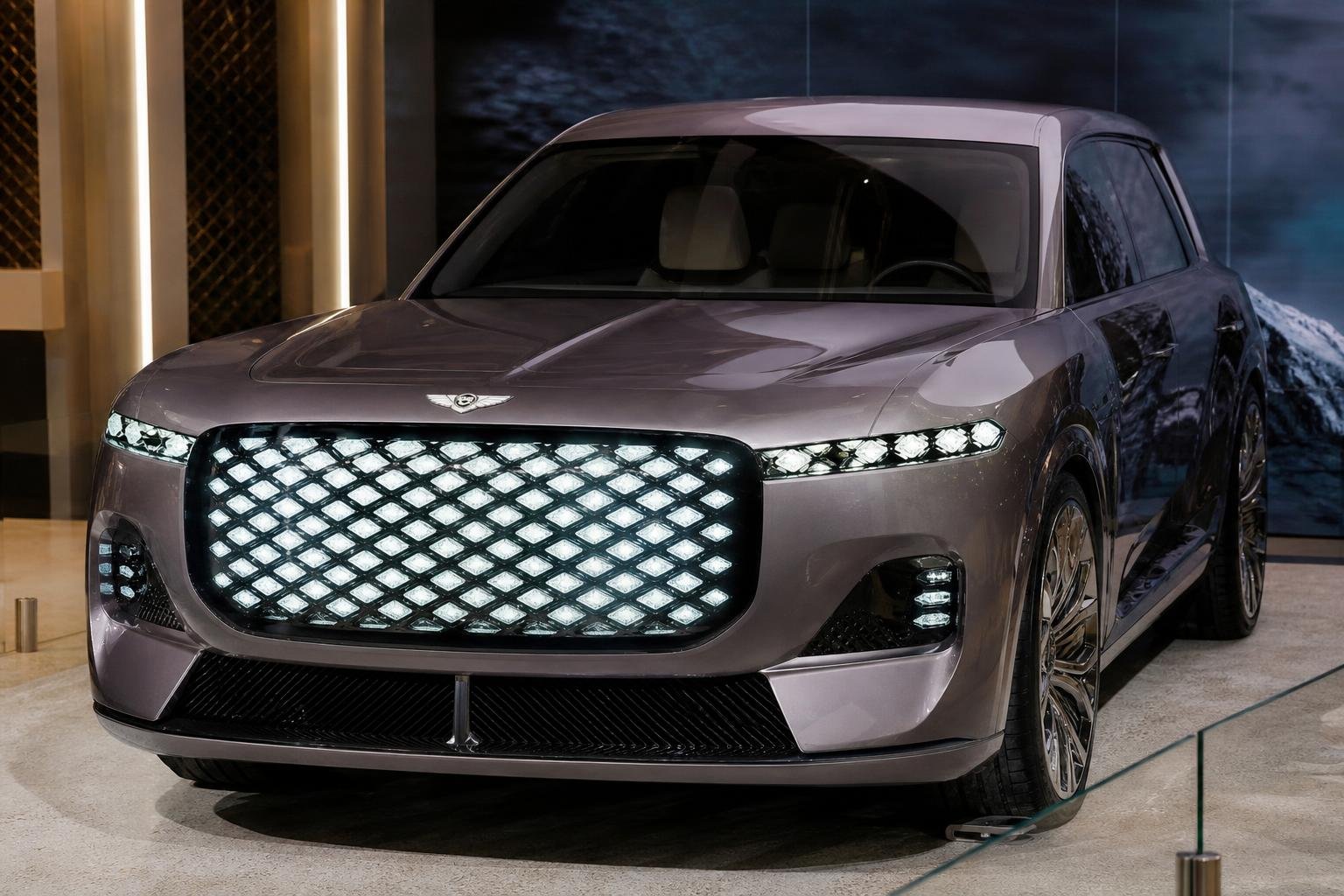

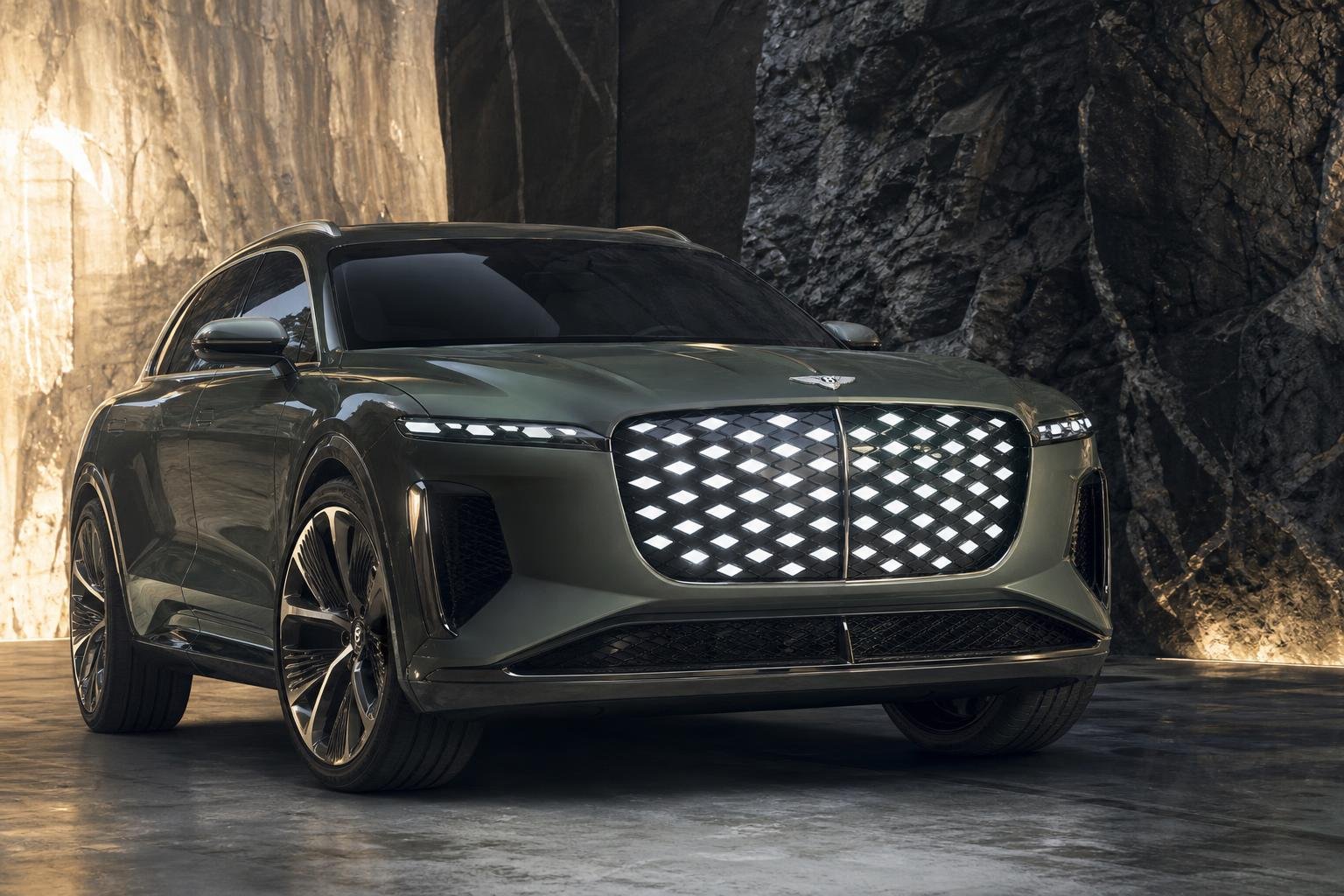
Bentley has found a suitably extravagant way to introduce the Torcal’s design identity: an illuminated grille built from 76 individually crafted diamond-shaped elements, more than 260,000 laser-drilled openings, and 202 concealed LEDs.
It is a theatrical detail, but not merely decorative. The grille is intended to become the visual signature of Bentley’s fourth model line, giving the all-electric Torcal a recognizable face during the day and an entirely different personality after dark. The question, as always with this sort of luxury-car spectacle, is whether the engineering underneath the show is as considered as the presentation.
A grille that changes character after sunset
The Torcal’s front grille draws inspiration from the Bentley Continental T, but the execution is far removed from a traditional upright mesh grille. Bentley uses 76 diamond-shaped pieces in varying sizes to create a three-dimensional composition. Each piece is individually assembled by hand, and the diamonds are protected behind a single transparent cover made using materials and coatings shared with the headlamp assemblies.
With the lighting switched off, Bentley says the assembly reads as a sculpted metal surface. Once illuminated, the diamonds become the centerpiece of the front end. The manufacturer’s official Torcal material calls the feature a “Floating Diamond Grille,” with the elements gradually lighting when the vehicle is unlocked. That welcome animation is very much in keeping with modern luxury-car design, where the arrival sequence is increasingly treated as part of the product rather than a simple convenience feature.
The diamond motif is not new to Bentley. According to the company’s design history, diamond-patterned brass controls appeared on Bentley models during the 1930s, initially providing additional grip. The pattern later became a recurring visual and tactile signature across switchgear, upholstery, veneers, and exterior details. The Torcal’s grille is therefore less a random flourish than an attempt to scale one of Bentley’s oldest decorative themes into a new digital era.
260,000 openings, but no visible light source
The more interesting technical detail is hidden in the metal frame around the diamonds. Bentley has laser-drilled more than 260,000 micro-openings into the surround, allowing light from 202 LEDs beneath the surface to emerge evenly. When the system is off, those openings are intended to disappear into the metallic finish. When it is active, the grille appears to glow from within rather than displaying obvious light points.
That dual behavior creates a difficult manufacturing problem. The surface must be precise enough to look premium in daylight, yet open enough to distribute light consistently at night. It also has to survive the hazards that a low-mounted front-end component encounters on public roads. Bentley says the grille underwent abrasion and gravel-impact testing, while an active condensation-management system helps keep the transparent cover clear.
Buyers will have two grille treatments to choose from. The Bright Pack adds metallic-finish covers to the diamond elements, giving the front end a more reflective appearance. Bentley has not supplied pricing in the available material, so the cost of choosing one version over the other remains unknown.
Micro LED headlights add substance to the spectacle
The grille is paired with a new headlamp system that uses four modules per side. Two are conventional low- and high-beam units, while the other two are vertical Micro LED projectors with 16,000 pixels each. Micro LED systems can control light distribution at a much finer level than a conventional fixed beam, allowing the headlamp to shape illumination around the driving environment.
Bentley says the upper projector spreads light across a 40-degree angle to illuminate the edges of the driver’s field of vision, with particular benefits when negotiating bends. The lower unit uses a narrower 20-degree beam to concentrate light farther ahead or in areas where greater precision is useful.
The system is also designed to adjust its distribution to improve the driver’s view while reducing glare for other road users. That is the practical reason for investing in pixel-controlled lighting. The illuminated grille may attract attention in a parking lot, but adaptive beam control is the feature that can make a meaningful difference on an unlit road.
Bentley claims the headlamps produce enough illumination to read a book from up to 0.6 miles away. That is a manufacturer statement rather than an independently verified performance result, and it is not a substitute for real-world testing. Still, the claim illustrates the company’s broader approach: the Torcal’s lighting is being positioned as both visual theater and advanced vehicle technology.
The Torcal is more than a lighting exercise
The lighting details arrive as Bentley pushes the Torcal into a new role for the brand. Bentley describes it as its first all-new model in a decade and an all-electric luxury SUV. The range includes the regular Torcal and the performance-oriented Torcal S, with the latter claimed to produce up to 876 hp and 996 lb-ft of torque when launch control is active.
Bentley’s U.S. materials list a claimed 2.8-second 0-to-60-mph time, a 162-mph top speed, a 300-mile maximum range, and a 16-minute DC charging time from 10 to 80 percent for the Torcal S. Those figures are manufacturer claims and may vary by market, equipment, and final certification. They also explain why Bentley is giving the Torcal such a carefully choreographed identity: this is not simply a battery-powered replacement for an existing model, but a highly visible attempt to define what the brand looks like in the electric age.
The rest of the vehicle follows the same formula. Bentley advertises a curved 12.25-inch OLED touchscreen, more than 450 LEDs in its Dynamic Waterfall Lighting system, optional wellness seating, and a cabin combining leather, Dinamica, wood, and other handcrafted finishes. On the Torcal S, darker exterior trim and a more muscular body kit make the vehicle’s performance intent less subtle.
A new Bentley face, with plenty of questions attached
There is an unavoidable contradiction at the center of the Torcal’s grille. Bentley is using painstaking hand assembly, laser-drilled metal, and carefully managed illumination to make an electric SUV look unmistakably expensive. At the same time, the grille is a welcome animation and branding device before it is an aerodynamic or cooling component. That is not necessarily a criticism; luxury vehicles have always sold craftsmanship and theater alongside transportation.
The important distinction is that Bentley has not treated the feature as a fragile styling prop. Its stated durability testing and condensation controls suggest the company understands that owners will encounter rain, road debris, car washes, and winter grime—not just carefully lit launch photography. Whether the grille remains convincing after years of use will matter more than how impressive it looks in a press image.
For now, the Torcal’s illuminated front end does what Bentley wants it to do. It preserves the brand’s familiar diamond language while making the grille behave like a piece of active technology. The result is bold, meticulously engineered, and just theatrical enough to remind everyone that Bentley has never been interested in blending into the background.
Sources: Motor1; Bentley Media; Bentley Motors Torcal; Bentley Motors Torcal S; Bentley Motors: The Bentley Diamond.
0 Comments