
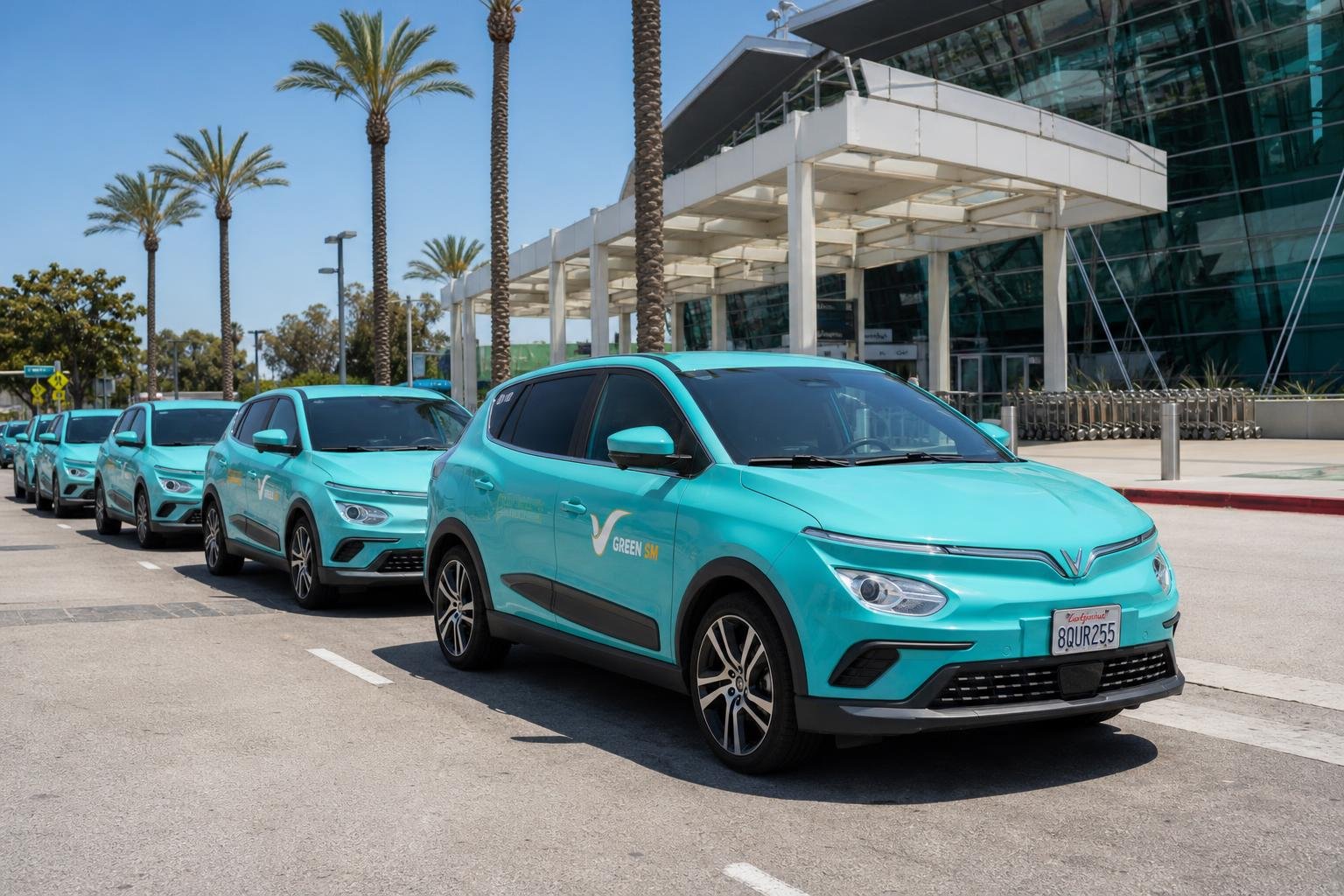

Green SM has entered the Los Angeles ride-hailing market with 500 company-owned VinFast VF8 electric SUVs and an equally large roster of full-time drivers. That operating model—not simply the use of electric vehicles—is the company’s clearest difference from Uber and Lyft, where drivers generally work as independent contractors using their own cars.
The Vietnamese transportation company launched its Los Angeles service on October 13, making the region its first U.S. market. Green SM says its vehicles are already operating across Los Angeles County, with coverage stretching south into Orange County. Riders can request a vehicle through the Green SM app, call the company’s hotline or hail one on the street.
A fleet built for scheduled work
Every launch vehicle is a five-seat VinFast VF8, an electric SUV that produces no tailpipe emissions. Green SM owns the vehicles outright and supplies the maintenance, training and operating structure. The company’s 500 Los Angeles drivers are employees who go through a common selection, onboarding and training process before taking passengers.
That arrangement makes the service closer to a traditional fleet operation than the typical app-based ride-hailing model. A Green SM driver reports for a shift in a company vehicle rather than deciding independently when to log on, which car to use and how much maintenance to absorb.
For riders, the practical benefit is consistency. The company controls the vehicle, driver training and basic service process. For drivers, the model replaces the flexibility of gig work with an employer relationship and predictable shifts, although the supplied information does not detail wages, benefits, scheduling rules or advancement opportunities.
Why the VinFast VF8 matters to the rollout
The VF8 gives Green SM a ready-made electric SUV with seating for five, allowing the company to standardize its fleet around one vehicle rather than mixing different makes and models. Standardization can simplify driver training, maintenance procedures and replacement parts, all of which matter when hundreds of vehicles are working daily in a demanding urban environment.
The fleet also puts VinFast vehicles in front of a large number of potential customers. The automaker has struggled to build momentum in the United States despite having a stronger position in Vietnam. A ride-hailing passenger may spend more time evaluating the vehicle’s rear-seat comfort, cabin layout and ride quality than someone who encounters it briefly at a dealership.
That exposure cuts both ways. Green SM can introduce the VF8 to passengers who might not otherwise consider the brand, but the vehicle will also be judged repeatedly in one of the toughest possible roles: frequent stop-and-go driving, heavy passenger use and long hours on Los Angeles roads.
Car and Driver’s reporting notes that an earlier VF8 evaluation raised concerns about handling, suspension and fit and finish, while newer U.S.-market models have seemingly addressed some of those issues. The supplied research does not establish how the specific vehicles in Green SM’s fleet compare with earlier versions, so the ride-hailing operation will be an interesting real-world test rather than proof that every past concern has been resolved.
The ownership model brings advantages and limits
Operating a company-owned fleet gives Green SM control that contractor-based services do not have. The company can set vehicle standards, inspect cars, schedule maintenance and train drivers around the same procedures. It can also present a consistent brand experience instead of relying on a wide mix of privately owned vehicles.
The trade-off is financial and operational exposure. Green SM is responsible for vehicle purchases, charging access, maintenance, insurance and depreciation. With 500 electric SUVs in service, keeping cars available is as important as attracting passengers. Downtime caused by repairs or charging constraints directly affects fleet utilization because there is no independent driver absorbing those costs or supplying a replacement vehicle.
The arrangement may also make service quality easier to manage, but it does not automatically guarantee a better passenger experience. That depends on dispatch efficiency, wait times, vehicle cleanliness, driver retention and the company’s ability to keep its fleet operating reliably. Green SM U.S. CEO Hoang Thanh Hang described the company’s approach as an effort to build trust through service quality and intentional customer interactions, but those goals will ultimately be judged by passengers using the service repeatedly.
Pricing and airport service remain important questions
Green SM says fares will vary according to time and distance. Early coverage has compared typical trip costs with Uber Comfort pricing, although the supplied information does not provide a complete fare schedule or establish how prices will change during periods of high demand.
The launch promotions are designed to reduce the risk for first-time users. New customers receive 50 percent off, up to $12 per ride, on their first five trips. Green Pass membership includes 10 monthly vouchers providing 30 percent off, up to $10 per ride. Those offers may help Green SM build an initial customer base, but they do not reveal whether the company can remain competitive after promotional pricing ends.
Airport transportation is listed among Green SM’s intended U.S. services, but neither the company nor Los Angeles World Airports has publicly detailed when—or under what permit—the fleet could serve Los Angeles International Airport. That is a meaningful unresolved issue for a ride-hailing service in Southern California, where airport trips are an important part of the market opportunity.
Green SM enters a crowded electric market
Green SM is not arriving in an empty field. Uber and Lyft already have established rider networks, while autonomous services are expanding in Los Angeles. Waymo’s driverless Waymo One service has been available to all Los Angeles riders since November 12, 2024, and Uber is also pursuing additional electric-vehicle partnerships.
Green SM’s answer is not autonomy or a contractor marketplace. It is a controlled fleet, employee drivers and an all-electric vehicle lineup. The company says it has completed approximately 850 million rides globally since beginning operations in Vietnam in 2023 and later expanding into other Asian and European markets. Whether that experience transfers successfully to Los Angeles will depend less on the launch-day fleet count than on daily execution.
The initial 500 VF8s give Green SM enough scale to be visible, but not enough to dominate Los Angeles ride-hailing. The more useful test will be whether the company can keep those vehicles available, make charging and maintenance routine, deliver competitive wait times and retain drivers while fares remain attractive to passengers. If it can, Green SM’s model could offer a credible alternative to both gig-based ride-hailing and emerging robotaxi services. If not, the electric fleet alone will not make the operation competitive.
Sources: Motor1.com; Car and Driver.
0 Comments