
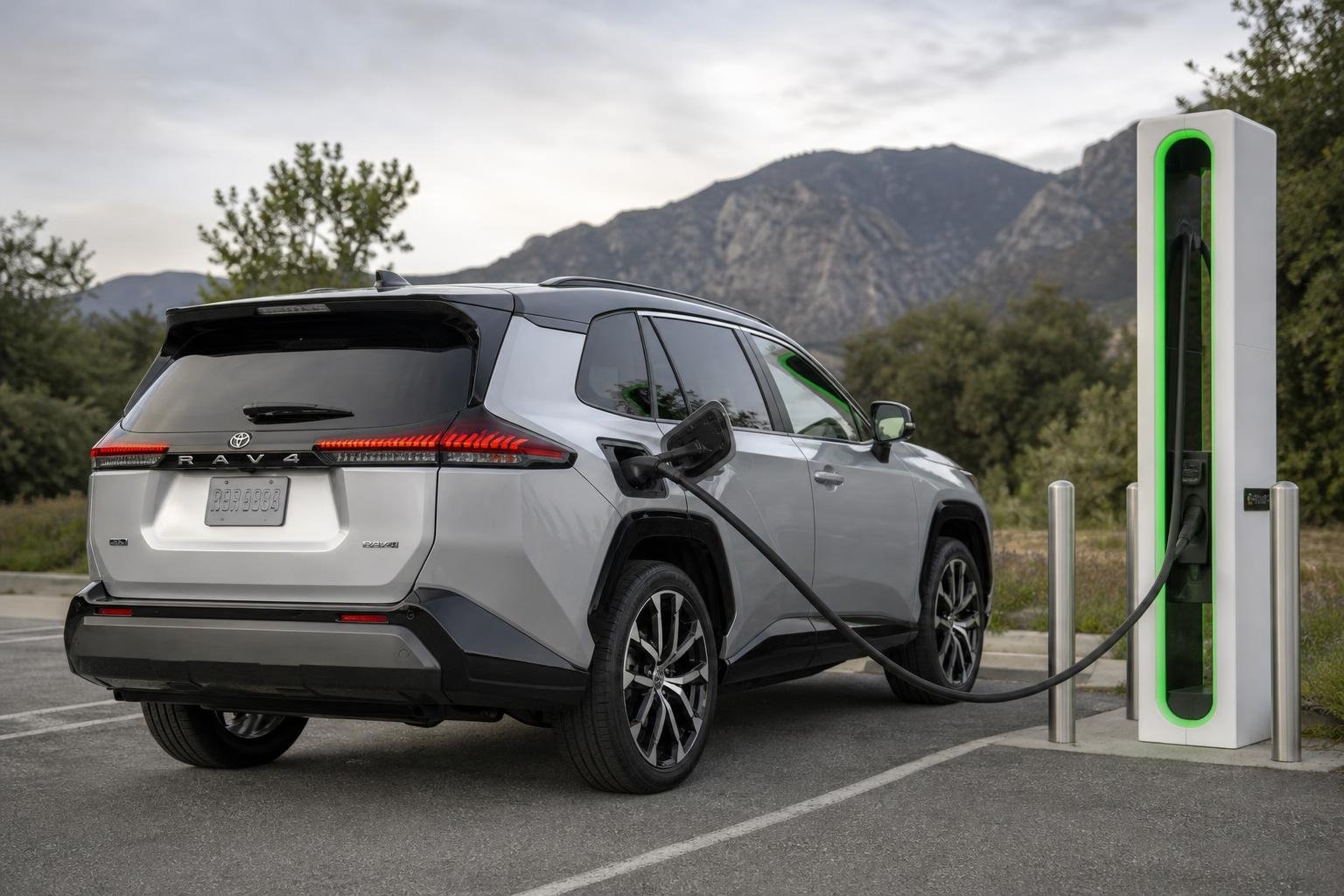

Toyota is giving the 2027 RAV4 Plug-in Hybrid a charging upgrade that could make the SUV substantially easier to live with. Every RAV4 PHEV trim now includes a factory-installed North American Charging Standard (NACS) port, along with DC fast-charging capability that was previously limited to more expensive versions.
The change is notable because the RAV4 PHEV is not simply gaining a different connector. Toyota is expanding faster charging across the lineup, increasing onboard AC charging capacity, and moving the charge port to the driver’s side. Together, those changes make the plug-in RAV4 more convenient for owners who want to use electric power for daily driving while retaining a gasoline engine for longer trips.
Fast charging is now standard across the lineup
For 2027, the RAV4 PHEV SE, XSE, Woodland and GR Sport all receive NACS hardware and Level 3 DC fast-charging capability. The base SE is therefore no longer excluded from the faster public-charging experience offered by higher trims.
Toyota’s plug-in SUV can accept up to 50 kW from a compatible DC fast charger. According to the original report from InsideEVs, a 10-to-80-percent charge takes approximately 30 minutes. That is not EV-style charging performance, but it is meaningful for a plug-in hybrid, particularly during a shopping stop or a break on a longer journey.
The NACS connector also reduces the need for an adapter at newer charging locations. Drivers can use compatible Tesla Supercharger sites and other networks installing NACS cables, although availability and access can vary by station and charging provider. Older Tesla V3 Superchargers may be less convenient because their cable positioning was designed around rear-left charge ports.
Why the connector change matters on a plug-in hybrid
Plug-in hybrids occupy an unusual position in the market. Unlike a battery-electric vehicle, a RAV4 PHEV does not depend on public charging to complete a journey. If the battery is depleted, its gasoline engine can continue powering the vehicle. That makes charging speed less critical than it is for a full EV, but faster charging still increases the likelihood that drivers will actually use the vehicle’s electric capability.
The RAV4 PHEV has a 22.7-kWh lithium-ion battery and offers up to 52 miles of EPA-estimated electric range. For a driver with a daily commute below the vehicle’s electric range, regular charging can eliminate gasoline use on many local trips. The engine remains available for highway travel and journeys where charging infrastructure is inconvenient.
That flexibility is the central argument for choosing the RAV4 PHEV over either a conventional hybrid RAV4 or a fully electric SUV. Owners can use battery power for local driving while keeping the gasoline engine available for longer journeys.
Every trim now gets 11-kW AC charging
Public DC charging is only part of the update. The 2027 RAV4 PHEV also receives an 11-kW onboard AC charger across the range for Level 1 and Level 2 charging.
XSE and Woodland models already offered 11-kW AC charging, but SE and GR Sport versions previously used a 7-kW system. Bringing every trim to the higher rating should shorten charging times when the vehicle is connected to a suitable Level 2 home or workplace charger. Actual charging speed will still depend on the electrical supply, wall equipment and the vehicle’s charge state.
Level 1 charging from a standard household outlet remains possible, but it is considerably slower and may not fully replenish the battery during a short overnight stop. For owners who intend to drive mostly on electricity, a properly installed Level 2 charger is likely to make the RAV4 PHEV’s electric range much easier to use consistently.
The charge port moves to the driver’s side
Toyota has relocated the RAV4 PHEV’s charge port from the passenger side to the driver’s side. There is no universal industry standard for charge-port placement, so the practical effect will depend on how an owner parks at home and which public stations are used most often.
The new position may work well for some driveways and curbside chargers, while older Tesla Supercharger layouts could be awkward because their cable management was designed around vehicles with rear-left ports. Newer V4 Superchargers and many recently built stations use longer cables, making port placement less restrictive.
Four trims, with charging now shared across the range
The 2027 RAV4 PHEV lineup includes the SE, XSE, Woodland and GR Sport. The four trims give buyers different equipment and styling choices, but the major charging upgrade is now shared across all of them: every version has the NACS port, DC fast-charging capability and an 11-kW onboard AC charger.
That consistency is important for shoppers comparing versions of the same vehicle. Earlier buyers had to move to a more expensive trim to obtain fast-charging capability. For 2027, the entry SE receives the same basic public-charging hardware as the rest of the PHEV range.
Pricing and the competitive picture
The supplied reporting lists the 2027 RAV4 PHEV SE at $42,100. The PHEV range also includes the Woodland, XSE and GR Sport. Buyers should check the final window sticker and current Toyota pricing before placing an order, since published totals can vary by source and may change with fees or regional pricing.
Fast-charging PHEVs remain uncommon in the United States. The Mercedes-Benz GLC 350e offers DC charging through a CCS connector, while the Mitsubishi Outlander PHEV uses the older CHAdeMO standard. By adopting NACS across every trim, Toyota is giving the RAV4 PHEV a more current public-charging interface than many of its plug-in competitors.
The upgrade does not turn the RAV4 PHEV into an EV, nor does it eliminate the compromises of a plug-in hybrid’s additional hardware and price premium. It does, however, address one of the most practical frustrations of earlier versions: paying more for a trim simply to obtain faster charging. For buyers who can charge regularly, the 2027 model’s broader charging capability makes the RAV4 PHEV a more complete bridge between conventional hybrids and battery-electric vehicles.
Sources: InsideEVs; Electrek; Car and Driver; Toyota information reproduced by AOL.
0 Comments