
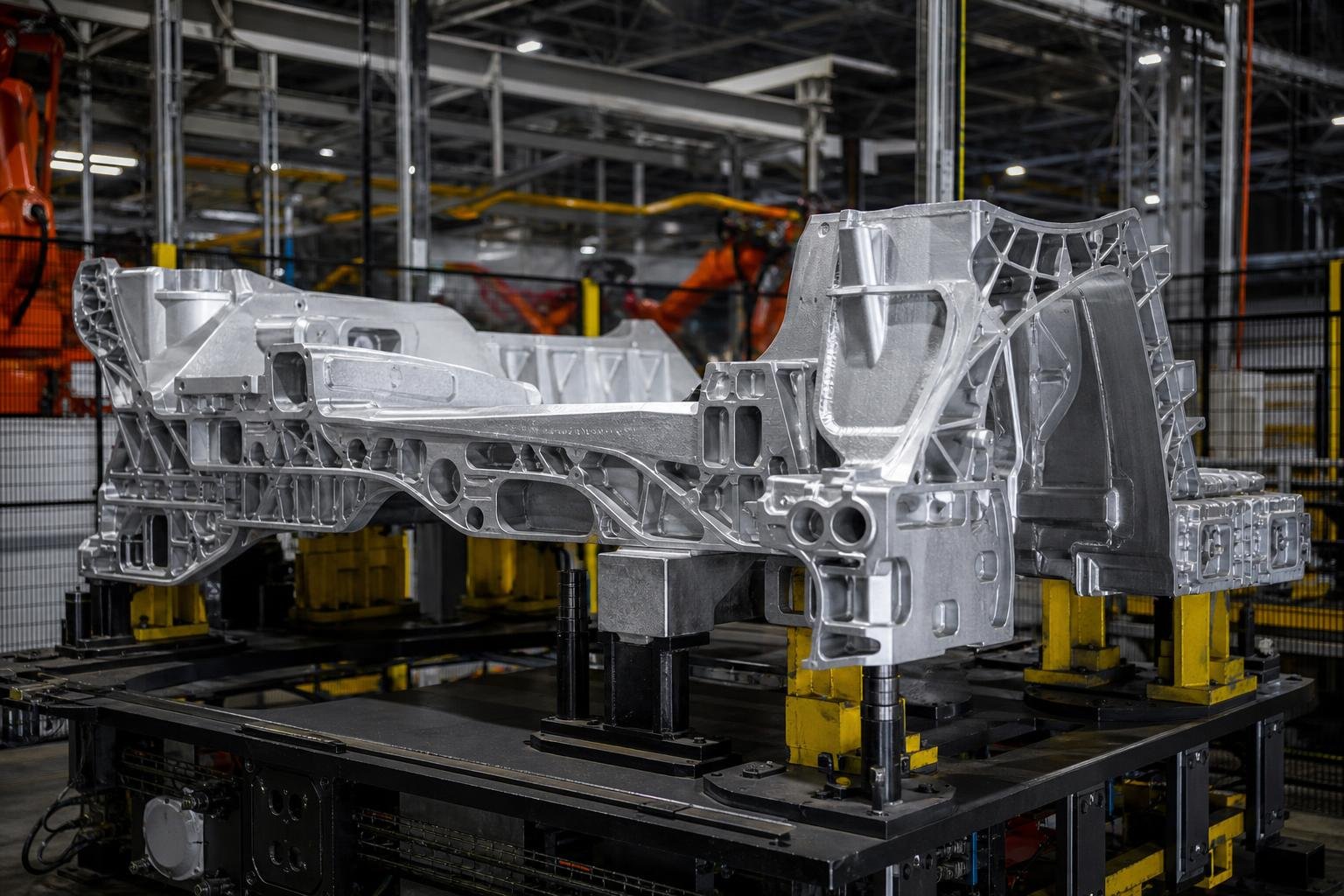

Ford is preparing the 2028 Fathom, a fully electric compact truck expected to start at $29,945, with a manufacturing process designed to help reach that price. The truck will use two large aluminum “unicastings” to replace 146 structural components traditionally assembled from smaller parts.
The approach resembles Tesla’s gig casting process and is not currently used on any other Ford vehicle. One casting forms the front section of the Fathom, while the other forms the rear, reducing the number of individual structural parts and changing how the truck is assembled.
How Ford produces the unicastings
Ford is making the castings at its Shelbyville Technical Center. Each component begins as an aluminum ingot, which is moved by elevator into a furnace and heated to approximately 1,300 degrees Fahrenheit, or 700 degrees Celsius. The molten aluminum then enters a casting machine to form one of the two large sections used on each truck.
The parts must pass several inspections before they can be shipped to Ford’s Louisville Assembly Plant in Kentucky, where production Fathoms will be built. A visual inspection is followed by a coordinate check in a climate-controlled room. That process verifies the casting’s dimensions and the locations of its holes against the required specifications.
Ford also uses industrial X-rays to inspect the interior for defects such as pores and voids. Optical scanning provides another dimensional check, while aluminum samples undergo tensile-strength testing and chemical-composition analysis. Individual batches are not released to Louisville until all of the required tests are complete.
A different assembly process
The unicastings will support a vehicle assembly method that differs from the conventional single-line approach associated with Henry Ford’s early production system. Fathom components will initially be assembled in three separate subsections, which will be joined together later in the build process.
Ford has already produced 5,000 castings, enough for 2,500 trucks, ahead of the Fathom’s official debut expected next spring. The vehicle is also expected to be assembled at the Louisville plant.
What is known about the Fathom
Additional details about the truck’s exterior design, battery, charging system and driving range have not yet been provided in the source material. Ford has indicated that the Fathom will seat five and provide more passenger space than a Toyota RAV4.
The electric truck will also offer bidirectional charging and is expected to accelerate from 0 to 60 mph in approximately 4.5 seconds. Further technical information is expected to emerge before its debut early next year.

0 Comments