
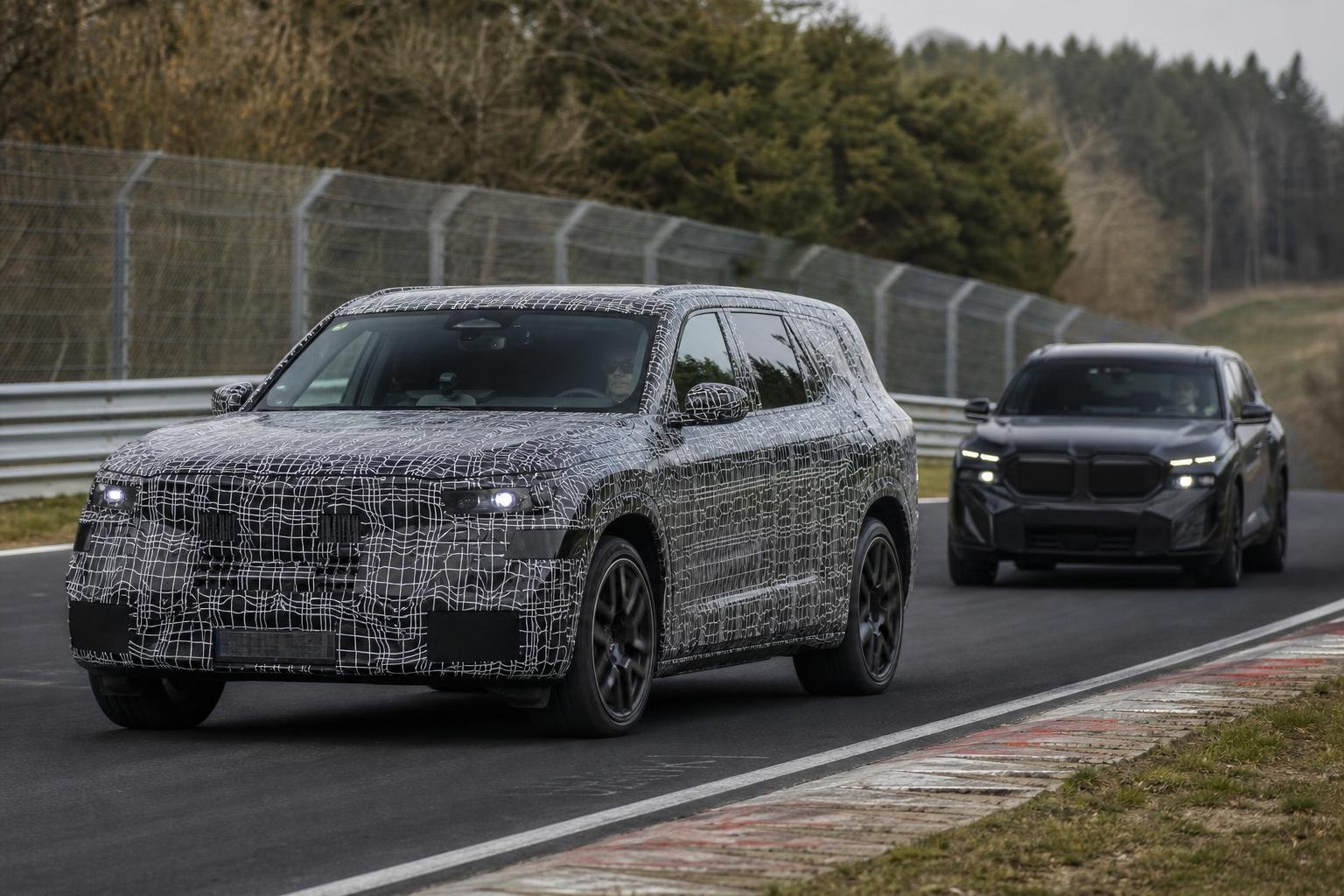

BMW’s electric luxury SUV expansion is moving beyond the upcoming iX5, with a camouflaged iX7 prototype spotted testing at Germany’s Nürburgring. A separate prototype believed to be the next X7 M60 was also observed, highlighting the continued development of both the electric and combustion-powered versions of BMW’s largest SUV.
iX7 testing continues
The three-row iX7 is not being developed as a track-focused vehicle, but the Nürburgring is used by automakers for both durability testing and dynamic evaluation. The latest prototype appears broadly similar to earlier test vehicles, indicating that development of the large electric SUV remains underway.
Unlike BMW’s newer iX3, iX4 and iX5, the iX7 does not appear to use the Neue Klasse platform or its visor-style front-end design. Instead, it retains the split-headlight layout introduced for the 2023 model year and also used by the recently facelifted 7 Series.
The exterior is still expected to receive more modern body surfacing, along with electrically operated door handles positioned at the base of the door pillars. The combustion-powered X7 is expected to share much of this design direction.
Updated CLAR platform and electric hardware
The iX7 and X7 are expected to use an updated version of BMW’s current CLAR architecture, as do the iX5 and X5. That platform choice does not rule out newer battery and electrical technology. The iX7 is expected to benefit from BMW’s cylindrical-cell battery systems and could support charging speeds of up to 460 kilowatts.
BMW’s iX5 60 uses a 144-kilowatt-hour battery and is projected to deliver an EPA range of 435 miles, or 700 kilometers. Because the X7 is expected to be approximately 5 inches, or 125 millimeters, longer than the X5, the iX7 could have room for an even larger battery pack. The source does not provide a confirmed battery capacity or range figure for the iX7.
The iX7’s motor configurations are expected to share hardware with the iX5. That could include a dual-motor version producing 570 horsepower, or 578 PS, as used in the iX5 60. More powerful M-badged electric variants are also considered likely, although BMW has not confirmed those versions.
Shared cabin technology
Inside, the electric and combustion-powered SUVs are expected to receive BMW’s Panoramic iDrive system as it expands across the automaker’s lineup. The system includes a pillar-to-pillar display arrangement and a centrally positioned, parallelogram-shaped infotainment screen, similar to the layout shown in the iX5.
BMW’s Spartanburg, South Carolina, plant is preparing to build the X7 and iX7 alongside the X5 and iX5. The iX7 is not expected to debut until 2027, with sales expected to begin in the fall.
Next-generation X7 M60
The next X7 M60 is being developed alongside the iX7 and is expected to replace the current X7 M60i. The model is likely to retain a revised version of BMW’s 4.4-liter S68 twin-turbocharged V8, while improving on the current model’s 523 horsepower and 553 pound-feet of torque.
BMW’s M760 xDrive sedan offers one possible indication of the engine’s future output. That model produces 563 horsepower, or 571 PS, while keeping torque unchanged and using a mild-hybrid system rather than a plug-in-hybrid setup. The next X7 M60’s final specifications have not been announced.
The M60 prototype can be distinguished from the electric iX7 by its open air intakes within the large kidney grilles and four prominent exhaust outlets. The iX7 uses closed-off grille sections instead.
BMW has never offered a full X7 M, and the source does not expect that to change with the next generation. A more luxurious Alpina version could follow in 2028, although that timing remains unconfirmed.
0 Comments