For a car that Porsche has reportedly struggled to bring to market for years, the next-generation Boxster is suddenly looking very real.
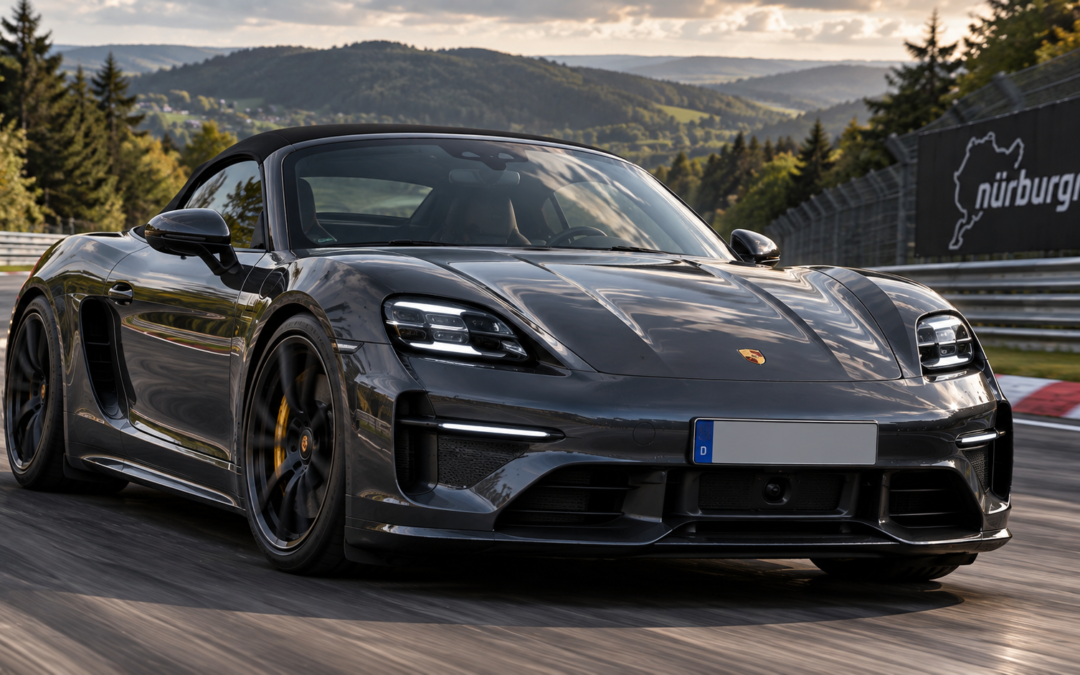
A nearly undisguised prototype of the all-electric Porsche 718 Boxster has been photographed testing at the Nürburgring, providing the clearest look yet at the sports car that was once expected to launch as early as 2025. The sighting comes after months of uncertainty surrounding Porsche's EV strategy—and rumors that the electric Boxster and Cayman could be abandoned altogether.
Instead, Porsche appears to be moving ahead.
The latest prototype also tells us something important about the car's development. This isn't an early engineering mule hiding underneath a completely unrelated body. The shape, lighting and aerodynamic surfaces now appear sufficiently close to production that Porsche is giving away far more of the finished design.
And while the new Boxster will abandon its traditional flat-six and four-cylinder engines in its electric form, Porsche is attempting something much harder than simply building another fast EV.
It is trying to make an electric sports car feel like a Boxster.
The Electric Boxster Nearly Didn't Happen
The 718's transition to electric power has been anything but straightforward.
Porsche announced plans for an all-electric successor to the Boxster and Cayman several years ago, with the Mission R concept providing an early preview of the technology and design philosophy.
The production 718 EVs were originally expected to arrive around 2025.
That obviously didn't happen.
Development problems, battery-supply issues and the sheer difficulty of creating a lightweight electric sports car reportedly pushed the program further and further behind schedule. Porsche was simultaneously reconsidering its broader EV strategy as demand for electric vehicles failed to develop as quickly as many automakers had expected.
Earlier reports even suggested that Porsche was considering abandoning the electric 718 altogether.
Those reports now appear to have been premature.
Porsche CEO Michael Leiters publicly reaffirmed that the 718 EV was still coming in August, describing it as a car that would be "a fantastic car." The latest Nürburgring prototype provides considerably more convincing evidence than any corporate statement.
And Now It's Almost Completely Undisguised
The latest prototype is particularly significant because there is remarkably little camouflage remaining.
The basic proportions are unmistakably Boxster.
The car retains the long, low nose, compact cabin and broad rear haunches that have defined Porsche's mid-engine roadster for generations.
But virtually every body panel has been redesigned around the requirements of an electric powertrain.
The headlights have a more technical appearance inspired by Porsche's latest EVs, while the rear lighting treatment appears to borrow elements from the current 911 and other modern Porsches.
The result is familiar without being retro.
That's an important distinction for Porsche.
The company isn't trying to recreate the previous-generation Boxster with an electric motor bolted underneath it. This is a new generation designed around a fundamentally different powertrain.
Porsche Is Still Trying To Preserve The Mid-Engine Feel
This is arguably the biggest engineering challenge.
The current Boxster's appeal has never been about straight-line acceleration.
It's about balance.
The engine sits behind the occupants but ahead of the rear axle, producing the kind of centralized mass distribution that makes the Boxster unusually agile.
An EV presents an obvious problem.
Most electric cars use a large, flat battery underneath the cabin.
That architecture is excellent for packaging, but it places a substantial amount of mass low and across a relatively large portion of the vehicle.
That's not necessarily a bad thing for handling—but it produces a very different vehicle from a lightweight mid-engine sports car.
Porsche therefore developed a different battery strategy for the 718.
The Battery Could Be The Secret To Making It Work
Reports have indicated that Porsche is using a battery arrangement sometimes described as an "e-core" layout, inspired by the Mission R.
Rather than simply placing a conventional skateboard battery underneath the entire cabin, the pack is expected to be concentrated around the center/rear portion of the vehicle.
The goal is to mimic the mass distribution of the combustion-powered Boxster while keeping the battery low enough to maintain a low center of gravity.
That approach could prove critical.
Porsche doesn't necessarily need the electric Boxster to weigh as little as the old gasoline model.
It needs the driver to feel like the weight is where it belongs.
That's a much more achievable target.
Rear-Wheel Drive Should Be The Starting Point
Current expectations point toward a range of electric 718 variants rather than a single configuration.
A single-motor model is expected to drive the rear wheels, preserving one of the fundamental characteristics of the Boxster.
More powerful versions could use two motors and all-wheel drive.
That would make the electric 718 significantly different from the traditional Boxster, which has never offered all-wheel drive.
For Porsche, the single-motor rear-drive version could actually be the more important car.
An electric sports car doesn't need enormous horsepower to be entertaining.
In fact, limiting power could help Porsche control weight, thermal demands and tire consumption while making the car more approachable.
A lighter, rear-drive Boxster EV could be more interesting than an all-wheel-drive version with supercar acceleration.
Porsche Could Give It A Serious Power Advantage
Exact production specifications remain unconfirmed, but various reports have pointed toward output comfortably above the current base Boxster's roughly 300-hp level.
Earlier speculation suggested a single-motor version could land around the 400-hp mark, while dual-motor variants could go considerably higher.
That would give the electric Boxster plenty of straight-line performance.
But Porsche has another challenge.
It needs to deliver that performance repeatedly.
A sports car isn't much use if it produces impressive acceleration for a few launches before its battery and motors become too hot.
Porsche's experience with the Taycan and electric racing programs should give it a substantial advantage here.
The company has already demonstrated that it understands sustained EV performance better than many manufacturers.
An 800-Volt Architecture Is Expected
The electric 718 is also expected to use Porsche's high-voltage architecture.
The platform is believed to be related to the technology used elsewhere in Porsche's EV lineup, although the 718 will require substantial changes because it is much smaller and has radically different packaging requirements.
An 800-volt electrical system would allow significantly faster charging than conventional lower-voltage EV architectures when paired with a suitably powerful charger.
That could become one of the Boxster's biggest advantages.
Sports-car owners are unlikely to accept enormous charging delays simply because they chose an EV.
For a car intended to be driven enthusiastically, rapid charging is particularly important.
A driver who spends an afternoon attacking mountain roads needs to be able to recover a useful amount of range without turning the experience into a lengthy charging stop.
The Range Question May Be More Complicated
Porsche probably won't chase the same maximum range numbers as its electric SUVs.
That's because the Boxster's proportions don't leave room for an enormous battery without compromising the very characteristics that make it a sports car.
A huge battery would add weight.
More weight would require larger brakes, stronger suspension components, bigger tires and additional structural reinforcement.
That creates a vicious cycle.
Porsche therefore has to find the sweet spot between usable range and acceptable mass.
The company may ultimately decide that a relatively modest battery is preferable if it can keep the car lighter and more responsive.
For a sports car, that's arguably the correct priority.
The Design Is Evolutionary—And That's Probably Intentional
The latest spy images suggest Porsche isn't taking the radical styling route seen with some electric sports-car concepts.
Instead, the new Boxster remains recognizable.
The hood is low and wide.
The windshield retains the familiar sports-car profile.
The cabin remains compact.
The rear fenders are broad.
But the details are distinctly new.
The headlights use Porsche's newer multi-element lighting signature, while the rear appears to incorporate a slim horizontal light treatment reminiscent of the company's latest models.
This is essentially the same design strategy Porsche has used successfully with the 911.
Don't reinvent the silhouette.
Refine it.
The Cayman Is Coming Along For The Ride
The Boxster isn't being developed alone.
Its hardtop sibling, the 718 Cayman, is also undergoing testing as an EV.
The two cars are expected to share their fundamental architecture and powertrain technology, although their body structures and aerodynamic characteristics will obviously differ.
Spy photographers have already caught the electric Cayman testing, including prototypes that reveal details of its liftback-style rear design and aerodynamic hardware.
That means Porsche isn't merely replacing one discontinued model.
It is effectively creating an entirely new electric sports-car family.
But Porsche Has Made A Major Change To The Original Plan
Here's where the story gets particularly interesting.
The original strategy called for the next-generation 718 family to become electric-only.
Porsche has since changed course.
Reports indicate that combustion-powered versions of the next-generation Boxster and Cayman are now being developed, particularly after Porsche reconsidered its earlier assumption that its sports-car lineup should move entirely to battery power.
That means the next generation could eventually offer buyers a choice between two very different interpretations of the 718 formula.
Electric for those who want instantaneous performance and new technology.
Combustion for enthusiasts who aren't ready to give up engines, exhaust notes and traditional Porsche character.
That's a considerably more attractive proposition than forcing every buyer into one technology.
The Gas-Powered Cars Could Be Very Different
The combustion versions aren't necessarily going to be simple carryovers of the outgoing 718.
Porsche is reportedly adapting the next-generation architecture to accommodate internal-combustion powertrains.
That would give the company an unusual opportunity.
Instead of designing a gasoline car first and then electrifying it, Porsche can develop the next generation around two fundamentally different propulsion systems.
The result could be a fascinating split in the lineup.
The electric Boxster might emphasize instant response, low center of gravity and digital control.
The gasoline model could emphasize low weight, mechanical feedback and engine character.
Neither would necessarily replace the other.
The Timing Has Become The Big Question
The latest prototype looks far closer to production than earlier development cars.
That suggests Porsche may finally be nearing the end of a development program that has dragged on far longer than originally intended.
Car and Driver currently expects the electric 718 could arrive as soon as 2027, although Porsche has not provided a definitive production launch date.
That would put the production car roughly two years behind its original target.
For Porsche, the delay is frustrating.
For buyers, however, it may have produced an unexpected benefit.
The car entering production could be considerably more sophisticated than the vehicle Porsche originally envisioned in 2021 or 2022.
Battery technology has improved.
Porsche's EV experience has expanded.
And the company now has a much clearer understanding of what its customers actually want.
Porsche Can't Afford To Make The Electric Boxster Boring
This is the central issue.
The Boxster has always been one of Porsche's most accessible driver's cars.
It isn't supposed to be the fastest Porsche.
It isn't supposed to have the most technology.
It's supposed to be fun.
That sounds simple, but recreating it with an EV is incredibly difficult.
Electric motors can make a car brutally quick.
They can't automatically make it engaging.
Steering feel, brake pedal response, throttle modulation, chassis balance, seating position, visibility, body control and weight all contribute to the experience.
Porsche will have to get almost all of those things right.
The company has plenty of experience making electric cars fast.
The electric Boxster will be judged on whether it can make an EV fun at 40 mph, not merely spectacular at 100.
The Weight Problem Won't Go Away
Even Porsche's clever battery packaging can't escape physics.
The outgoing 718 is relatively compact.
Its combustion engine is dramatically lighter than a battery large enough to provide meaningful EV range.
That means the electric Boxster will almost certainly weigh more than its predecessor.
The question is how much more.
Some earlier reports and industry speculation have placed the target around the mid-3,000-pound range, but Porsche has not confirmed a production curb weight.
If Porsche can keep the car somewhere around that territory, the result could still be extremely impressive.
If it climbs substantially beyond that, the engineering challenge becomes much harder.
The difference between a sports car and a small electric grand tourer could ultimately come down to a few hundred pounds.
The 718's Recent Sales Tell Porsche Something
There's another interesting piece of context.
The outgoing 718 actually had its best U.S. sales year of the current generation in 2025, with 6,399 Boxster and Cayman models sold.
That came as Porsche prepared to end production of the combustion-powered generation and move toward its electric successor.
It's reasonable to assume at least some buyers accelerated their purchases because they wanted one of the last traditional 718s.
But those numbers also demonstrate something important.
There is still an audience for a small Porsche sports car.
The challenge for the electric replacement isn't necessarily finding people who want a Boxster.
It's convincing them that an electric one is still a Boxster.
This Is Porsche's Most Important EV Sports Car Yet
The Taycan proved Porsche could make an electric car that genuinely feels like a Porsche.
The Macan EV demonstrated that the company could transfer that philosophy to a high-volume SUV.
The electric 718 is a much harder test.
There is nowhere to hide.
A customer buying a large electric SUV can tolerate additional mass.
A customer buying a two-seat sports car cannot.
That makes the Boxster one of the clearest demonstrations yet of whether Porsche can translate its traditional driving philosophy into the electric era.
The Latest Prototype Suggests Porsche Isn't Giving Up
For a while, the electric 718 looked like one of the casualties of Porsche's changing EV strategy.
Now the opposite appears to be happening.
The company has reaffirmed the project.
Prototype testing continues.
The Boxster has emerged with almost none of its camouflage.
And the car appears to be approaching production after years of delays and speculation.
The irony is that Porsche may ultimately launch the car into a very different market from the one it originally envisioned.
The electric Boxster was conceived during the industry's rush toward an all-EV future.
It now arrives at a time when Porsche itself is hedging its bets.
That could actually make the new 718 more interesting.
An Electric Boxster And A Gasoline Boxster Could Be The Best Outcome
Instead of asking enthusiasts to choose between the past and the future, Porsche may soon offer both.
The electric Boxster can become the technology showcase.
It can demonstrate what Porsche can do with batteries, motors, advanced chassis control and high-speed charging.
Meanwhile, combustion-powered versions can preserve the traditional character that made the Boxster a Porsche icon in the first place.
And if Porsche gets the electric car's weight, balance and steering right, enthusiasts might eventually discover something unexpected:
They may not miss the engine as much as they thought.
That's the gamble.
The latest prototype suggests Porsche is finally ready to find out.
The electric Boxster isn't dead.
After years of delays, changing strategies and rumors that the project could be canceled, Porsche appears to be bringing its first dedicated electric sports car to the finish line.
Now comes the hard part.
Making sure it feels like a Porsche.