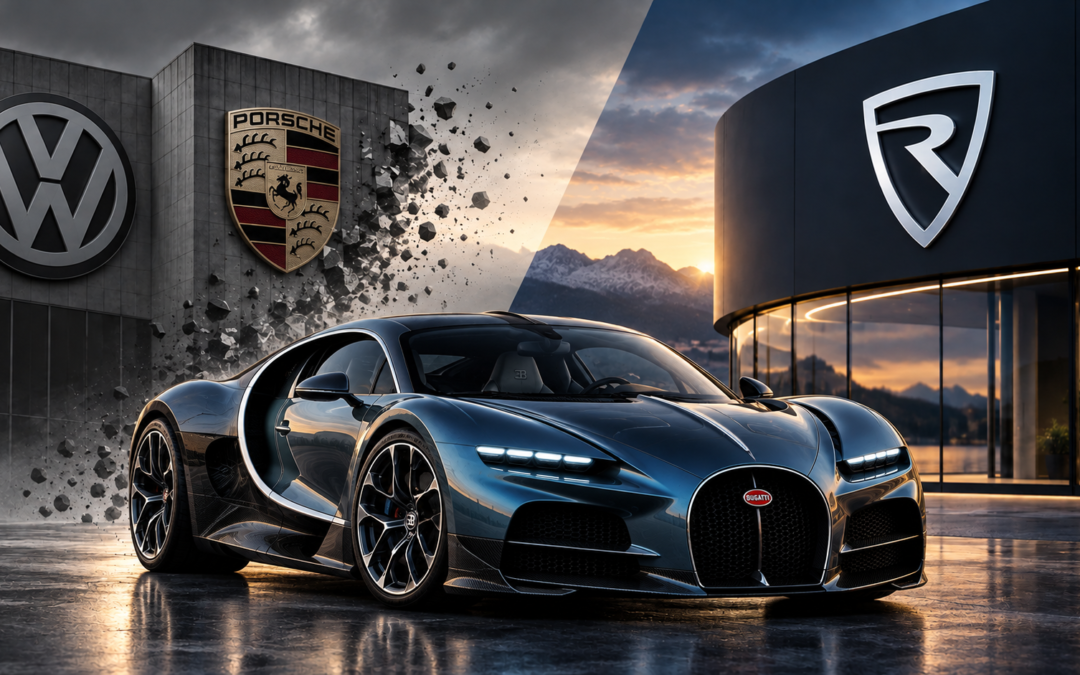
Bugatti Has Officially Entered a New Era
Porsche has completed the sale of its remaining interests in Bugatti Rimac and Rimac Group, ending Volkswagen Group's ownership connection to Bugatti after nearly three decades. The transaction closes a remarkable chapter that began when Volkswagen revived the historic French marque in the late 1990s and ultimately led to a partnership with Croatian electric-car company Rimac.
The deal does not simply change the names on Bugatti's ownership documents. It gives Mate Rimac and the broader Rimac organization substantially more freedom to shape the future of one of the world's most exclusive automakers.
And remarkably, that future is not being built around an all-electric Bugatti.
Instead, the company is moving forward with the Tourbillon, a hybrid hypercar built around a naturally aspirated V16 engine.
Porsche's Exit Ends Volkswagen's Bugatti Era
Porsche completed the transaction on September 9 following regulatory approval.
Under the previous arrangement, Porsche owned 45% of Bugatti Rimac, while Rimac Group held the remaining 55%. Porsche also owned approximately 20.6% of Rimac Group itself.
Those holdings have now been sold to a consortium led by New York-based HOF Capital, with Abu Dhabi-based BlueFive Capital serving as its largest investor alongside institutional investors from the United States and Europe.
Rimac Group retains its 55% majority position in Bugatti Rimac, while the new investors replace Porsche as the company's financial partners.
Porsche is receiving approximately €1 billion from the transaction. The German automaker says €250 million of that money will be used to further fund its pension obligations.
The proceeds also improve Porsche's financial outlook. The company raised its forecast for its 2026 automotive net cash-flow margin to between 5.5% and 7.5%, compared with its previous forecast of 3% to 5%.
For Porsche, the sale represents another step in concentrating resources on its core automotive business.
For Bugatti, however, the implications are considerably more significant.
A Partnership That Started With Very Different Expectations
The current Bugatti Rimac structure dates back to 2021, when Porsche and Rimac combined Bugatti and Rimac into a new joint venture.
At the time, the arrangement seemed almost tailor-made for the changing automotive industry.
Bugatti brought extraordinary brand recognition, craftsmanship and decades of experience building some of the world's fastest combustion-powered cars.
Rimac brought cutting-edge electric powertrain technology and the experience of developing the Nevera, an electric hypercar capable of extraordinary acceleration and performance.
The expectation from the outside was that Rimac's technology would eventually push Bugatti toward electrification.
Instead, Mate Rimac took the brand in a rather different direction.
The resulting Tourbillon combines electrification with an enormous naturally aspirated V16 rather than abandoning the combustion engine altogether.
That decision may prove to be one of the most important aspects of the new ownership structure.
The Tourbillon Wasn't The Electric Bugatti Many Expected
The Bugatti Tourbillon represents a fascinating compromise between the old and new automotive worlds.
Rather than replacing the combustion engine with batteries, Bugatti developed a hybrid powertrain centered around a naturally aspirated 8.3-liter V16 engine developed with Cosworth.
Three electric motors supplement the engine, producing a combined system output of approximately 1,800 horsepower.
Bugatti says the car is expected to reach 60 mph in roughly two seconds and ultimately achieve a top speed of around 276 mph.
That makes the Tourbillon very different from Rimac's own Nevera.
The Nevera is an unapologetically electric hypercar. The Tourbillon instead attempts to preserve the emotional character of an exotic combustion engine while using electric motors to provide additional performance.
That distinction could become increasingly important now that Porsche is no longer involved.
Mate Rimac Takes A Bigger Role At Bugatti
The ownership transition is accompanied by a significant management reshuffle.
Mate Rimac, who founded Rimac and has served as CEO of Bugatti Rimac, is taking over as President of Bugatti Automobiles.
Christophe Piochon is stepping down as President of Bugatti Automobiles and Chief Operating Officer of Bugatti Rimac.
Marko Brkljačić, formerly Chief Operating Officer at Rimac Technology, is planned to join Bugatti Rimac as its new Chief Operating Officer.
The changes further consolidate Bugatti's direction around Rimac's leadership.
Piochon had been an important figure during Bugatti's Volkswagen era and had been involved with the brand through the Veyron, Chiron and Tourbillon generations.
His departure therefore represents more than an ordinary executive transition. It marks the closing of another link between the modern Bugatti brand and the Volkswagen/Porsche organization.
Volkswagen's Bugatti Story Was Already Unusual
Volkswagen acquired Bugatti in 1998, during a period when the German conglomerate was assembling an extraordinary collection of luxury and performance brands.
Under Ferdinand Piëch's leadership, Bugatti was transformed from a dormant historic name into a modern hypercar manufacturer.
The Veyron became the centerpiece of that revival.
With its quad-turbocharged W16 engine and four-wheel-drive system, the Veyron demonstrated that Volkswagen was willing to spend extraordinary amounts of money simply to answer a seemingly simple question:
How fast can a production car actually be?
The Chiron followed, pushing the concept even further.
But the automotive landscape eventually changed.
Developing ever-more-powerful combustion engines became increasingly difficult from a regulatory and financial perspective, while electrification created an entirely new technological battlefield.
That made Rimac an increasingly logical partner.
Porsche's Relationship With Rimac Goes Back Further
Porsche's connection with Rimac actually predates Bugatti Rimac.
Porsche first invested in Rimac in 2018 and gradually increased its stake in the Croatian company to roughly 21%.
That relationship gave Porsche exposure to a young company developing high-performance electric powertrain technology at a time when the automotive industry was accelerating toward electrification.
The 2021 Bugatti Rimac joint venture expanded that relationship dramatically.
Five years later, Porsche is now completely out.
The irony is that Rimac has arguably become much more than the electric-hypercar startup Porsche originally invested in.
The Rimac Group now spans several businesses, including Bugatti Rimac, Rimac Technology, robotaxi company Verne and Rimac Energy, which is developing stationary energy-storage systems.
That diversification makes the company's relationship with Bugatti considerably different from what it was when the joint venture was created.
Why Porsche Wanted Out
The Bugatti sale is also part of a much larger story at Porsche.
The sports-car manufacturer has been dealing with weaker demand in China, pressure on earnings and a slower-than-expected transition toward electric vehicles.
Porsche's decision to sell its Bugatti Rimac and Rimac Group interests allows the company to redirect capital toward its core operations while improving near-term cash flow.
That doesn't necessarily mean Porsche considers Bugatti a bad business.
Quite the opposite may be true.
Bugatti is an extremely valuable luxury brand. But owning a minority stake in a highly specialized hypercar operation is not necessarily where Porsche wants its capital tied up while it works through its own strategic challenges.
The €1 billion proceeds give Porsche considerably more financial flexibility.
The New Investors Are Buying Into More Than Bugatti
The HOF Capital-led consortium isn't simply acquiring exposure to a famous French badge.
The transaction also includes Porsche's interest in Rimac Group itself.
That is important because Rimac has evolved into a broader technology company rather than remaining solely a hypercar manufacturer.
Rimac Technology supplies advanced electric components and systems to other automakers, while Rimac's other businesses give the group exposure to autonomous transportation and stationary energy storage.
The new investment structure therefore gives outside investors exposure to both the glamour of Bugatti and the technology businesses surrounding Rimac.
HOF Capital described Bugatti as a brand where heritage and innovation coexist, while BlueFive Capital has emphasized the opportunity to preserve the marque's legacy while supporting its future growth.
What Happens To Bugatti Now?
The immediate future is relatively clear.
Bugatti's focus will be on bringing the Tourbillon to production while continuing to develop the brand beyond the current generation of hypercars.
The more interesting question is what comes after it.
The end of Porsche's involvement removes one of the major corporate voices that helped shape Bugatti's modern development.
Mate Rimac now has considerably more influence over the company's direction.
That could produce some unusual products in the years ahead.
Rimac has demonstrated that it understands electrification at a level few automakers can match. At the same time, the Tourbillon demonstrates that the company does not believe every future Bugatti needs to be purely electric.
That combination could become Bugatti's defining characteristic.
Instead of choosing between combustion and electric power, Bugatti may continue looking for ways to combine the two technologies at the extreme end of the market.
Bugatti's Future Could Be More Independent Than Ever
The most important consequence of the transaction may ultimately have little to do with money.
Bugatti is finally becoming much less constrained by the priorities of a massive automotive group.
Volkswagen was instrumental in resurrecting Bugatti and creating the modern Veyron and Chiron.
Porsche then helped establish the Bugatti Rimac joint venture and provided Rimac with an important strategic partner.
Both played critical roles in bringing Bugatti to where it is today.
But neither is now an owner.
The brand is entering its next era with Rimac Group retaining majority ownership of Bugatti Rimac and a new consortium of investors providing additional capital and financial backing.
That gives Mate Rimac and his team a much clearer mandate.
The Biggest Test Is Still Ahead
Owning Bugatti is one thing. Keeping Bugatti relevant is another.
The brand operates at an almost absurdly small volume compared with mainstream automakers, while each vehicle requires enormous engineering effort and craftsmanship.
At the same time, the expectations surrounding a Bugatti are unlike those placed on almost any other car.
It has to be exceptionally fast, technically extraordinary, beautifully engineered and unmistakably different from everything else on the road.
The Tourbillon is therefore more than a new hypercar.
It is the first major statement about what Bugatti can become without Volkswagen or Porsche sitting behind it.
And now that Porsche's exit is complete, the answer will belong primarily to Rimac.
For the first time since Volkswagen resurrected the brand in 1998, Bugatti is heading into the future without Volkswagen ownership.
The company that began life as one of the automotive world's most extravagant experiments is now effectively entering another one — this time under the leadership of the Croatian technology company that was once expected to turn it into an electric-car brand.
Instead, Rimac has chosen a more complicated path.
A V16.
Three electric motors.
A new ownership structure.
And a Bugatti that is finally standing on its own.