
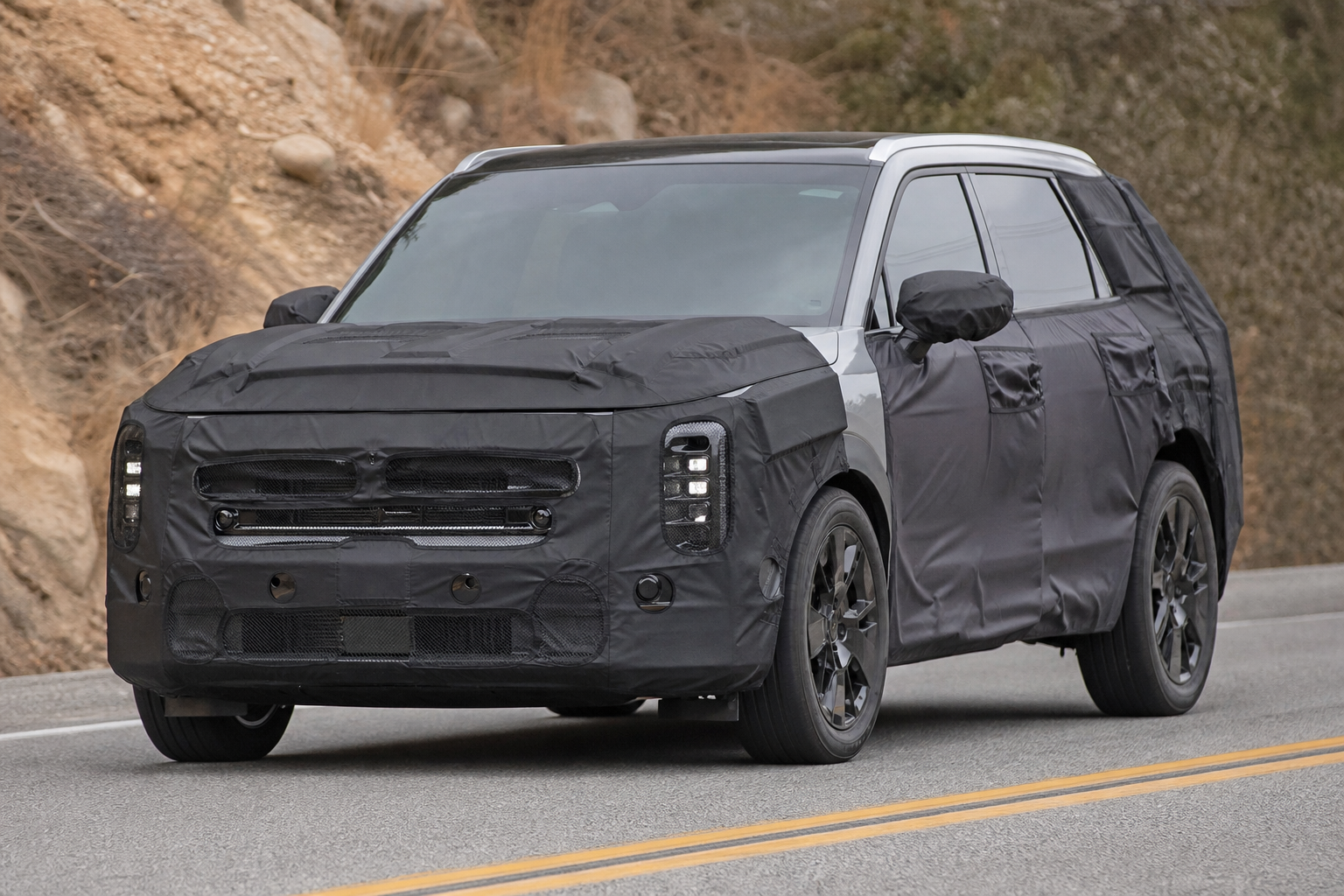

Kia has begun testing the next-generation Sportage, revealing a heavily camouflaged prototype with a more upright and angular design. The new SUV is expected to share much of its hardware with the 2027 Hyundai Tucson, including its platform and powertrain options.
Although thick black cladding conceals most of the prototype, its overall proportions are visible. The next Sportage appears boxier than the current model, with sharply angled side windows replacing the outgoing vehicle’s more rounded profile. Its flat roof and upright stance also appear closer to Kia’s electric SUVs, including the EV5 and EV9.
Split headlights and revised front styling
The prototype features a redesigned front fascia with a different grille. Its lighting arrangement is expected to depart significantly from the current Sportage, which combines the headlamps and daytime running lights in a large single assembly.
The new model appears likely to use split headlights. The camouflage makes the final design difficult to determine, but the prototype seems to show a combination of vertical and horizontal LED elements. The primary headlamps may be positioned lower on the front bumper inside square housings.
Black wheels are fitted to the test vehicle, though the source indicates they are being used only during development and will not be offered on the production model. The rear remains largely hidden beneath camouflage, leaving the shape of the taillights unclear. The lights are expected to follow the bold styling seen on other current Kia models.
Shared platform and expected powertrains
Like the current Sportage and the new Tucson, the next-generation model is expected to use Hyundai and Kia’s N3/N4 platform. It is also expected to grow by about 60 millimeters in length, with a slightly longer wheelbase than the outgoing SUV.
Powertrains are anticipated to overlap with those offered in the Tucson. Expected gasoline options include a turbocharged 1.6-liter four-cylinder and a naturally aspirated 2.0-liter four-cylinder, with outputs ranging from 148 to 190 horsepower. Torque in the related Tucson ranges from 141 to 195 pound-feet, depending on specification, and similar figures are expected for the Sportage.
Hybrid and plug-in hybrid versions are also expected. The conventional hybrid uses a turbocharged 1.6-liter four-cylinder, a 1.49-kWh battery, and a compact electric motor. Depending on the market, that configuration produces either 233 or 242 horsepower.
The plug-in hybrid pairs the same engine with a larger 17.1-kWh battery. In the Tucson, it produces 288 horsepower and 258 pound-feet of torque, figures that are expected to carry over to the Sportage PHEV.
0 Comments