
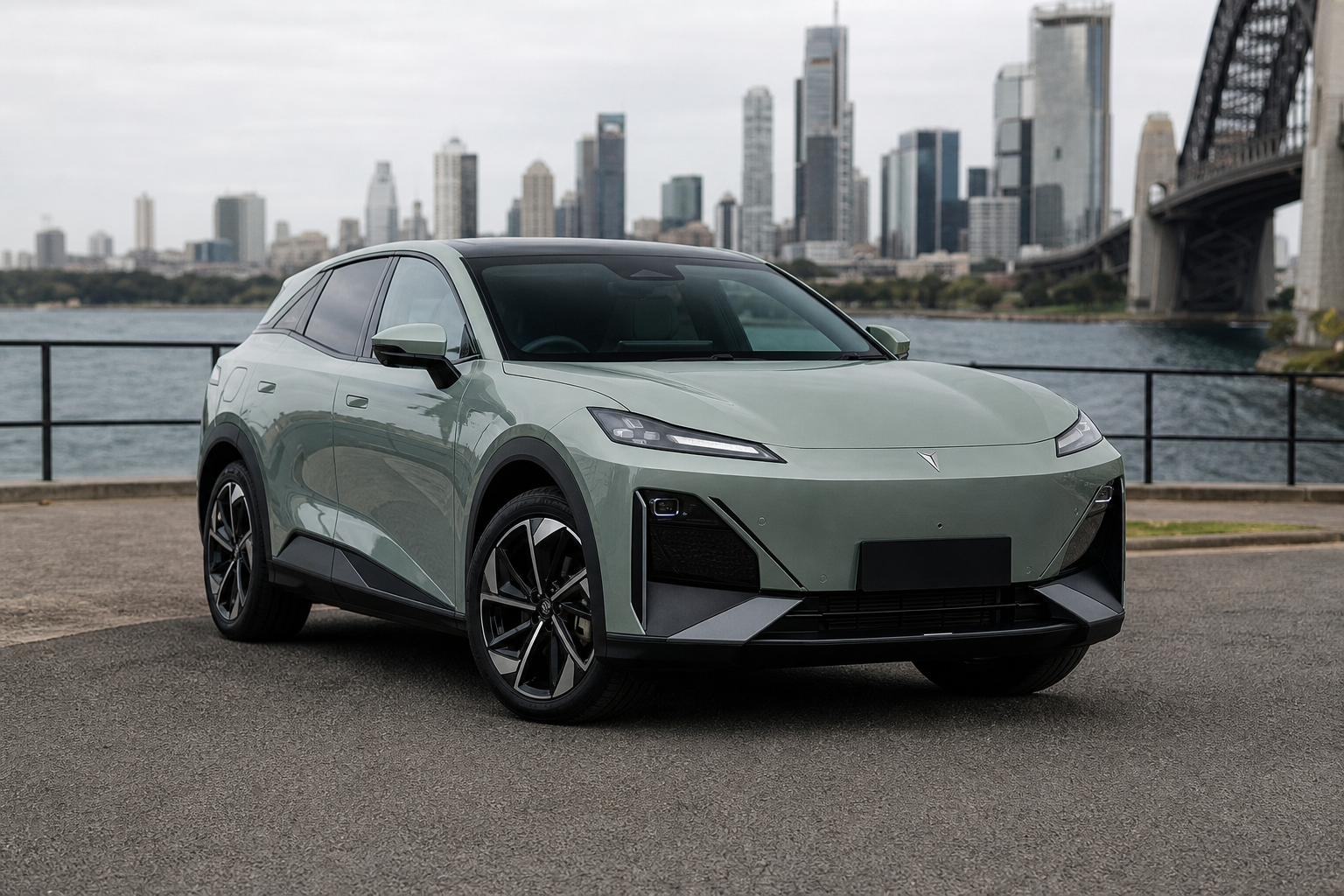

The Deepal S07 is entering Australia’s crowded electric SUV market with a competitive price, distinctive coupe-inspired styling and a thoughtfully designed cabin. After a week with the rear-wheel-drive model, the S07 proved comfortable and capable, although its charging speed and driver-assistance systems remain notable weaknesses.
Competitive pricing and a single configuration
Deepal offers the S07 locally in one configuration, with a choice of 19- or 20-inch wheels. Its current price is AU$47,990 including on-road costs, approximately AU$10,000 less than when it launched in Australia in early 2025.
That positions it AU$2,000 below a base Kia EV5 and more than AU$15,000 below a Tesla Model Y. For a relatively unfamiliar brand in Australia, the pricing gives the S07 a clear point of difference.
Power comes from a 79.97-kWh ternary lithium battery connected to a rear-mounted electric motor producing 160 kW and 320 Nm. The S07 can accelerate from zero to 100 km/h in around 7.9 seconds, which is adequate for everyday use rather than especially quick.
Charging is less competitive. The S07’s maximum DC charging rate is 92 kW, with a 30-to-80-percent charge taking 35 minutes. AC charging supports up to 11 kW. A 3.3-kW vehicle-to-load function is included.
Distinctive exterior, considered cabin
Designed by Changan at its Turin, Italy facility, the S07 stands apart with its sloping roofline and distinctive lighting. Inside, the design is more familiar for a modern Chinese electric SUV, but soft-touch synthetic leather and orange stitching help give the cabin a premium appearance.
The 15.6-inch central display includes wireless Apple CarPlay and Android Auto. Its unusual feature is the ability to angle the screen toward the driver or front passenger instead of leaving it fixed in the center. After using it in the driver-oriented position, returning to a conventional centered display felt less convenient.
The software is responsive and clear, though the volume of controls can be overwhelming. Climate functions are integrated into the screen, and adjusting individual vents was not always straightforward. An AI voice assistant activates when the driver enters the vehicle, but it can be disabled.
There is no separate digital instrument display. Instead, the S07 uses a large augmented-reality head-up display. The driving position is comfortable, although additional steering-wheel adjustment and a lower seat position would improve it.
Rear-seat space is sufficient for two large adults, with separate climate controls and switches that allow the front passenger seat to be moved from the back. Cargo capacity is 445 liters with the rear seats raised and 1,385 liters when they are folded.
Comfortable driving, imperfect assistance systems
Several software updates appear to have addressed some of the unfinished qualities and poorly calibrated safety systems reported when the S07 first launched. The driver-monitoring system can now be switched off through the screen menu, and that setting remains disabled after the vehicle is restarted. When active, however, it was frequently judged to be overly sensitive.
The rear-wheel-drive layout gives the S07 a direct feel through corners and avoids the torque steer associated with some front-wheel-drive rivals. It remains composed in sweeping bends and tighter turns, while the ride balances comfort with a modestly sporty character.
Regenerative braking can be customized, but there is no one-pedal driving mode or steering-wheel paddles for changing regeneration while driving. The transition between regenerative and friction braking could also be smoother.
Deepal quotes consumption of 18.6 kWh/100 km and a maximum range of 475 km. During the review, consumption averaged 17.8 kWh/100 km, suggesting the claimed range is achievable in suitable conditions. Adaptive cruise control and lane centering generally work well, although the S07 can drift toward freeway lane markings rather than staying centered.
With 522 examples sold in Australia through the end of June, the S07 was reportedly ahead of the Leapmotor C10 and roughly level with the Hyundai Elexio, but behind the Kia EV5’s more than 3,000 sales. It is not the strongest all-rounder in the segment, but its current price, styling and interior features make it a credible alternative for buyers seeking something less familiar.
0 Comments