
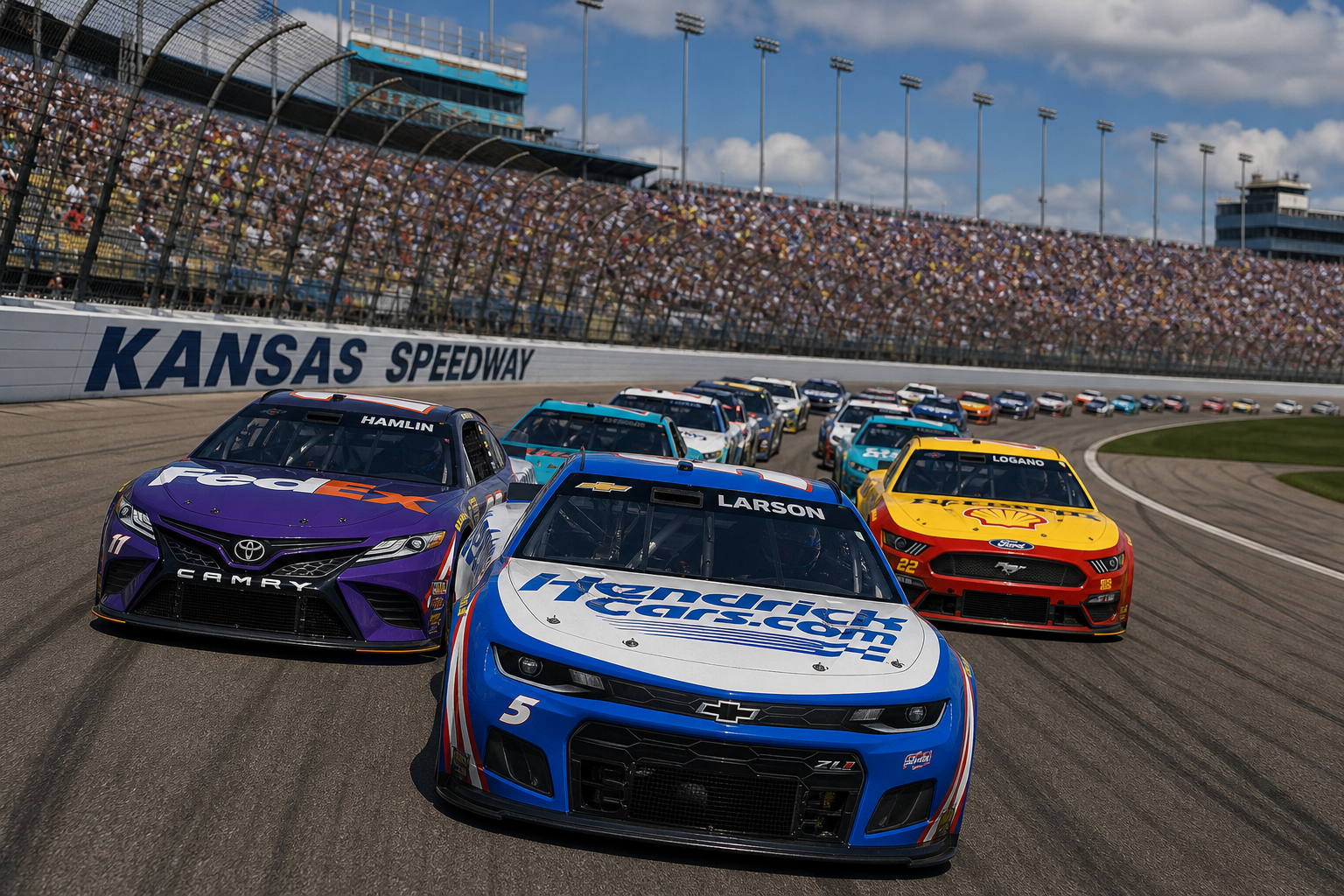

Kansas II arrives with rather more intrigue than the title might suggest. The NASCAR Cup Series headlines the weekend, but the schedule also brings the NASCAR Craftsman Truck Series and ARCA Menards Series to the same venue, creating a full slate of stock-car racing rather than a single Sunday appointment followed by several hours of people discussing tire strategy.
The championship picture is especially tight. Kyle Larson enters Kansas as the new Cup Series points leader, holding a one-point advantage over Denny Hamlin. Joey Logano, fresh from his victory at Bristol, sits 16 points behind Larson. That is hardly comfortable territory for anyone, particularly with Hamlin directly behind the leader and Kansas capable of producing a race that changes shape quickly.
Why Kansas II Deserves Attention
Last fall’s Cup race at Kansas ended with the sort of finish that keeps a track in the conversation long after the haulers have left town. Chase Elliott took the victory after Denny Hamlin and Bubba Wallace collided on the final lap, turning what had been a tense contest into a piece of NASCAR theater with an especially expensive final scene.
That result is useful context for this weekend. Kansas has a habit of keeping the field close enough for late-race decisions to matter, and a race can remain unsettled until the final restart, pit stop, or unfortunate meeting of two cars that really ought to have remained several feet apart.
The venue also rewards drivers who can manage a car over a long run. A stock car that feels comfortable early in a stint may not behave the same way once the tires wear and the balance moves around. That places a premium on setup choices, traffic management, and the ability to preserve enough performance for the closing laps. Speed is helpful. Having four tires left when everyone else has driven theirs into the ground is generally helpful as well.
The Cup Series Points Battle
Larson’s arrival at the top of the standings gives the weekend an immediate storyline, but his margin is almost comically small. One point over Hamlin means that a modest swing in finishing positions, stage results, or other race developments could change the order again.
Hamlin therefore has no need to treat Kansas as a damage-limitation exercise. He is close enough to retake the lead with a strong showing, while Larson is trying to turn his new position into something more substantial than a temporary line on the timing sheet.
Logano’s position adds another layer. Sixteen points is a larger gap than Larson’s lead over Hamlin, but it is hardly a chasm in a championship fight that still has plenty of opportunities for momentum to change. His Bristol win also means the conversation around him will focus on whether that success becomes a springboard or remains an isolated burst of form.
For viewers, the standings make every part of the Cup race more relevant. A driver does not need to win to leave Kansas in better shape, and a race leader can lose considerable ground through a poor restart, a slow pit stop, or an incident that arrives with all the subtlety of a dropped piano.
Three Series, Three Different Races
The Cup Series is the main event, but the supporting races are not merely decorative programming. The NASCAR Craftsman Truck Series brings a different kind of contest to the weekend, with smaller, closely matched trucks that can produce aggressive racing in traffic and under braking. The drivers may share the circuit, but the machinery demands different decisions and exposes different weaknesses.
The ARCA Menards Series adds another layer to the schedule. ARCA has long served as an important proving ground for young drivers building experience on larger tracks and in heavier stock cars. Kansas gives those competitors a chance to learn the same broad challenges faced by the Cup field: managing tire wear, finding a reliable line, and surviving the frantic closing stages without turning the car into a collection of expensive panels.
Watching all three series also gives the weekend a clearer rhythm. The support races show how the surface is behaving before the Cup cars arrive, while the Cup race provides the highest level of speed, experience, and strategic complexity. It is a useful reminder that NASCAR weekends are not built around one green flag alone.
How to Follow the Kansas II Weekend
Viewers should plan around three separate race broadcasts: the ARCA Menards Series event, the NASCAR Craftsman Truck Series race, and the NASCAR Cup Series race. The Cup contest is the centerpiece, but following the earlier sessions can provide useful context about track conditions and the way drivers are using the racing surface.
The available event information confirms the three-series lineup, while exact start times and television assignments should be checked against the latest listings from NASCAR, Kansas Speedway, and the relevant broadcast partners. Race-weekend schedules can shift because of weather, track activity, or television programming, so relying on an old listing is an excellent way to arrive just in time for the final restart.
For the Cup race itself, the main points to watch are Larson and Hamlin’s direct championship duel, Logano’s attempt to carry momentum from Bristol, and Chase Elliott’s return to the track where he won the previous fall race. Elliott’s victory was shaped by the final-lap collision between Hamlin and Wallace, so the memory of that finish will hang over the event without telling us exactly how this year’s race will unfold.
What Could Decide the Cup Race?
Kansas is unlikely to reward a driver who treats the race as a series of short qualifying laps. Long-run balance, tire management, and clean pit work should be central to the outcome. A car that can run consistently through changing traffic may prove more valuable than one that looks spectacular for a handful of laps and then fades when the tires give up.
Restarts remain the obvious danger zone. They compress the field, erase the advantage of a comfortable lead, and place drivers in situations where a small misjudgment can damage several championship contenders at once. Last year’s final-lap drama showed how quickly a race can be transformed, but the more ordinary hazards—bad timing under caution, a slow stop, or a car that loses balance in traffic—can be just as damaging over the course of an afternoon.
That is why Kansas II matters to more than the driver at the front. Larson has the points lead, Hamlin is close enough to snatch it back, and Logano arrives with a recent win to his name. Add a three-series weekend and the memory of a chaotic finish, and Kansas has assembled a rather effective recipe for keeping viewers in their seats.
There is no guarantee of another last-lap collision. NASCAR would probably prefer that, particularly the team accountants. But with the championship separated by a single point at the top, the closing laps should have plenty of consequence even if everyone manages to keep all four corners attached.
0 Comments