
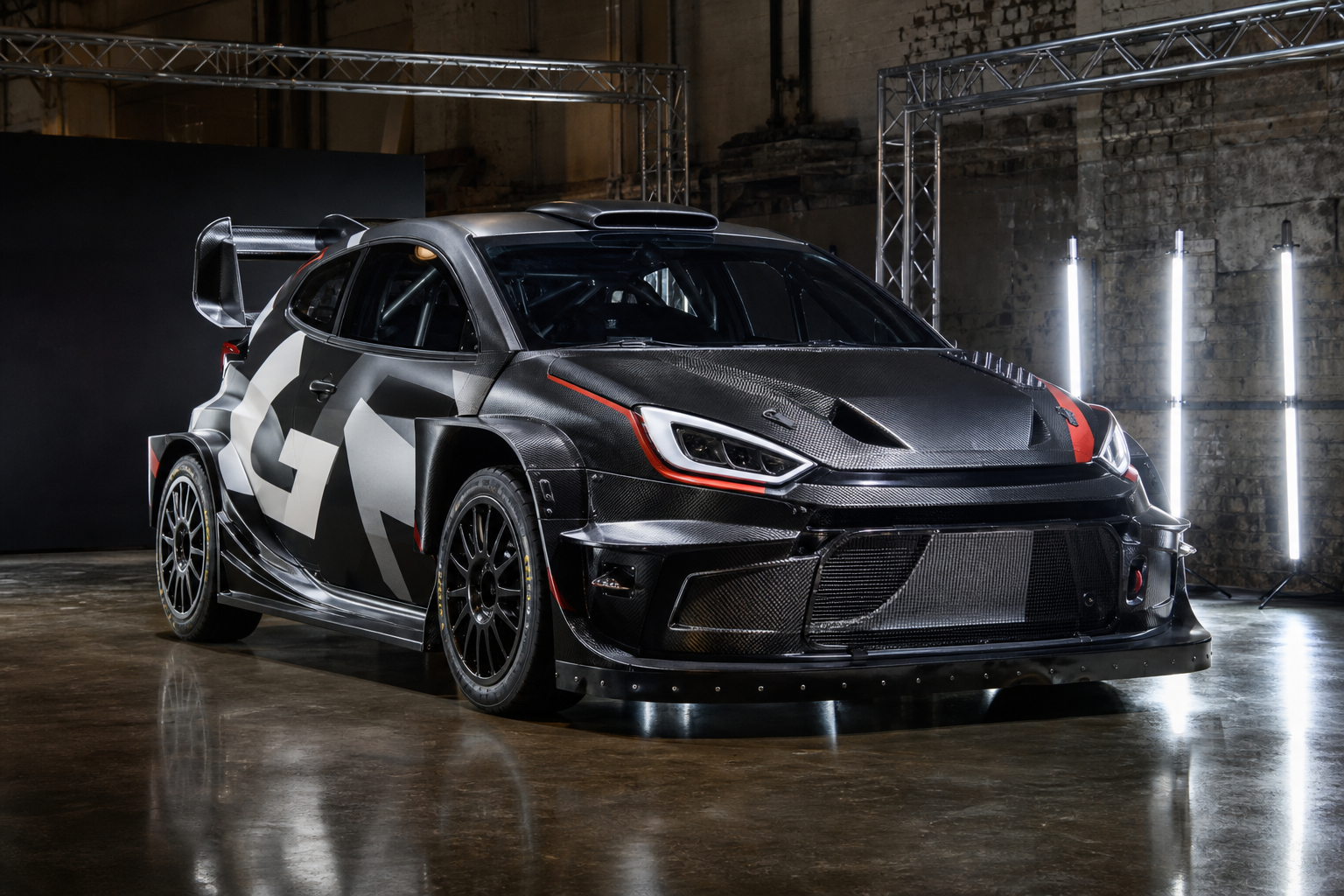

Project Rally One has put a physical car on display before it has turned a competitive wheel, making the Belgian tuner operation the first team to officially present a machine built for the World Rally Championship’s 2027 Rally1 regulations.
That is a useful way to announce yourself in rallying. It is also a rather bold one. The new Rally1 era is still approaching, yet Project Rally One is already asking the paddock to take its ambitions seriously, with plans that could see the team contest as many as seven rounds next year.
A New Name at the Top of the WRC
Project Rally One is not arriving as an established factory giant with decades of rallying heritage and a transport fleet large enough to invade a small country. It is a tuner operation preparing to step into the WRC’s highest category, where the cars are fast, technically demanding and exposed to some of the harshest conditions in motorsport.
The team is one of two tuner outfits involved in the new Rally1 landscape. The other has not yet been identified in the available details, but the presence of two independent operations is important. A championship dominated entirely by manufacturer-backed programs can become expensive, politically complicated and, occasionally, rather short on variety. Tuner teams bring a different commercial model and can give the grid additional depth without requiring every manufacturer to build and operate a full works program.
That does not make the job easy. A WRC entry needs far more than a quick car. It requires engineering support, spare parts, logistics, testing, crew preparation and the ability to rebuild a machine after it has been introduced to a forest at considerable speed. Rallying is wonderfully efficient at exposing optimistic business plans.
The First 2027 Rally1 Car to Be Presented
Project Rally One’s most significant achievement so far is straightforward: it has shown an example of a car designed to the WRC’s new 2027 technical regulations. The team became the first to officially present a car from this next generation of Rally1 machinery last week.
That does not mean the car has already proved itself in competition, nor does an official presentation reveal how close the project is to its final competitive specification. A displayed rally car can demonstrate the direction of a program, but rally stages provide the less forgiving examination. Gravel, mud, jumps, rocks, snow and repeated high-speed impacts tend to find weaknesses that remain invisible beneath presentation lighting.
Still, getting to the point of showing a complete car is no trivial exercise. It suggests that Project Rally One has moved beyond a purely theoretical proposal and has produced something tangible around which its testing, development and event planning can be organized.
Why Seven Rounds Would Be a Sensible Start
The wording matters: Project Rally One could contest as many as seven World Rally Championship rounds next year. That is a possible program, not a confirmed full-season schedule.
For a new entrant, a limited campaign makes practical sense. The team can choose events that suit its preparation, spread development costs across a manageable number of rallies and learn the behavior of the car without immediately committing to the financial and logistical burden of a complete championship assault.
Seven rounds would still represent a substantial undertaking. Each event demands preparation well before the start, while the car must be supported through reconnaissance, shakedown, competition and whatever repairs the terrain decides to request. A partial season is not a casual outing. It is simply less likely to turn the entire operation into a traveling emergency.
A carefully selected schedule could also help Project Rally One build experience in stages. Different WRC events place very different demands on a car and crew. Smooth asphalt rewards precision and confidence, while rough gravel exposes suspension, cooling and durability. Snow rallies bring their own peculiar physics, where grip is scarce and the scenery has an alarming habit of arriving very quickly. The available information does not yet confirm which rounds Project Rally One is considering, so any detailed calendar would be guesswork.
The Gap Between a Show Car and a Rally Program
There is a natural temptation to treat the launch of a new rally car as the main event. In reality, it is the opening chapter. The engineering work that follows will determine whether Project Rally One becomes a genuine championship participant or merely the owner of an attractive prototype and a heroic collection of invoices.
Development will need to cover the obvious areas—performance, reliability and serviceability—but rallying adds a particularly brutal requirement: the car must remain competitive after being abused. A circuit car can spend its life on a relatively predictable surface. A rally car has to cope with changing grip, imperfect roads, jumps, compression, debris and stages that can punish the machine before the driver has finished the first pass.
Serviceability is especially important for a smaller operation. Factory teams can deploy large engineering groups and extensive parts inventories. A tuner team has to make every component, technician and transport movement count. A quick repair at service can rescue a rally; a missing part or damaged assembly can end it with remarkable efficiency.
What Project Rally One Has—and Has Not—Revealed
The early announcement establishes three useful facts. Project Rally One is a Belgian tuner operation. It intends to enter the WRC’s top tier under the new Rally1 rules for 2027. And it is considering a campaign of up to seven rounds next year.
The important blanks remain sizeable. The available information does not identify the car’s manufacturer, its engine, the drivers, the exact events, the budget or whether the seven-round plan has been formally confirmed. It also does not provide performance figures, technical specifications or details of the team’s testing program.
Those omissions are not unusual at this stage. Rally programs are often assembled piece by piece, with technical development, commercial backing and driver contracts progressing at different speeds. A team can have a car before it has a complete calendar, and it can have an ambitious calendar before every element of the operation is ready to go.
A Welcome Test for the New Rally1 Formula
Project Rally One’s arrival gives the 2027 regulations an early practical test. New rules are judged not only by the cars they produce, but also by who can realistically build, run and compete with them. If independent tuners can enter the category without needing the resources of a global manufacturer, the regulations may create a healthier spread of teams.
That will depend on the costs and complexity of the final programs, neither of which can be assessed from a launch presentation alone. A regulation set can appear accessible on paper and become rather less friendly once testing, parts manufacture, homologation and event support are added. Motorsport has a long and distinguished history of discovering that the expensive bit was hiding just behind the inexpensive bit.
For now, Project Rally One has done the part that many prospective entrants never reach: it has presented a real 2027 Rally1 car and attached a plausible competition plan to it. Seven rounds would not make the operation a championship favorite overnight, nor should it. But it would give the Belgian team a meaningful route into the WRC, enough events to gather hard-earned experience and the chance to show whether its new machine can survive the place where rally cars are properly introduced to reality: the stage.
0 Comments