
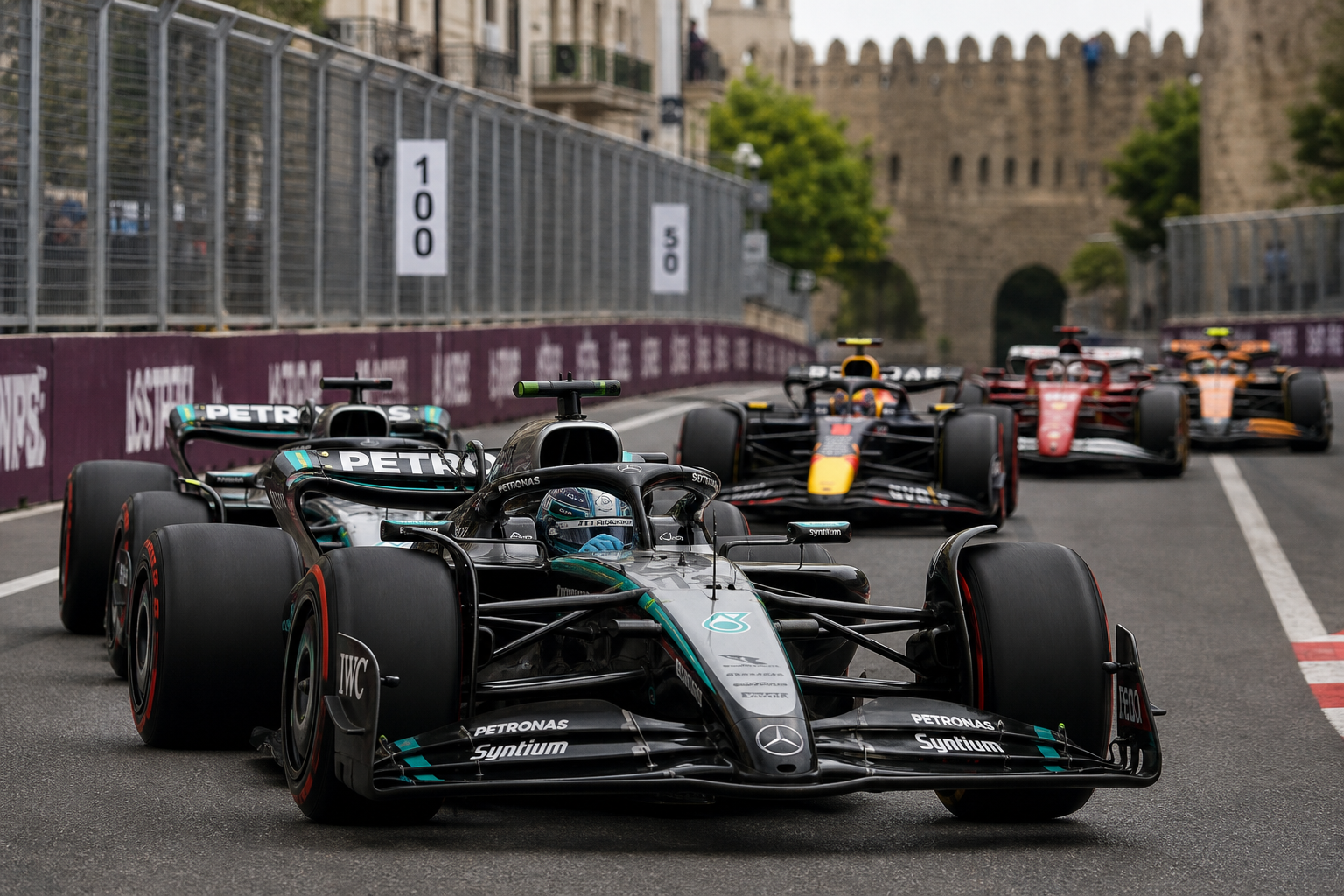

Mercedes arrived in Baku with a rather useful answer to the question nobody could properly answer before practice: which team has the car suited to Azerbaijan’s peculiar blend of long straights, slow corners and unforgiving walls?
George Russell supplied the first response. He led second practice for the Azerbaijan Grand Prix by more than half a second from Mercedes teammate and championship leader Kimi Antonelli, giving the team a remarkably emphatic one-two at the end of Friday’s running. Max Verstappen placed third for Red Bull, while Charles Leclerc, Lewis Hamilton and Lando Norris completed the leading group.
It is only practice, naturally. Formula 1 has been known to produce a completely different answer once fuel loads, tire preparation and engine modes stop being hidden behind polite timing screens. Still, a gap of more than half a second is not the sort of thing a team casually ignores, particularly at a circuit where small mistakes tend to become expensive conversations with a concrete barrier.
Russell Gives Mercedes a Clear Early Advantage
Russell’s pace was the headline from FP2, but the shape of the result was just as interesting. Antonelli followed his teammate in second, putting both Mercedes cars ahead of Verstappen’s Red Bull and the two Ferraris of Leclerc and Hamilton.
That order matters because Baku is not a circuit where a car can rely on one particular strength. The lap begins and ends with speed, but it also includes the famously narrow section around Baku’s old city walls, where a car that feels excellent on a straight can suddenly seem rather less clever when asked to change direction at low speed.
Mercedes therefore appears to have found a promising compromise, at least over one Friday session. Russell had enough straight-line performance to establish a substantial advantage, while the team’s overall package was sufficiently settled for Antonelli to match the pace closely. A one-two does not tell us exactly how much fuel each driver carried or how aggressively each power unit was being used, but it does indicate that the basic direction is not wildly wrong.
That is particularly relevant for Antonelli. Leading the championship heading into Baku brings a different sort of pressure from chasing the leader. Every practice session becomes part of a larger campaign, and every decision is judged against points rather than merely potential. Finishing second behind his teammate is hardly a problem, but the young Mercedes driver will still want to understand why Russell found the extra margin.
Why Baku Makes Practice Results Difficult to Read
The Baku City Circuit is one of Formula 1’s more awkward engineering puzzles. Its lap combines a long full-throttle section with heavy braking zones, tight traction corners and a narrow, technical passage that leaves no room for enthusiastic experimentation. Teams must decide how much aerodynamic load to carry without throwing away too much speed on the main straight.
Run too little downforce and the car may be quick between the corners but nervous when braking or turning. Add more wing and it may behave more confidently in the twisty sections, only to lose time every time the throttle is opened. This is the sort of compromise that produces long meetings, many graphs and at least one person staring at a laptop as though it has personally betrayed them.
Track evolution adds another layer. Baku’s street surface can change considerably as more rubber is laid down, while wind can alter the car’s behavior from one run to the next. A setup that looks acceptable early in the day may become less convincing as grip increases. Equally, a team that appears slightly off the pace can recover quickly once it understands how the tires are responding.
That is why Mercedes’ advantage is encouraging rather than conclusive. Russell’s lead gives the team a strong starting point, but the more important question will be whether the car remains predictable when the track changes and the pressure rises. Baku rewards confidence, but it punishes overconfidence with remarkable efficiency.
Verstappen Keeps Red Bull in the Conversation
Verstappen ended FP2 in third, putting Red Bull within striking distance of the Mercedes pair. The gap to Russell means the team has work to do if it wants to control the weekend, but third place is hardly a disaster at a circuit where a small setup change can alter the competitive order.
Red Bull’s challenge will be familiar. The car needs to be fast enough through the low-speed sections without sacrificing too much at the end of the lap, and it must give Verstappen confidence under braking. At Baku, confidence is not a soft, subjective extra. It is a performance tool. A driver who trusts the front end can brake later and attack the apex; a driver who does not will leave a few inches in reserve, which soon becomes a few tenths on the timing screen.
Verstappen’s presence near the front also prevents Mercedes from treating Friday as a private team test. The Red Bull may not yet have the outright pace of the silver cars, but the gap is close enough to keep strategy and qualifying from becoming an afterthought.
Ferrari Brings Hamilton and Leclerc Into the Leading Group
Leclerc was fourth, with Hamilton fifth, giving Ferrari two cars inside the top five. That result is especially notable at Baku because Leclerc has historically been comfortable on circuits where precision and commitment matter, while Hamilton brings a wealth of experience in managing the awkward compromises required by street tracks.
The Ferrari drivers were separated by only one position in the published order, but the important detail is that both remained close enough to the front to stay relevant. Neither Mercedes’ advantage nor Red Bull’s third place should obscure the fact that Ferrari has started the weekend in the leading conversation.
The team will still need to examine where the time is being lost. On a circuit like Baku, the answer can sit in several places at once: braking stability into the heavy stops, traction out of the slower corners, energy deployment along the straight or the car’s ability to ride the bumps without unsettling itself. A lap time rarely reveals which of those problems is responsible. Engineers, regrettably, must do actual engineering.
Norris Leads McLaren but Sits Outside the Top Five
Lando Norris was the fastest McLaren driver in sixth. That is a respectable position, but it leaves the team looking up at Mercedes, Red Bull and Ferrari after the first major practice comparison.
McLaren has generally been a formidable reference point in recent Formula 1 competition, so sixth place will not tell the whole story. Baku’s unusual layout can expose weaknesses that remain hidden at more conventional circuits. A car may be excellent in medium-speed corners yet struggle to generate the right combination of traction and straight-line efficiency here. Conversely, a machine that looks slightly less polished elsewhere can come alive when low drag and strong braking performance become decisive.
Norris’ position also shows why Friday practice remains valuable even when a team is not immediately at the top. McLaren can now compare its performance against the Mercedes one-two, identify where the deficit appears and decide whether to prioritize qualifying speed or race consistency. Those choices are not interchangeable. A setup that produces one spectacular lap may leave the tires or brakes in a rather less cheerful state over a full Grand Prix distance.
What to Watch as the Azerbaijan Weekend Develops
The immediate focus will be whether Mercedes can preserve its advantage when the field moves toward qualifying conditions. Russell’s margin is large enough to attract attention, but the team still needs to verify that both cars can produce the performance consistently and that the balance remains manageable when drivers push closer to the walls.
Antonelli’s performance will be watched particularly closely because of his championship position. A strong Friday has given him a solid platform, but Baku offers little reward for forcing the issue too early. The ideal weekend here is built on precision: clean practice laps, reliable braking references and enough confidence to attack without crossing the line into optimism.
Verstappen, Leclerc, Hamilton and Norris all remain close enough to complicate the picture. One lockup, one poorly timed yellow flag or one gust of wind in the wrong place can rearrange the order quickly. That is the peculiar charm of Baku. It is a high-speed circuit with a slow-speed personality, a street race that behaves like a technical examination and occasionally marks its own homework with a crash.
For now, Mercedes has the advantage and Russell has the strongest evidence to support it. The rest of the field has the opportunity to respond before the weekend’s more meaningful sessions arrive. In Formula 1, that is not a verdict. It is merely the first warning shot.

0 Comments