
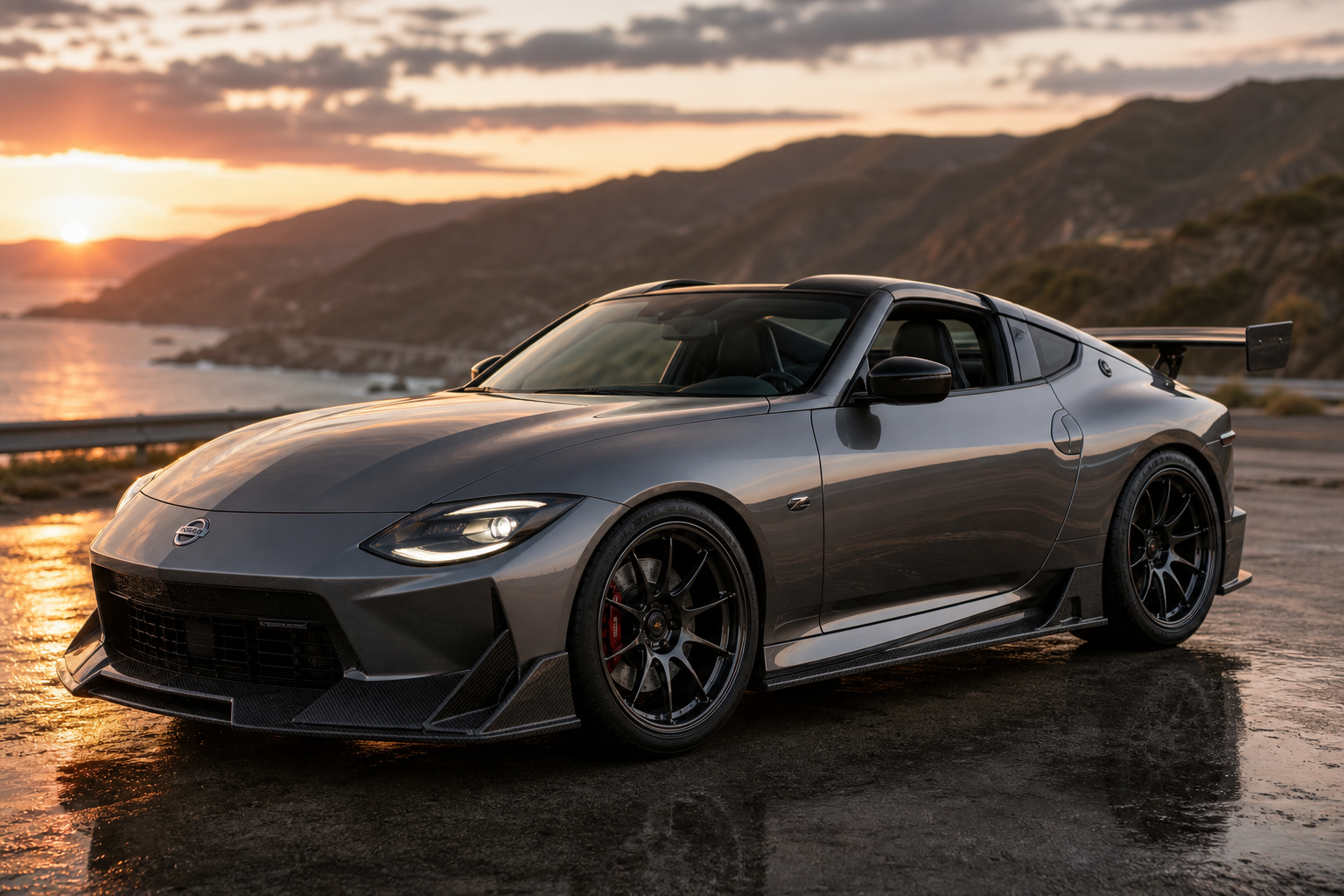

The Nissan Z Kaze has done something modern sports cars rarely dare: it has looked backward without seeming embarrassed about it. Its defining feature is a removable T-top roof, a wonderfully old-fashioned bit of theater that once made sports cars feel like they came with their own weather system.
Nissan has paired the roof treatment with a set of NISMO LMGT2 wheels and a carbon-fiber aerodynamic body kit. The result is a Z concept with a distinctly retro attitude, but not one that has been assembled from nostalgia alone. The Kaze appears to use the familiar Z formula as a starting point, then adds the sort of visual hardware that would make a standard showroom car look rather conservative at a tuner gathering.
The T-Top Is the Big Idea
There are faster ways to attract attention than removing two roof panels. A large rear wing, absurd exhaust tips, or a grille the size of a small garage door will usually do the job. Yet the T-top has a special kind of charm because it changes the experience of driving without turning the car into a full convertible.
Two removable roof sections sit on either side of a fixed central bar. Structurally, that allows the Z to retain a spine through the roof while giving occupants an open-air view when the panels come out. It is not quite the same as driving a convertible, nor is it as simple as opening a sunroof. That slight inconvenience is part of the appeal. You have to stop, unlatch things, find somewhere to put the panels, and accept that the sky is now involved in the journey.
Modern cars tend to remove such rituals wherever possible. The T-top does the opposite. It asks the driver to participate.
That makes the feature particularly appropriate for the Z, a nameplate with a long relationship with removable roof panels. Earlier generations of the sports car helped make the T-top a familiar sight on Japanese performance cars, especially during the 1980s and 1990s. The design later faded from fashion as manufacturers favored more rigid bodies, improved sealing, simpler roof structures, and the relentlessly tidy packaging demanded by modern safety standards.
The Kaze therefore works as more than a styling exercise. It reconnects the current Z with a piece of its own visual and cultural history.
NISMO Wheels Give the Concept Some Mechanical Intent
Retro styling can become painfully theatrical when it stops at painted stripes and a nostalgic badge. The Kaze avoids that trap, at least visually, with NISMO LMGT2 wheels. Their presence gives the concept a motorsport-flavored foundation rather than leaving the roof to do all the talking.
Wheel design has an outsized effect on a sports car. The wrong set can make an otherwise convincing machine look like it has been dressed for a promotional video from 2004. The LMGT2 name brings a more serious tone, linking the Z to NISMO’s performance catalog and its long-running association with Nissan competition cars.
There is also a practical visual benefit. A lightweight-looking, purpose-built wheel helps communicate that this is intended to be a performance concept, not merely a Z with its roof panels removed for a photo opportunity. The source material does not establish whether the Kaze receives suspension, brake, or powertrain changes, so it would be foolish to pretend the wheels prove anything about its dynamic specification. They do, however, make the car look ready for more than a slow parade through a design studio.
Carbon Fiber Adds a Sharper Edge
The Kaze also wears a carbon-fiber aerodynamic body kit. That detail shifts the design away from a purely sentimental recreation of an older Z and toward the modern aftermarket performance scene, where visible carbon fiber has become almost as familiar as black wheels and claims about downforce.
Carbon fiber makes sense on a concept because it is visually loud even when the aerodynamic details themselves are subtle. Splitters, side extensions, and other bodywork can look technical without requiring Nissan to turn the Z into a full competition car. The material also contrasts neatly with the smooth, rounded forms associated with older Z models. The Kaze can borrow the attitude of the past while wearing a distinctly current set of accessories.
Whether the body kit delivers meaningful aerodynamic performance is not established here, and the sensible approach is to treat it as a design and performance statement rather than a laboratory result. Road cars often wear aerodynamic parts that contribute as much to the visual drama as they do to high-speed stability. That is not necessarily a criticism. A sports car is allowed to look like it has plans.
A Familiar Z With a Different Mood
The current Nissan Z already has a deliberate relationship with the past. Its shape references earlier generations without copying one particular car, while its turbocharged powertrain, modern chassis, and contemporary cabin keep it from becoming a museum piece with license plates.
The Kaze pushes that retro conversation in a more specific direction. Instead of revisiting only the silhouette or lighting details, it brings back an ownership ritual associated with older performance cars. The T-top changes how the car is used, how it is parked, and even how it is stored. A roof panel that has been removed cannot simply be ignored in the trunk, because it has become luggage with a very clear job description.
That slight faff is precisely what separates the idea from another special-edition graphics package. A T-top gives the Z a feature people can talk about after the novelty of the carbon fiber has worn off. It creates an experience rather than merely adding another visual texture to the exterior.
Will the Kaze Reach Production?
The available information identifies the Nissan Z Kaze as a concept and describes its principal design features. It does not establish production plans, pricing, performance figures, or whether Nissan intends to offer the T-top on a customer car.
That distinction matters. Concept cars are often allowed to ignore the dreary practical questions that arrive later: structural rigidity, water sealing, wind noise, crash certification, storage, manufacturing cost, and the small matter of persuading customers to pay for all of it. The T-top may look simple from the outside, but turning an attractive idea into a durable production roof is rather more complicated than drawing two black lines across the roof panel.
Still, the Kaze makes a strong case for why manufacturers continue to build concepts. It tests a reaction. Do buyers want another screen, another drive mode, and another layer of electronic assistance, or would they rather have a roof they can physically remove with their own hands?
Nissan has not answered that question with a production announcement. It has asked it with a very good-looking sports car.
The Kaze’s charm comes from that mixture of old and new: a current Z wearing NISMO LMGT2 wheels and carbon-fiber aero, but with a roof arrangement that belongs to the era of cassette players, oversized sunglasses, and cars that occasionally demanded a little patience. In a world increasingly fond of sealed glass roofs and touch-sensitive everything, that sounds less like a step backward than a pleasantly mischievous change of pace.


0 Comments