
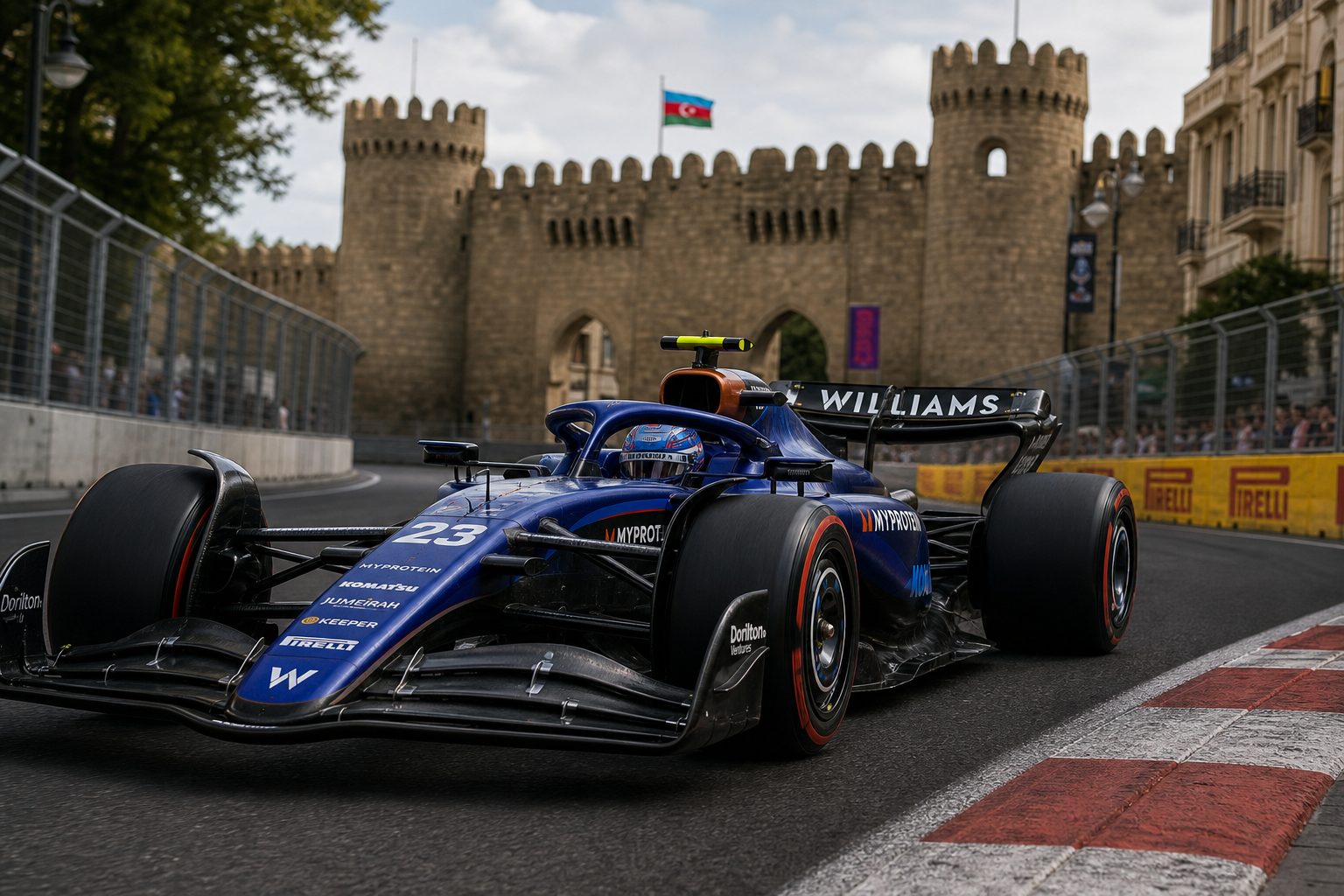

Williams is about to find out whether its grandest development gamble of the season is a genuine step forward or an expensive exercise in rearranging carbon fiber.
The team will introduce a major upgrade package at the Azerbaijan Grand Prix, following an earlier promise from team boss James Vowles that the car would become “almost completely new.” Alex Albon has described the package as a “big step,” which is encouraging. It is also the sort of phrase that makes every engineer in the garage stare intensely at their laptop and pretend not to be nervous.
The difficult part is that Williams will not be judged only on whether the updated car is quicker around Baku. The package must also provide useful information for the team’s longer-term development work, including the direction of its 2027 program. That gives the upgrade two jobs: deliver performance now, and prove that Williams is learning the right lessons for the future.
A Major Change Arriving Late in the Season
Large midseason upgrades are nothing unusual in Formula 1, but a package described as an “almost completely new” car carries rather more weight than a revised front wing or a modest floor adjustment. Williams has clearly decided that incremental development alone was not enough. The team has instead taken a sizeable swing at its design direction.
That approach can produce a worthwhile performance gain, but it also introduces risk. A modern F1 car is an interdependent collection of aerodynamic surfaces, suspension behavior, tire usage and electronic systems. Change one area and the effect can travel through the entire machine. A part that works beautifully in isolation may not deliver the expected benefit once it is fitted to the complete car.
The available information does not identify every component included in Williams’ package, nor does it provide a promised lap-time improvement. That matters. “Big upgrade” is a useful description of intent, not a performance figure. Until the car runs in practice and qualifying, nobody outside the team can know whether the new design will produce the hoped-for gains.
And even then, the answer may not be immediately obvious. Baku is a particularly awkward place to evaluate a new aerodynamic concept because the circuit combines a long, flat-out section with a tight, unforgiving collection of slow corners. A car can look marvelous on the main straight and rather less marvelous when asked to change direction near a wall. The circuit is not known for handing out simple verdicts.
Why Baku Is a Difficult Test
The Azerbaijan Grand Prix takes place on a temporary street circuit where setup compromises are unavoidable. Teams need enough straight-line efficiency to avoid being swallowed on the long run toward Turn 1, while still requiring sufficient aerodynamic stability and mechanical grip through the slower sections.
That makes Baku an entertaining venue for racing and a slightly mischievous one for development engineers. A car may show improved top speed because of reduced drag, but that does not necessarily mean the package is faster over a complete lap. Conversely, a gain in slow-corner performance can be difficult to exploit if the car gives away too much along the longest acceleration zone.
Track evolution can muddy the picture as well. Street circuits tend to change significantly as rubber builds on the surface, and small setup decisions can have an outsized effect. Traffic, yellow flags and limited running further complicate the comparison between old and new specifications. If Williams finds a few tenths, the team will still need to determine how much came from the upgrade, how much came from setup, and how much came from the circuit behaving differently.
That is why the first weekend with a major package is rarely a neat before-and-after experiment. The team will be looking at balance, tire behavior, ride-height sensitivity and the correlation between its simulation tools and the track. A stopwatch is important, obviously, but it is not the only instrument in the orchestra.
Albon’s “Big Step” Sets the Tone
Alex Albon’s description of the update as a “big step” is significant because drivers tend to be cautious when discussing upgrades before they have been properly evaluated. There is little value in making a grand prediction on Thursday only to discover on Saturday that the new parts have the manners of a shopping cart with one square wheel.
His wording suggests that the package represents a noticeable change from the current car, at least in the team’s expectations. It does not guarantee a specific grid position or a sudden transformation into a front-running operation. Formula 1 performance is relative: Williams can improve and still find that other teams have made a larger gain.
The useful question for Albon and his engineers will be whether the car becomes easier to place into its performance window. A car that is quicker in ideal conditions but extremely sensitive to setup may not be a convincing step forward across an entire race weekend. A slightly less dramatic gain that produces a broader operating range can be more valuable, particularly at circuits with changing grip and unusual demands.
The upgrade also needs to provide a clear driving response. If the drivers can identify what the car wants from them, Williams can build a more reliable setup process around the new specification. If the car produces inconsistent behavior from one session to the next, the team may gain data without gaining much confidence.
The 2027 Question
Williams’ decision must be viewed beyond the immediate result in Azerbaijan because Vowles has linked the project to the team’s 2027 development direction. That turns the package into a rolling test of Williams’ technical understanding.
Formula 1 teams constantly try to separate useful development trends from attractive dead ends. Wind-tunnel results, computational simulations and track data all have to agree closely enough for the team to trust the next design step. When they do not, a car can become a very expensive argument between several departments.
A major update gives Williams the chance to compare its predicted gains with what the car actually does on track. The important information may involve more than raw pace. Engineers will want to know whether the aerodynamic platform behaves as expected, whether the tires remain predictable over a stint, and whether the car responds to setup changes in a logical manner.
That evidence can influence the architecture of future cars. A successful package could validate the direction Williams wants to pursue. A disappointing one would not automatically make the work worthless, provided the team identifies why the result fell short. Formula 1 development is littered with solutions that looked promising in the virtual world and rather less convincing once exposed to wind, asphalt and an impatient stopwatch.
What Counts as a Successful Weekend?
For Williams, success in Azerbaijan should not be measured solely by whether both cars suddenly qualify several places higher. That would be the simplest result to explain, but not necessarily the most useful one.
The team needs to establish several things:
- Whether the expected aerodynamic performance appears on track.
- Whether the new car behaves consistently through Baku’s contrasting corners and straights.
- Whether tire performance improves without creating new weaknesses.
- Whether the drivers can work with a wider or more predictable setup window.
- Whether the data supports the development direction being considered for 2027.
A strong qualifying result would make the headlines, quite reasonably. A stable long-run performance might tell Williams more. If the upgrade allows the team to understand the car better and reproduce its pace across different conditions, that could prove more valuable than one spectacular lap on a circuit where the margins are notoriously fragile.
There is also the practical issue of comparison. If one driver uses the full package and the other runs a different specification for part of the weekend, Williams may sacrifice a little immediate clarity in exchange for better information. That sort of split testing is not glamorous, but it is how teams discover whether a component genuinely works rather than merely looking persuasive in a technical briefing.
A Gamble Worth Taking
Williams is taking a calculated risk by bringing such a substantial update to a late-season race. The package may deliver a visible performance improvement, expose weaknesses in the current concept, or produce a mixture of both. None of those outcomes can be confirmed from the description alone.
What is clear is that the team has chosen not to treat the remainder of the season as a holding pattern. Vowles’ promise of an almost completely new car created expectations, and Albon’s comments have added a little more fuel to them. Now the machinery has to justify the language.
Baku will provide the first proper answer, although probably not the final one. A major upgrade is not judged only by the first timing sheet. Its real value will emerge through the data Williams gathers, the problems it uncovers and the confidence it gives the team in shaping its next cars. If the “big swing” works, it could offer immediate pace and a clearer route forward. If it misses, Williams will at least learn whether it has been aiming at the wrong target.
That is the peculiar bargain of Formula 1 development: even a failed idea can be useful, provided the team is honest enough to understand the failure. The stopwatch, naturally, remains far less sentimental.

0 Comments