
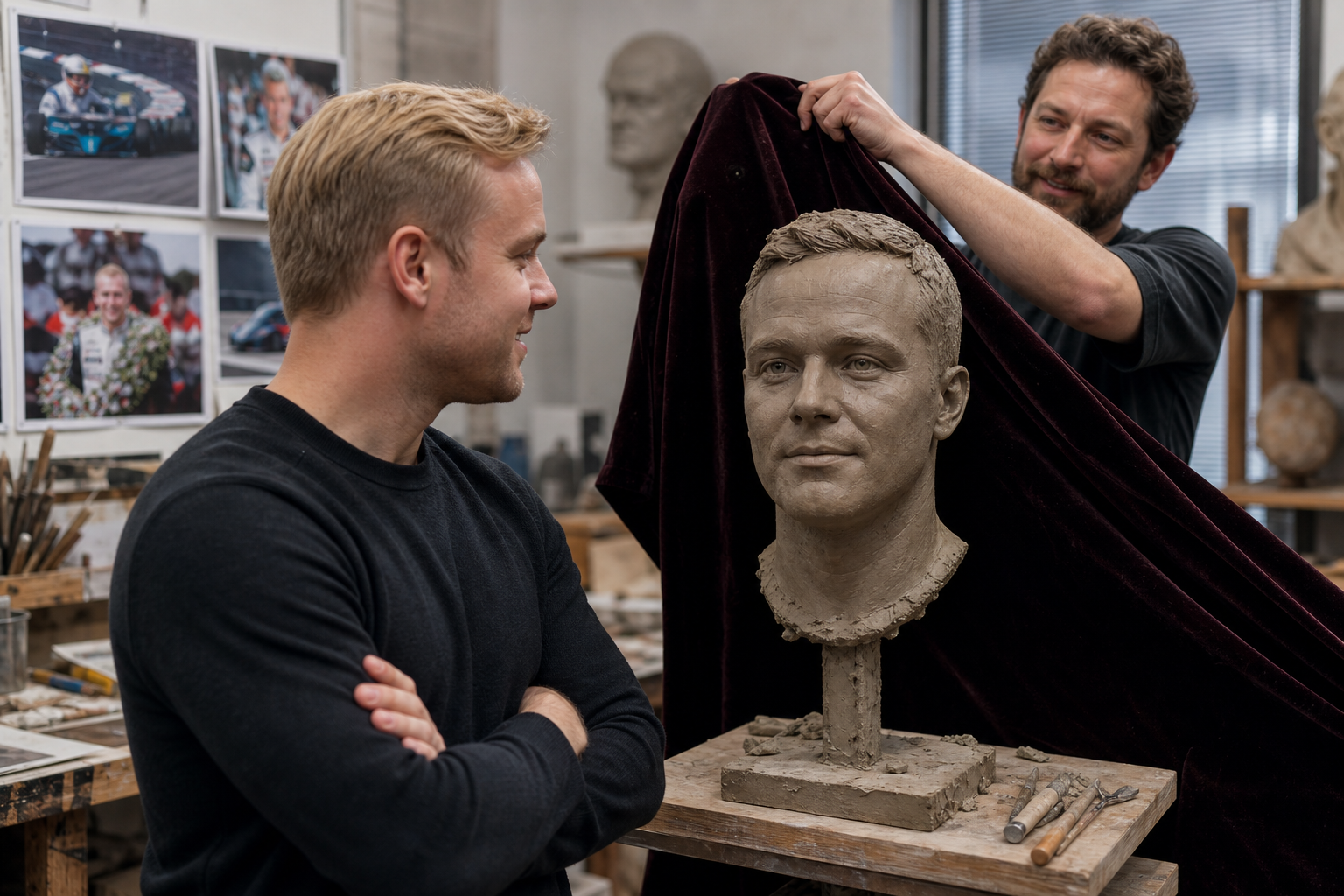

Felix Rosenqvist already had the result sheet, the photographs, the headlines and the sort of trophy-room memory that makes ordinary conversation about weekend plans seem rather underwhelming. Now his victory in the Indianapolis 500 has something more permanent: a sculpted likeness of the man who won the race by 0.0233 seconds.
Inside sculptor Will Behrends’ studio, a velvet cloth was lifted from a carefully modeled clay head. Rosenqvist was suddenly looking at a physical representation of his own place in Indianapolis history. It is an unusual moment, even by the wonderfully peculiar standards of major-league motorsport. Most drivers celebrate a win with champagne. Indy 500 winners eventually get turned into sculpture.
A Victory Measured in the Blink of an Eye
Rosenqvist’s win came in the 110th running of the Indianapolis 500 on May 24, 2026. The margin over David Malukas was just 0.0233 seconds, making it the closest finish in the history of the race.
That number is almost comically small when placed against the scale of the event. The Indianapolis 500 covers 500 miles around Indianapolis Motor Speedway, with the field circulating at extraordinary speeds while drivers manage traffic, tire performance, fuel strategy and the aerodynamic turbulence created by the cars ahead. After all that distance, the difference between victory and second place came down to a gap so narrow it sounds like a timing system having a nervous breakdown.
Close finishes are not unusual at Indianapolis, but this one has a particular sting to it. A race that lasts for hundreds of miles can be shaped by decisions made long before the final lap, yet the final classification may still be separated by inches. Rosenqvist and Malukas did not merely finish near one another; they produced the smallest winning margin the event has ever recorded.
That is the sort of statistic that keeps growing in significance. A driver can win the Indy 500 and become part of its history. A driver can win by a record margin and be remembered for domination. Rosenqvist won in a way that gives the result an instantly repeatable detail: 0.0233 seconds.
When a Race Result Becomes a Portrait
The clay head gives the achievement a physical form. Rather than existing only as a line in the official results or a frozen image from the finish, Rosenqvist’s win is being translated into the traditional language of Indianapolis: the sculpted face.
That tradition matters because the Indy 500 has always been unusually interested in preserving its past. Indianapolis is not merely a venue where a race happens once a year. It is a place where previous winners remain present through trophies, photographs, bricks, plaques and stories repeated until they acquire the weight of family folklore. The event has a long-running connection with sculptural portraits, most famously through the winner’s likeness represented on the Borg-Warner Trophy.
Against that backdrop, Behrends’ work is more than a decorative keepsake. The clay model is part of the process by which a fleeting sporting achievement becomes an enduring historical record. The checkered flag falls, the cars are packed away and the temporary noise fades. The sculptor’s job is to make sure the winner still has a face when the grandstands are quiet.
There is also something pleasingly old-fashioned about the method. Modern racing is stuffed with telemetry, onboard cameras, simulation software and data streams capable of telling engineers almost everything except whether a driver has had a decent night’s sleep. Yet Rosenqvist’s achievement is being commemorated with clay, handwork and close observation. No software update required.
Why the Clay Model Matters
A clay head is not the final monument. It is a working stage in the sculpting process, allowing the artist to develop the proportions, expression and character of the subject before the finished piece is created. Seeing Rosenqvist encounter that model makes the story more intimate than a conventional trophy presentation.
The driver is not looking at an abstract symbol of victory. He is looking at a version of himself captured at the point where a racing career intersects with sporting history. That can be an oddly confronting experience. Drivers spend their lives concentrating on the next braking zone, the next restart and the next championship point. The sculpture forces the opposite perspective: stop moving and consider what the achievement will look like years from now.
Rosenqvist’s expression becomes part of that record, but the sculpture also carries the tension of the race itself. A portrait cannot show the final-lap speed, the pressure of Malukas behind him or the tiny separation between the two cars. It has to suggest all of that through a stationary face. This is a rather unfair assignment for a lump of clay, although Behrends appears to have accepted it.
The Importance of the 110th Indianapolis 500
Winning any Indianapolis 500 is a career-defining achievement. Winning the 110th running adds another layer to the occasion, placing Rosenqvist’s name into a history that stretches across generations of drivers, cars and technical eras.
The race has changed dramatically over time. Cars are faster, safety standards are stronger and teams use levels of engineering analysis that previous generations could scarcely have imagined. Yet the essential test remains recognizable: 500 miles, four left-hand turns, relentless traffic and the need to remain composed when the race begins behaving like a badly supervised argument.
That continuity is why the event’s commemorative traditions carry such force. A modern Indy 500 winner is not being filed away as merely another successful driver from a particular season. The winner joins a permanent list that readers and fans will continue to revisit when discussing the race’s greatest finishes and most memorable characters.
A Record That Will Follow Rosenqvist
The closest finish in Indy 500 history is the kind of fact that will accompany Rosenqvist for the rest of his career. It will appear whenever his Indianapolis victory is mentioned, just as famous races are routinely identified by their decisive passes, dramatic crashes or extraordinary margins.
That does not diminish the broader achievement. A record margin would not make the win more legitimate, and a more comfortable victory would still have placed Rosenqvist’s name on the list of Indianapolis champions. But the razor-thin result gives the victory a distinctive shape. It supplies a permanent answer whenever somebody asks what made that particular race memorable.
Malukas is part of that story too. A finish cannot be separated from the competitor who made it close, and a 0.0233-second margin says as much about the runner-up’s challenge as it does about the winner’s success. The two drivers created the record together, even though only one received the winner’s celebration.
That is the slightly cruel beauty of racing. Thousands of decisions, miles of preparation and hours of physical effort can eventually be reduced to a number smaller than the time it takes to blink. Then an artist comes along and tries to preserve the people behind it.
When Rosenqvist saw the clay likeness beneath Behrends’ velvet cloth, his Indianapolis victory had crossed another boundary. It was no longer only a race he had won. It had become an object, a face and a permanent piece of the Indy 500’s visual history.


0 Comments