
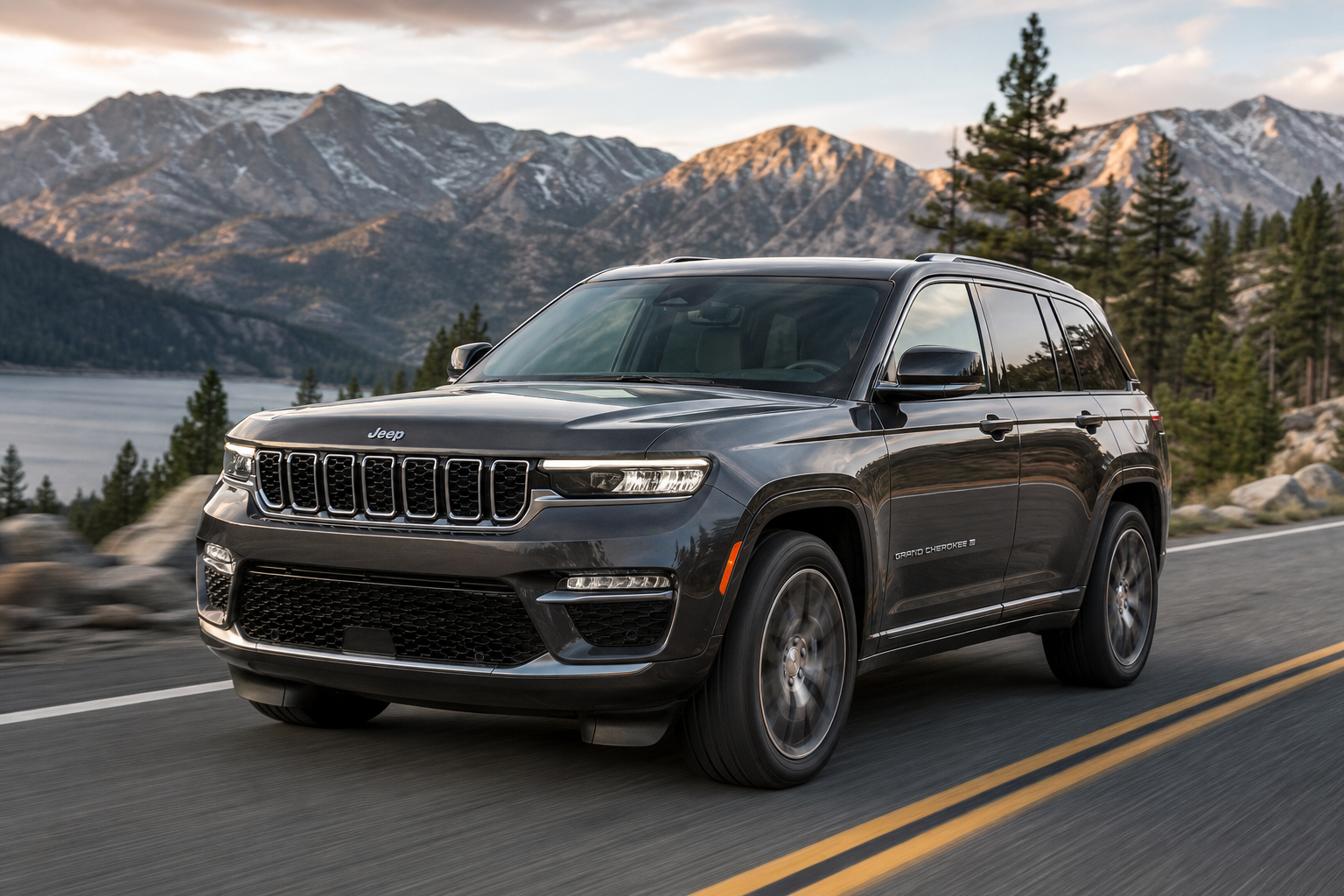

The Jeep Grand Cherokee may finally receive the engine many expected it to get in the first place: Stellantis’ 3.0-liter twin-turbocharged Hurricane inline-six. According to a new report, the 2028 Grand Cherokee could offer the engine with approximately 420 horsepower, giving Jeep’s large SUV a considerably more serious powertrain than the V6 engines it has traditionally relied upon.
There is an important word in that first paragraph: could. Jeep has not officially confirmed the engine, its output, or even the 2028 model-year application. For now, this is a reported plan rather than a product announcement. Still, the idea makes considerable mechanical and business sense, particularly after Stellantis spent years developing the Hurricane family for its trucks and full-size SUVs.
A More Appropriate Engine for Jeep’s Bigger SUV
The current-generation Grand Cherokee is a thoroughly capable SUV, but its conventional gasoline engine lineup has never been especially glamorous. The familiar 3.6-liter Pentastar V6 produces roughly 293 horsepower in its standard form, which is adequate rather than thrilling. It moves the Grand Cherokee competently, but “adequate” is not exactly the word that makes a buyer’s pulse quicken in the showroom.
A 420-horsepower Hurricane inline-six would change that. It would give the Grand Cherokee an extra 127 horsepower over the V6, assuming the reported figure is accurate. That is a meaningful increase, not the sort of brochure arithmetic that requires a magnifying glass and a generous interpretation of the word “sporty.”
The engine would also provide a more natural bridge between the regular Grand Cherokee and larger, more expensive Jeep products such as the Wagoneer. Stellantis already uses versions of the Hurricane engine in vehicles including the Jeep Wagoneer and Ram 1500. In those applications, the engine is available in different tunes, including a standard-output version producing about 420 horsepower and a high-output version rated at approximately 510 horsepower.
The reported Grand Cherokee application appears to point toward the lower-output calibration. That would be the sensible choice. A 420-horsepower version would be plenty for a midsize-to-large SUV, while the 510-horsepower tune could create uncomfortable overlap with more expensive Wagoneer models. Product planners do enjoy a little internal competition, but they generally prefer it when the cheaper vehicle is not quietly humiliating the expensive one.
Why the Hurricane Inline-Six Fits
The Hurricane is a particularly useful engine for Stellantis because it offers substantially more power than the company’s older V6 and V8 options without requiring a full return to large-displacement engines. It uses two turbochargers and a 3.0-liter displacement, combining relatively compact packaging with strong torque output.
That matters in a Grand Cherokee. This is not a lightweight sports utility vehicle. Depending on configuration, equipment, drivetrain, and electrification hardware, the SUV can carry a considerable amount of mass. A turbocharged inline-six can provide the low-end torque needed to move that weight cleanly, while its extra breathing capacity should make highway passing and towing less laborious than they are with a naturally aspirated V6.
The inline-six layout also has a natural smoothness advantage. With six cylinders arranged in a straight line, primary and secondary engine balance is inherently favorable. That does not guarantee a perfect driving experience—turbo response, transmission calibration, cooling, and noise insulation still matter—but the basic architecture is well suited to a premium SUV that needs to feel refined rather than merely fast.
Jeep has not disclosed the reported Grand Cherokee engine’s torque figure. That number will be just as important as horsepower. A 420-horsepower SUV with a broad, useful torque curve would feel dramatically different from a V6 Grand Cherokee, particularly when loaded with passengers or pulling a trailer.
The Grand Cherokee’s Powertrain Gap
The Hurricane would also address an awkward gap in the Grand Cherokee range. The current model has occupied a middle ground between mainstream family SUVs and larger luxury-oriented vehicles, but its standard gasoline powertrains have not always reflected its size or price. The V6 is familiar and proven, yet it lacks the effortless shove buyers increasingly expect from a well-equipped SUV costing serious money.
The Grand Cherokee 4xe plug-in hybrid already offers a more powerful and technically elaborate alternative, using a turbocharged 2.0-liter four-cylinder with electric assistance for a combined output of 375 horsepower. That powertrain brings the advantages of electric torque and the potential for short electric-only trips, but it also adds weight, complexity, and charging requirements.
A Hurricane-powered Grand Cherokee would be a simpler proposition for buyers who want strong performance without committing to a plug-in hybrid system. It would not offer the 4xe’s electric driving capability or potential fuel savings on short journeys, but it could deliver a more consistent experience on long highway trips, in cold weather, or when towing—provided the final calibration and fuel economy figures justify the arrangement.
That last point is crucial. Turbocharged six-cylinder engines can be impressively efficient when driven gently, but a heavy SUV with 420 horsepower will happily consume gasoline when its driver takes advantage of the available performance. Physics remains stubbornly old-fashioned in this regard.
What It Could Mean for Towing and Highway Driving
Jeep has not announced towing figures for the reported engine, so there is no responsible way to attach a specific rating to it yet. However, the Hurricane’s torque-rich character should make it well suited to towing applications if Jeep pairs it with the appropriate cooling, transmission, axle gearing, and trailer-control systems.
That hardware matters. More power alone does not make an SUV a better tow vehicle. Cooling capacity, transmission durability, brake performance, suspension tuning, wheelbase, and stability under load all determine whether an engine’s output is useful in the real world. A Grand Cherokee equipped with the Hurricane would need to be engineered as a complete package rather than treated to a simple engine swap and a larger number on the tailgate.
On the highway, the benefits would be easier to appreciate. The extra power should reduce the need for aggressive downshifts when merging or passing, while the inline-six’s torque could make the vehicle feel less strained when climbing grades. That is precisely where a larger turbocharged engine earns its keep: not necessarily in dramatic launches, but in the relaxed, quietly forceful way it handles ordinary work.
Packaging Will Be the Interesting Part
Installing the Hurricane in the Grand Cherokee should be more straightforward than placing it in an entirely unrelated vehicle, since Stellantis already has experience pairing the engine with rear-drive-based platforms and eight-speed automatic transmissions. Even so, the Grand Cherokee’s engine bay, front suspension, cooling system, exhaust routing, and crash structure would all need to accommodate the change.
An inline-six is longer than a V6, which can make front-end packaging more demanding. Engineers may need to revise cooling airflow, accessory placement, exhaust routing, and front-axle arrangements on four-wheel-drive models. None of these challenges is insurmountable, but they are the sort of details that determine whether a powerful engine feels factory-integrated or like an expensive guest who has brought too much luggage.
Weight distribution will also deserve attention. A larger engine can alter the Grand Cherokee’s front-axle load, affecting steering response, ride quality, and suspension tuning. Jeep’s engineers have plenty of experience making heavy SUVs behave properly, but adding power is only half the job. The vehicle still needs to stop, turn, and absorb rough pavement without becoming a rolling demonstration of Newton’s less marketable laws.
A Logical Move, If Jeep Gets the Positioning Right
The reported 2028 timing suggests the Hurricane Grand Cherokee would arrive as part of a broader product update rather than as a minor engine option quietly added to an existing lineup. That gives Jeep time to determine where the engine belongs, how it should be priced, and whether it should be offered across several trims or reserved for higher-specification versions.
Pricing will be important. A 420-horsepower engine would likely command a premium over the V6, but the Grand Cherokee cannot drift so close to Wagoneer money that buyers begin wondering why they have not simply purchased the larger vehicle. It also needs to make sense beside the 4xe, which delivers a different sort of performance and efficiency proposition.
For Jeep, the Hurricane would provide a powerful answer to a straightforward criticism: the Grand Cherokee looks and costs like a serious SUV, so why does its standard gasoline engine sometimes feel like it is doing community service? If the reported plan becomes reality, the inline-six could give the model the effortless performance its size and status suggest.
Until Jeep confirms the program, the details remain provisional. There is no official horsepower figure, pricing, towing rating, trim strategy, or launch schedule beyond the reported 2028 model year. But the basic idea is convincing. A 420-horsepower Hurricane-powered Grand Cherokee would not need theatrical styling or a silly badge to make its point. A quiet start, a long stretch of highway, and one determined press of the accelerator would probably do the job rather nicely.
0 Comments