
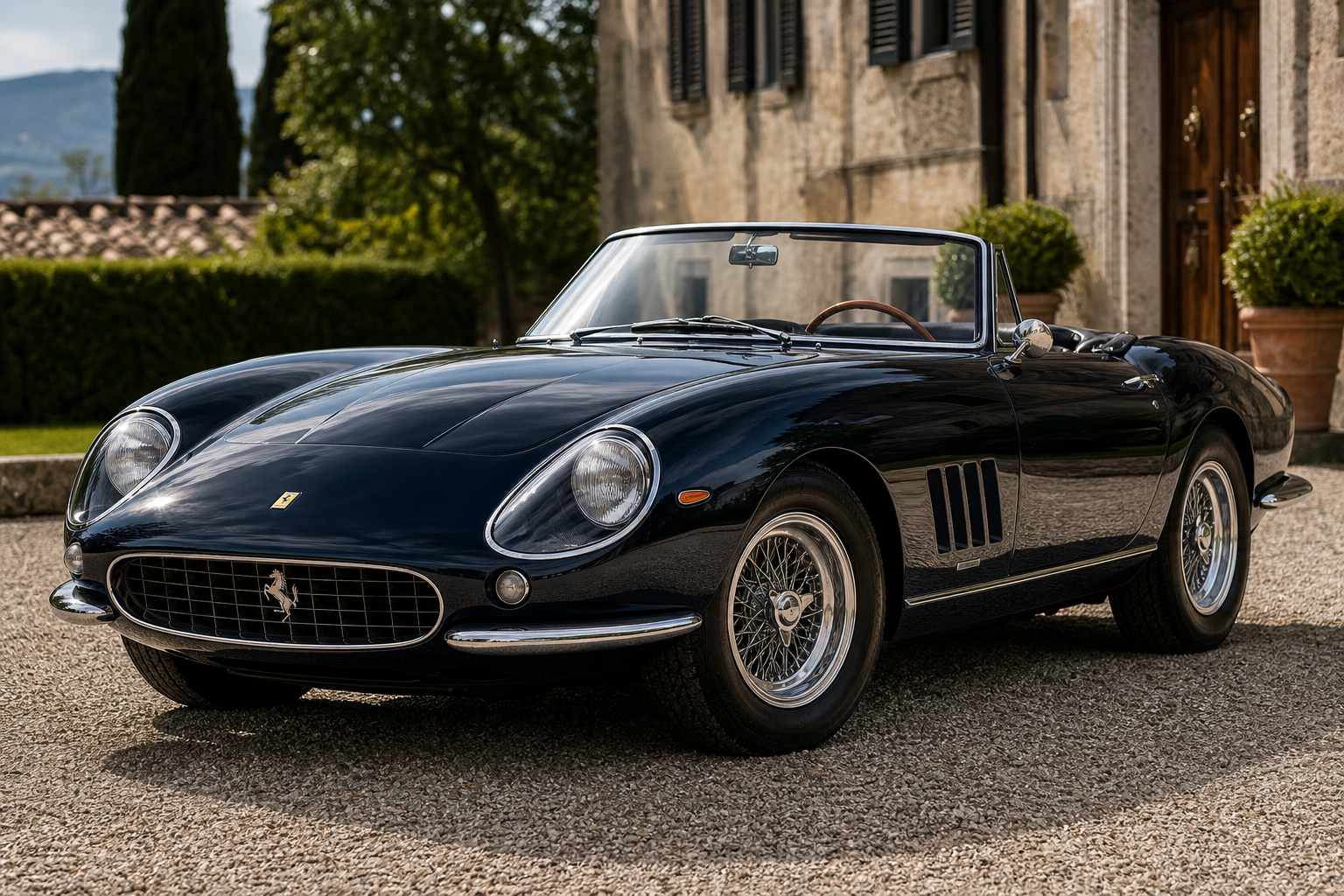

Some classic Ferraris are valuable because they are rare. Others are valuable because they are beautiful. Steve McQueen’s 1967 Ferrari 275 GTB/4*S NART Spider manages the rather inconvenient trick of being both—and it carries one of the most recognizable names in Hollywood attached to its history.
The open-top Ferrari is headed to Gooding Christie’s inaugural Rétromobile New York auction this November, where it is expected to command around $20 million. That is an extraordinary amount of money for any automobile, even one wearing a prancing horse badge. It is also exactly the sort of figure that makes the classic Ferrari market briefly forget that houses, yachts, and perfectly sensible retirement plans exist.
A Ferrari Built in Tiny Numbers
The 275 GTB/4*S NART Spider was never intended to be a common sight. Ferrari built just 10 examples, making it one of the rarest road-going Ferraris of the 1960s. The “NART” name came from the North American Racing Team, the competition organization founded by Ferrari importer Luigi Chinetti. Chinetti helped establish Ferrari’s reputation in the United States and pushed the company toward creating a roadster that could appeal to wealthy American buyers.
The car was based on Ferrari’s 275 GTB/4, one of Maranello’s great front-engine sports cars. The “4” referred to its four overhead camshafts, while the “S” indicated the Spider body style. The result was a machine with the mechanical seriousness of a competition-bred grand tourer and the visual drama of a proper Italian convertible.
Its body was shaped by Pininfarina and built by Scaglietti, the coachbuilder responsible for many of Ferrari’s most desirable road cars. The long hood, short rear deck, delicate windshield, and impossibly clean flanks give the NART Spider an elegance that modern designers would struggle to reproduce without adding three vents, an aerodynamic explanation, and a screen somewhere in the dashboard.
The Engineering Underneath the Sculpture
Despite its jewelry-like appearance, the 275 GTB/4*S was not merely a boulevard ornament. It used Ferrari’s 3.3-liter V12, fitted with four overhead camshafts and six Weber carburetors. Output was approximately 300 horsepower, delivered through a five-speed manual transmission.
That combination made the car seriously quick for its era. Period performance figures put its top speed in the neighborhood of 160 mph, depending on the source and test conditions. Independent suspension, four-wheel disc brakes, and a transaxle layout helped give the 275 GTB/4 a level of sophistication that separated it from many contemporary sports cars.
The transaxle was particularly clever. Ferrari placed the transmission at the rear to improve weight distribution, allowing the long-nose Ferrari to behave with more composure than its proportions might suggest. This was still a front-engine car in the grand touring tradition, but it was not a lazy one. The engine sat ahead of the cabin, the gearbox sat behind it, and the driver sat in the middle of a mechanical argument conducted almost entirely in polished metal and combustion noise.
There was no turbocharger, no launch-control program, and no electronic mode selector offering “Sport,” “Race,” and “Please Stop Pressing Buttons.” The driver had a throttle, a clutch, a steering wheel, and a large amount of responsibility.
Why Steve McQueen’s Ownership Changes the Equation
The NART Spider would already be a major collector car without a famous previous owner. Its limited production, Ferrari engineering, Scaglietti coachwork, and open-air configuration would be enough to place it among the most sought-after 1960s sports cars.
McQueen’s connection adds a different kind of electricity. He was not simply a movie star who happened to own an expensive Ferrari. His public image was tightly bound to cars, motorcycles, racing, and the particular sort of cool that cannot be ordered from a marketing department. Films such as Le Mans cemented his relationship with motorsport, while his personal collection reflected a genuine interest in machinery rather than a celebrity’s habit of accumulating fashionable objects.
That distinction matters in the collector-car world. Provenance is not just a footnote in an auction catalog; it can alter the identity of a car. A mechanically identical Ferrari with an ordinary ownership history might be an exceptional automobile. McQueen’s Ferrari becomes a cultural artifact as well as a piece of engineering.
There is a danger, naturally, in allowing celebrity to overwhelm the car itself. The NART Spider does not need a Hollywood association to justify its place in Ferrari history. McQueen’s ownership is the extra layer, not the foundation. The foundation is a ten-car run of open 275s powered by one of Ferrari’s great V12s and clothed by two of Italy’s most respected design and coachbuilding houses.
The NART Spider’s Place in Ferrari History
The 275 GTB/4*S NART Spider arrived during a particularly rich period for Ferrari road cars. Ferrari was still building relatively small numbers of highly specialized automobiles, before production volumes and product families expanded into the broader luxury performance business the company operates today.
It also occupied an interesting space between road car and racing machine. The NART name suggested competition, but these Spiders were built for road use. They delivered the theater of a race-bred Ferrari without requiring their owners to spend every Sunday arguing with a pit crew beside a truck.
The model’s rarity is partly the result of its limited original demand. Ferrari and Chinetti had hoped to sell more examples, but only 10 were completed. That modest production run now looks less like a commercial disappointment and more like a recipe for astronomical valuations. Classic-car markets have a long memory, particularly when the cars in question are beautiful, historically important, and almost impossible to replace.
That last point is crucial. A collector can find another modern supercar with more power, greater grip, and a faster lap time. There is no practical shortage of machines capable of humiliating a 1967 Ferrari in a straight line. But nobody can commission an eleventh original NART Spider. The supply is fixed, and the surviving cars carry their own individual histories.
What a $20 Million Estimate Actually Represents
A $20 million auction expectation places McQueen’s Ferrari firmly in the upper tier of collectible automobiles. It is not a price based on utility, performance-per-dollar, or even conventional luxury-car logic. It reflects scarcity, design, engineering, provenance, and the status of the Ferrari 275 GTB/4*S within the collector market.
The estimate also assumes that more than one serious buyer will decide this particular Ferrari is the one they must have. That is how auctions reach spectacular numbers. A fixed-price listing can establish what a seller wants; an auction discovers how far two determined bidders are willing to go when the car is on the block and disappearing from reach in real time.
For most people, the practical implications are pleasantly theoretical. A $20 million Ferrari is not a used-car recommendation, and nobody should be checking tire replacement costs before placing a bid. Yet the car remains relevant to enthusiasts because it demonstrates what collectors are prepared to preserve—and why certain cars continue to matter decades after their production ends.
It also shows how the value of a great automobile can extend well beyond its specification sheet. A modern performance car may produce substantially more than 300 horsepower and cover ground at an entirely different pace. But the NART Spider offers something modern machinery has largely engineered out: a sense that every component exists in plain view, that the car’s shape follows its mechanical purpose, and that the person at the wheel is expected to participate.
A Star Car That Does Not Need the Gimmick
Celebrity-owned cars can sometimes feel like ordinary vehicles wearing a famous name tag. This Ferrari is different. Even without Steve McQueen in the story, the 275 GTB/4*S NART Spider would be one of the most desirable open Ferraris of its generation.
McQueen’s ownership gives it an unforgettable narrative, but the car earns attention on its own terms: a 3.3-liter four-cam V12, a five-speed manual transmission, Scaglietti construction, Pininfarina design, and a production total of only 10 examples. That is a formidable list before the auction catalog reaches the provenance section.
When it crosses the block at Gooding Christie’s Rétromobile New York sale this November, bidders will not merely be competing for a rare Ferrari. They will be bidding for one of the few cars that sits comfortably at the intersection of motorsport culture, Hollywood history, Italian design, and old-fashioned mechanical theater. The $20 million question is whether the market believes those ingredients are worth the price of admission.


0 Comments