
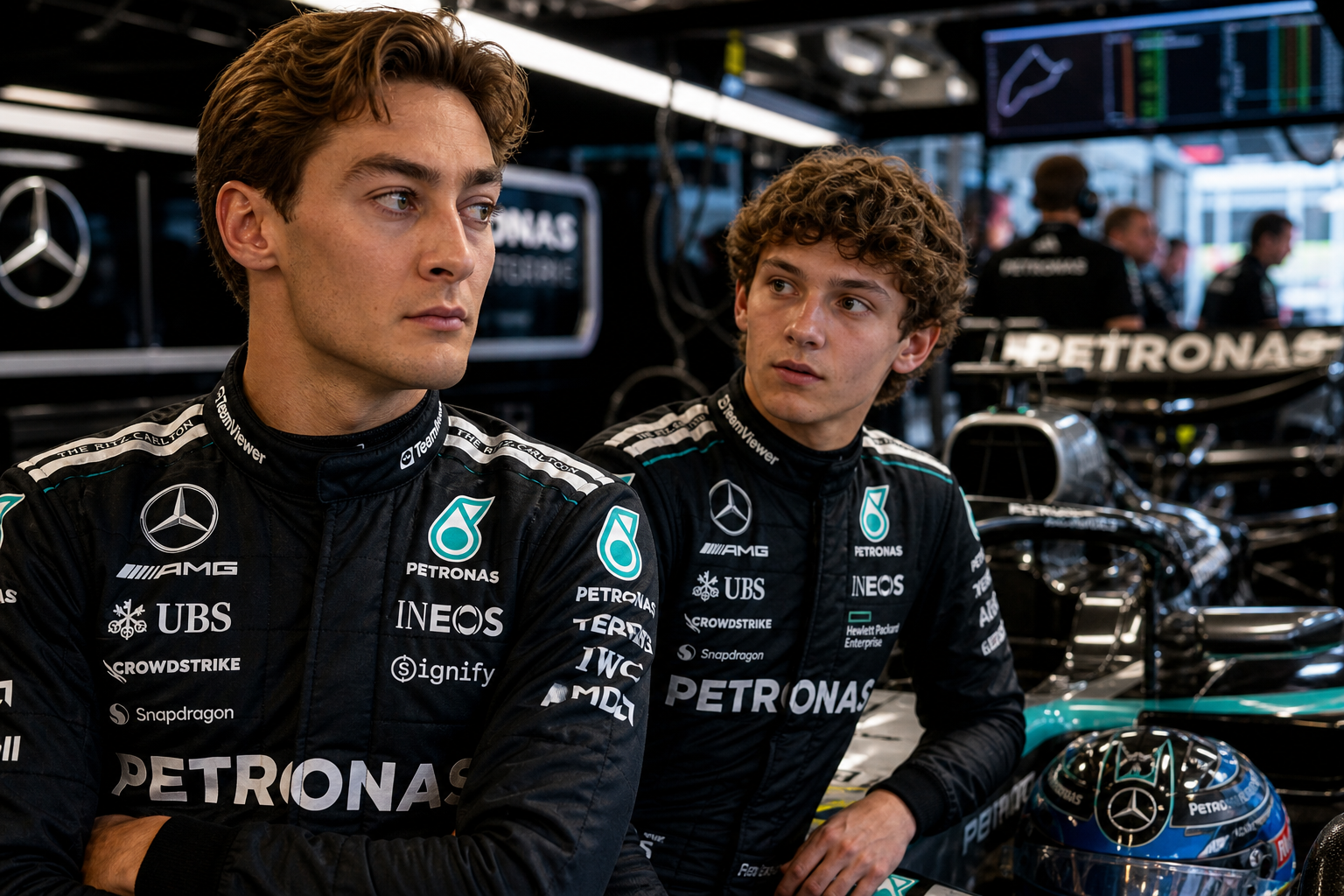

George Russell arrived in 2026 with the sort of momentum that makes a Formula 1 driver look like a title favorite rather than merely a very good employee of a very large German corporation. He won the Australian Grand Prix, added victory in the Chinese sprint race, and appeared to have Mercedes’ campaign moving in the right direction.
Then his teenage teammate began making life considerably less comfortable.
Former Formula 1 driver David Coulthard believes Russell is being forced to “rewire his brain” as he tries to respond to Kimi Antonelli’s pace. That is a striking way of describing the problem, but it gets to the heart of what makes a teammate so difficult to beat: the data is in the next garage, the machinery is broadly shared, and excuses have nowhere sensible to park.
The Problem With Having a Fast Teammate
Formula 1 drivers are rarely judged against the entire field in the first instance. Their most immediate opponent is the person using the other car in the same garage.
That comparison is unusually revealing. Teammates have access to the same broad technical package, the same engineers, the same simulator work, and the same opportunity to understand how the car behaves. There can be differences in setup, strategy, tire management, traffic, and reliability, of course. But over a run of races, a rapid teammate has a habit of exposing weaknesses that a driver can disguise against the rest of the field.
Russell’s situation is especially interesting because he was not entering the season as an unproven driver. He had already established himself at Mercedes, earned victories, and built a reputation for strong qualifying performances and measured racecraft. He was also considered one of the leading candidates for the 2026 championship before the season began.
That status changes the nature of a difficult weekend. A driver trying to prove he belongs in Formula 1 can treat a setback as part of the education. A driver expected to fight for a championship has to explain why the other side of the garage is extracting more from the same opportunity.
Why Coulthard’s “Rewire” Comment Matters
Coulthard’s choice of words suggests that this is not merely a matter of Russell needing to find a few hundredths of a second in one corner. “Rewire his brain” points toward adaptation: changing how he approaches the car, how he prepares for a session, or how he responds when the balance moves away from his preferred window.
That process can be uncomfortable for an established driver. Success tends to reinforce habits. If a particular braking technique, tire preparation routine, or approach to qualifying has delivered results for years, abandoning it requires more than a note from an engineer on a laptop. It requires accepting that the old answer may no longer be the best one.
Modern Formula 1 cars are particularly demanding in this respect. Their performance can shift sharply with tire temperature, ride height, wind direction, fuel load, and the relationship between aerodynamic load and mechanical grip. A driver may feel comfortable in one session and suddenly lose confidence when the car moves outside a narrow operating window.
The most useful information may be sitting on the other side of the garage. A teammate who can attack the same corner with a different brake release, carry more speed into the turn, or preserve the tire more effectively becomes a living engineering report. A rather irritating one, admittedly, but a very valuable one.
Antonelli’s Arrival Changes the Mercedes Hierarchy
Kimi Antonelli’s presence gives Mercedes a different sort of internal contest from the one Russell previously faced. A young driver does not arrive carrying years of established Formula 1 habits. That can be a weakness, but it can also be an advantage. Antonelli is still developing his reference points, his technical language, and his understanding of how to manage a full Grand Prix weekend. He is also less invested in protecting methods that worked in the past.
The teenager’s challenge to Russell therefore carries weight beyond a single result. If Antonelli can produce comparable or superior speed while still learning the demands of Formula 1, Russell cannot simply wait for the situation to settle down. He has to respond directly.
That response does not necessarily mean copying Antonelli. Drivers rarely improve by becoming carbon copies of their teammates. The objective is to understand where the performance is coming from, then decide which parts of that approach can be absorbed without damaging a driver’s own strengths.
It is a delicate exercise. A driver who changes too little risks remaining stuck behind the same problem. A driver who changes too much can lose the confidence and consistency that made him successful in the first place. Somewhere between stubbornness and panic lies the useful adjustment. Finding it is the job.
Early Wins Do Not Cancel Out a Difficult Garage
Russell’s victories in Australia and the Chinese sprint race make the situation more complicated, not less. They demonstrate that he has the speed to win and that Mercedes has given him a car capable of converting strong weekends into silverware. This is not a story about a driver suddenly becoming incapable of performing.
Championship campaigns are rarely judged by isolated peaks, however. A driver can win early in the season and still face serious questions if a teammate begins producing more consistent pace, stronger qualifying performances, or better execution across the full weekend. The distinction between a win and a title challenge is often found in the less glamorous sessions: tire preparation, recovery after a poor qualifying lap, and the ability to salvage points when the car is not perfectly suited to the circuit.
That is where internal pressure becomes particularly useful. Russell may have been expected to lead Mercedes into the new season, but Antonelli’s emergence means the team now has a genuine comparison rather than a ceremonial hierarchy. The young Italian does not need to defeat Russell every weekend to alter the dynamic. He only needs to show often enough that the Mercedes has more performance available than Russell is currently extracting.
The Championship Pressure Is Now Psychological as Well as Technical
Formula 1 drivers spend enormous amounts of time examining data, but the decisive adjustment is sometimes less measurable. A driver who begins each session wondering whether the teammate has found something obvious can lose time before the car reaches the first corner. Confidence affects braking commitment, throttle application, tire preparation, and the willingness to lean on a car that is not behaving politely.
That does not mean Russell’s challenge is purely psychological. The car still has to work, the setup still has to be correct, and the engineers still have to provide a competitive package. But the mind determines how much of that package a driver can use. Coulthard’s “rewire” description captures the unpleasant reality that technical problems and mental habits often become tangled together.
Russell has already shown enough in 2026 to remain a serious contender. His wins are evidence of that. The question is whether he can turn those flashes of front-running form into a sustained response to Antonelli’s pressure.
Mercedes may have hoped for a straightforward championship campaign built around an established leader. Instead, it has acquired a much more useful—and much less comfortable—test. Russell must prove that he can adapt without losing his identity as a driver, while Antonelli gets the rare opportunity to establish himself against a teammate who was expected to be the team’s reference.
That is why this contest deserves attention. The most important battle at Mercedes may not be decided by one dramatic pass or one spectacular qualifying lap. It may come down to which driver learns faster when the car refuses to behave, and which one can keep his head when the timing screens begin making the other garage look rather clever.


0 Comments