
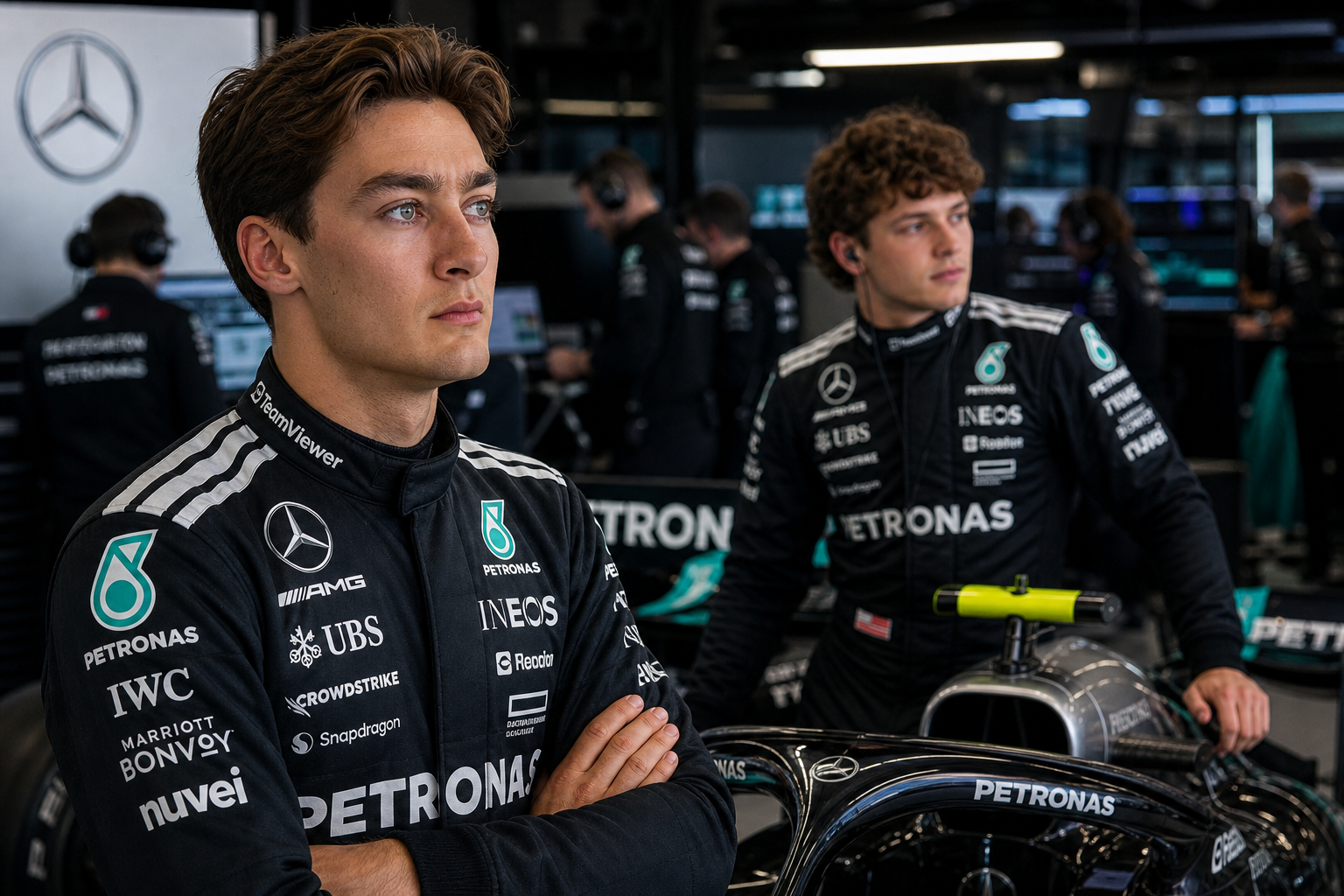

George Russell began the 2026 Formula 1 season as one of the obvious title favorites. A few difficult months later, he is no longer looking comfortably ahead of the Mercedes field. He is looking over his shoulder.
That is because Kimi Antonelli, his Mercedes teammate, has accelerated away from him during a period in which Russell has been forced to reconsider almost everything about the way he drives. The current technical rules have created a car that does not necessarily reward familiar instincts, and Russell’s grand hope is that F1’s next adjustment in 2027 will give him a more natural platform.
It is a fascinating situation. Russell is not suddenly an inexperienced driver who has forgotten how to operate a racing car. He is a highly accomplished Grand Prix driver being asked to extract performance from machinery with demands that appear to conflict with the techniques he has built his career around. Meanwhile, Antonelli is adapting faster. Motorsport is a cruel business, particularly when your teammate is the evidence board.
Russell’s Problem Is Bigger Than a Bad Weekend
The important detail here is that Russell’s difficulties have apparently forced him to question his entire driving approach. That is a much more serious issue than struggling with one circuit, one setup direction, or a single technical problem.
Every Formula 1 driver develops a working method. Some prefer a car that responds sharply to initial steering input. Others want a stable rear axle, a forgiving platform, or the freedom to carry speed deep into a corner. The best drivers can adapt, but adaptation has limits. If the car consistently asks for behavior that feels unnatural, a driver can end up spending the race managing the vehicle rather than attacking the circuit.
That appears to be the challenge Russell is facing under the latest technical formula. The car may be fast, but speed on paper does not guarantee confidence from the cockpit. A driver who cannot lean on the front end, rear stability, braking behavior, or traction characteristics in the way he expects will often become cautious in precisely the places where lap time is won.
That caution does not always look dramatic. It may be a fraction of a second released before turn-in, a slightly earlier brake application, or a reluctance to commit to a corner exit. Add those small compromises together and a previously competitive driver can appear strangely ordinary. Formula 1 is full of such optical illusions. The stopwatch sees everything.
Why 2027 Has Become Russell’s Big Hope
Russell’s theory is that the current situation may not define his long-term level. If the technical direction changes for 2027, the assumptions built into the cars could shift with it. That would give drivers another opportunity to reset their reference points, and potentially allow Russell’s preferred methods to become more effective again.
This is not an unusual belief. Drivers often perform best when the car’s balance matches their instincts, and a regulation change can scramble the established order without changing the driver lineup. The same person can look transformed when the machine responds in a more familiar way.
There is, however, a rather large catch. Hoping for a future regulation change is not the same as surviving the present one. Russell still has to score points now, develop the car now, and beat Antonelli now. A future reset may offer a fresh opportunity, but it cannot erase the championship standings already being built.
Nor can Russell assume that a new formula will automatically favor him. Engineers will have to interpret the rules correctly, Mercedes will need to produce a competitive car, and Antonelli will receive exactly the same opportunity to adapt. Regulation changes are not personalized rehabilitation programs. They are more like handing the entire paddock a new box of complicated parts and asking everyone to assemble a championship contender before lunch.
Antonelli Has Become the Uncomfortable Comparison
The presence of Antonelli makes Russell’s situation considerably more revealing. If both Mercedes drivers were struggling, the explanation would be easier: the car might simply be poor, unpredictable, or badly matched to the circuit. But Antonelli’s progress gives the team a live comparison.
That does not prove the car suits Antonelli perfectly, nor does it mean Russell’s concerns are misplaced. Teammates can extract performance in different ways. One may tolerate a nervous rear end; another may prefer a sharper front axle. One may adapt quickly to a peculiar energy-management requirement or corner-entry behavior, while another needs the car to communicate more clearly.
Still, the timing is awkward for Russell. Antonelli’s acceleration into the distance turns a technical explanation into a competitive problem. Every strong result for the younger driver makes it harder to argue that the current package is simply undriveable. It may be difficult, yes. It may reward a different set of habits. But somebody in the same garage is finding more from it.
That is why Antonelli’s reply to Russell’s theory carries weight even without turning the exchange into a manufactured feud. The Italian does not need to dismiss his teammate’s view for the contrast to matter. His performance is already a response. Formula 1 drivers communicate through lap time with remarkable efficiency, and usually without the bother of complete sentences.
Mercedes Has a Driver Management Problem as Well as a Technical One
For Mercedes, the issue is not merely deciding which driver is faster on the current evidence. The team must also determine how much of Russell’s struggle belongs to the car, how much belongs to adaptation, and how much can realistically be solved through setup work.
That distinction matters because a driver who is uncomfortable may ask for changes that improve confidence but reduce outright performance. Engineers then face a familiar compromise: build a car that makes the driver happier, or preserve a configuration that appears faster even if it is difficult to exploit consistently.
Russell’s position inside Mercedes adds another layer. He entered this period as the expected title threat, while Antonelli has emerged as the teammate applying pressure from the other side of the garage. The established order can change quickly in Formula 1, particularly when a new technical environment exposes different strengths.
The answer will not come from motivational slogans or a single dramatic setup change. Russell needs a clearer understanding of what the current car demands, and Mercedes needs to know whether those demands are an unavoidable feature of the rules or a consequence of its own design choices. If the team misunderstands that distinction, 2027 will arrive carrying the same problem in a different costume.
The Real Test Is Whether Russell Can Wait Without Standing Still
Russell may be right that a future technical adjustment will suit him better. Drivers are often able to recognize when a regulation concept is pulling them away from their strengths. But the most successful response is rarely to sit patiently and wait for the rules to become kinder.
He must still learn enough from the current car to remain competitive, challenge Antonelli, and help Mercedes understand what its next-generation machine should do differently. That may mean changing braking habits, accepting a less familiar cornering style, or abandoning techniques that have worked perfectly well until now. None of it will be comfortable.
That is the peculiar lesson of Russell’s 2026 season so far. A driver can be good enough to become a preseason title favorite and still find himself rebuilding his approach a few months later. A teammate can provide the benchmark, the pressure, and the unwanted proof that another solution exists.
Perhaps 2027 will give Russell the reset he wants. Perhaps it will merely give Antonelli another opportunity to move the goalposts. Mercedes, meanwhile, has the unenviable task of making sure its future does not depend on either possibility.
0 Comments