
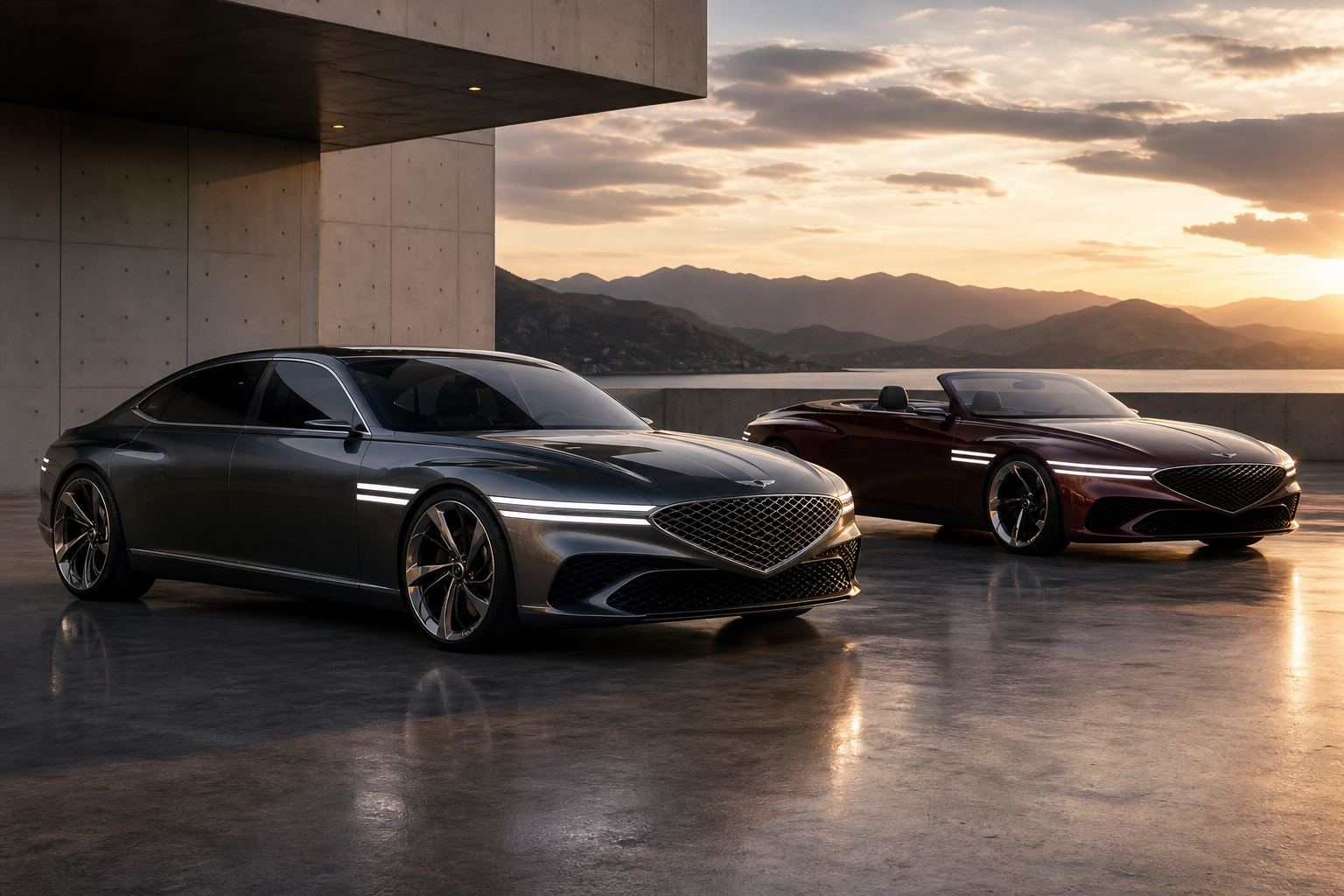

Genesis has patented the exterior designs of its X Gran Coupe and X Convertible in the United States, giving the two elegant concept cars a fresh brush with reality. That is the interesting bit. The less satisfying bit is that a design patent does not mean either car is headed for a showroom.
It means Genesis has formally protected the appearance of the vehicles. Production approval, engineering development, powertrains, pricing, and timing remain unknown. In other words, the paperwork is real, but the cars are still waiting for somebody with a spreadsheet to stop having doubts.
What the Genesis Design Patents Actually Tell Us
A U.S. design patent covers the ornamental appearance of a product rather than its mechanical operation. In this case, the filings define the visible bodywork of the Genesis X Gran Coupe and X Convertible. That can include the shape and arrangement of exterior surfaces, lighting elements, body panels, and other styling details shown in the patent drawings.
It does not confirm that Genesis has completed a production chassis, selected an engine, approved a manufacturing location, or committed to a launch date. It certainly does not guarantee that the final car will appear exactly as shown. Automakers frequently protect concept designs for legal, commercial, or strategic reasons, even when the vehicle itself never reaches production.
Still, filing design protection in the U.S. is more meaningful than simply displaying a concept on a rotating platform at an auto show. It suggests Genesis wants control over the designs in one of its most important markets. That may be defensive housekeeping, or it may indicate that the company is keeping the door open to a road-going version.
The X Family Was Always Meant to Be More Than a Styling Exercise
Genesis introduced the original X concept in 2021 as a two-door grand touring coupe. The car was deliberately different from the brand’s sedans and SUVs, using a long hood, a low cabin, and the brand’s distinctive two-line lighting signature to present Genesis as a maker of serious luxury coupes rather than merely a very polished alternative to the usual German suspects.
The follow-up arrived in 2022 with the X Speedium Coupe, a shooting-brake-like evolution of the original design. It kept the low, dramatic proportions while stretching the rear bodywork into a more practical fastback shape. Later that year, Genesis showed the X Convertible, a four-seat open-top grand tourer with a folding hardtop and a front-end treatment closely related to the X family.
The X Gran Coupe appears to occupy the space between those ideas: a formal four-door interpretation of the X design language, with the visual drama of a coupe but the additional access and rear-seat usefulness of a sedan. That distinction matters. A two-seat or small four-seat halo car can be beautiful and commercially marginal. A four-door model has at least a theoretical chance of becoming part of a broader luxury lineup.
Why the Convertible Would Be the Bigger Statement
A convertible would be the more extravagant choice, and therefore the more revealing one. Open-top luxury cars are expensive to engineer, difficult to package, and rarely sold in large numbers. They need substantial body reinforcement to replace the stiffness provided by a fixed roof, while the folding roof itself consumes space, adds weight, and creates another mechanism that must function reliably for years in weather that is not always interested in cooperating.
That makes a production Genesis X Convertible unlikely to be justified by volume alone. Its purpose would be to advertise the brand’s ambition, give dealers a halo product, and create the sort of visual presence that does not require a customer to understand every detail of the powertrain. Park one outside a hotel and people will notice. Park a sensible crossover there and people will assume a conference is happening.
The convertible would also give Genesis a direct rival to low-volume grand tourers from established luxury manufacturers. That is a bold place to stand. Genesis has made considerable progress with design and cabin presentation, but a flagship convertible would demand equally convincing refinement, structural engineering, wind management, and ride quality. A pretty roof mechanism is not enough once the check arrives.
The Gran Coupe Makes More Practical Business Sense
If Genesis were to approve only one of the two designs, the X Gran Coupe would be the easier argument to make internally. A fixed-roof four-door can share more components with existing vehicles, offers greater year-round usability, and avoids the complexity of a folding roof. It could also sit above the current sedan range as a style-led flagship without requiring customers to tolerate the compromises that accompany an exotic two-door.
That does not make the Gran Coupe a straightforward project. Its low roof and long proportions would challenge rear-seat headroom, ingress, trunk capacity, and visibility. Designers can make a concept look wonderfully sleek because concepts are not required to accommodate child seats, luggage, crash structures, production glass, or a person attempting to get out after eating too much at dinner.
Production would require careful decisions about what survives from the show-car treatment. The lighting signature could remain a central feature, but complex lamps are expensive. The body surfacing would need to be adapted for manufacturing. The wheel sizes, mirrors, door handles, glass, and safety equipment would all have to work in the real world rather than merely photograph well under theatrical lighting.
Powertrain Questions Remain Wide Open
The patents do not disclose what would power either car. Genesis has used both gasoline and electric propulsion across its lineup, and the X concepts have been discussed visually rather than through a firm production specification. There is therefore no confirmed engine, battery size, output, transmission, range figure, or performance target to report.
That uncertainty is important because the choice would shape the character of the cars. A large gasoline-powered grand tourer would fit the traditional formula: effortless torque, long-distance range, and the mechanical richness buyers expect from an expensive coupe. An electric version could deliver astonishing acceleration and a clean, quiet cabin, but it would also bring battery mass and charging considerations to a pair of cars whose appeal is built heavily around elegance and proportion.
Genesis could theoretically use different powertrains for different body styles, although that would add cost to an already low-volume program. The sensible corporate answer may be to share as much hardware as possible. The romantic answer is to give the cars a powertrain with enough character to match the styling. Automotive history is littered with sensible corporate answers, usually parked beside cars nobody remembers.
Why the Filings Matter Even Without a Production Announcement
Genesis is still establishing what its top-level identity should be. The brand has proved that it can build attractive luxury sedans and SUVs, but those categories are crowded and increasingly dependent on technology, dealer experience, and brand reputation. A dramatic coupe or convertible would show that Genesis intends to be judged on desire as well as equipment.
That distinction is crucial. A luxury brand cannot rely entirely on offering more screens, more driver-assistance features, or a longer list of standard equipment. Those things matter, but they are easy for rivals to copy and increasingly difficult for customers to distinguish. A flagship coupe has a different job. It must create an emotional reason to want the badge.
The X concepts already perform that role from a design standpoint. Protecting their exterior forms gives Genesis the option to move forward without surrendering the styling to imitators. It also keeps attention on a family of cars that might otherwise fade into the usual concept-car graveyard, somewhere between a forgotten electric scooter and an abandoned infotainment interface.
Production Is Still the Big Question
For now, the patents should be read as evidence of intent to protect the designs, not as a launch announcement. Genesis has not confirmed production approval, a reveal date, pricing, specifications, or even whether both vehicles remain active development proposals.
The X Gran Coupe is the more plausible candidate for a commercially defensible program. The X Convertible would be the grander gesture and the more difficult engineering project. Either could become a striking halo car, but neither will be easy to justify in a market that increasingly rewards SUVs and high-volume electric models.
That is precisely why the filings are worth watching. Genesis does not need another anonymous luxury vehicle with a large grille and a swollen touchscreen. It needs products that make people stop, look, and ask what the badge is. The X Gran Coupe and X Convertible were designed to do exactly that. Whether Genesis is brave enough to build them is the part the patent documents cannot answer.
0 Comments