
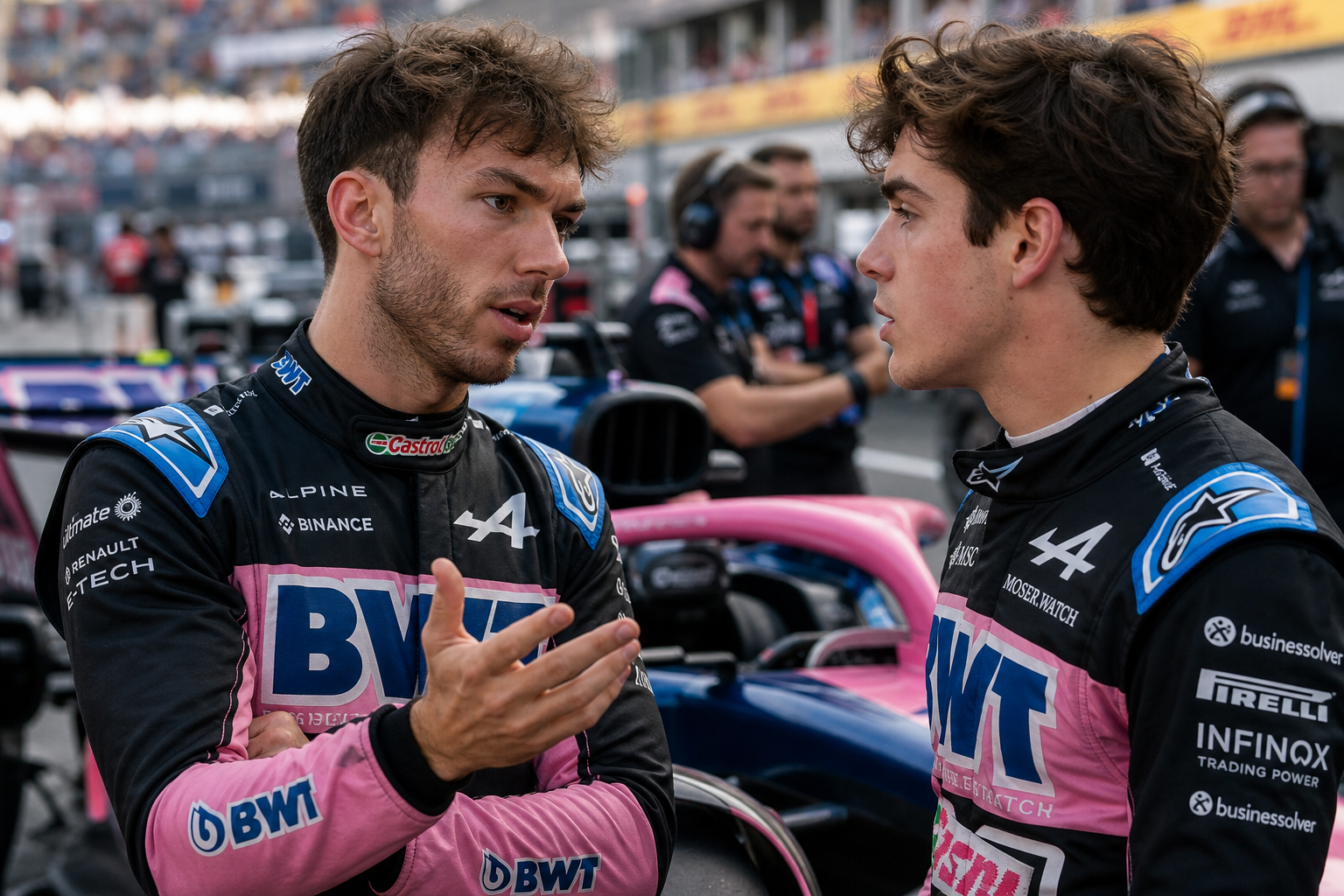

Formula 1 has always attracted strong opinions, but Pierre Gasly has drawn a firm line between passionate debate and personal abuse after his late-race clash with Alpine teammate Franco Colapinto at the Spanish Grand Prix.
Gasly said the reaction on social media was “completely inappropriate” after the incident at the Madring circuit, revealing that the abuse extended beyond him and was directed toward his family. It is a grim reminder that a tense moment between two drivers can become something altogether uglier once it passes through the internet’s least well-adjusted machinery.
A Late-Race Situation Turned Into a Bigger Story
The incident came at the end of the Spanish Grand Prix, when Colapinto caught Gasly on track. Gasly was running on older tires and still had to make a pit stop, leaving the Alpine pair in very different strategic situations despite sharing the same garage.
That distinction matters. A driver on worn tires, with a pit stop still to complete, cannot approach a closing teammate in the same way as a car running a settled strategy to the checkered flag. Colapinto had an opportunity to gain ground, while Gasly had to manage the immediate situation with the wider race plan still hanging over him.
To spectators watching a timing screen, the scene can look wonderfully simple: one driver catches another, therefore the driver ahead should move aside. Racing rarely bothers with such tidy logic. Tire condition, pit windows, team instructions, fuel management and the risk of damaging two cars in the final stages all complicate the picture. Formula 1 is full of moments that look obvious until someone has to make the decision at 190 mph.
Gasly remained focused on his own race rather than treating the encounter as a straightforward request to exchange positions. That appears to have frustrated some fans, who then took their objections far beyond criticism of a driving decision.
Gasly Draws the Line at Personal Abuse
Drivers are accustomed to criticism. They are public figures competing in a sport that broadcasts every mistake, tactical disagreement and radio message to millions of people. A driver can be accused of poor judgment before reaching the end of the pit lane, and the argument will usually be replayed from several camera angles before the next corner.
None of that makes threats or abuse acceptable.
Gasly’s comments are particularly pointed because the dispute involved a teammate rather than a rival from another team. Internal battles are normal in Formula 1, and they are often essential to a driver’s reputation. Colapinto wants to establish himself within Alpine. Gasly wants to remain the team’s reference point. Both men are expected to race hard, protect their own opportunities and follow the team’s instructions. That tension is part of the job.
It is not an invitation for supporters to turn a sporting disagreement into a personal campaign.
Social media has made the relationship between drivers and fans more direct, but it has also removed much of the distance that once existed between a public figure and an angry spectator. A driver can finish a race, sit down to review data with engineers and find that a stranger has sent abuse to members of his family before the debrief is over. The speed is impressive. The judgment, less so.
The Difficult Politics of Teammate Racing
Team-mate incidents carry an extra charge because both drivers use the same equipment, answer to the same management and depend on the same strategic decisions. There is no clean separation between “our race” and “their race.” A move that benefits one Alpine can affect the other, and a decision made in a few seconds may later become a subject for engineers, team principals and stewards.
The team also has to protect the larger result. If one driver is on worn tires and another is arriving quickly, Alpine must assess whether a position change is fair, safe and strategically useful. A request to swap places is not automatically correct simply because the following car is faster at that particular moment. Nor is refusing such a request automatically evidence of selfishness.
Those judgments become even more difficult late in a race, when drivers have limited time to understand what the team wants and limited room to recover from contact. The sensible solution is usually established before the cars reach the track: clear rules, clear radio communication and a shared understanding of how teammates should race one another.
When that process is not visible to the public, fans fill the gaps themselves. Some will assume a driver was denied a deserved opportunity. Others will conclude that the pursuing driver was being impatient. Both sides can build a complete legal case from a few seconds of television footage, which is one of the internet’s more peculiar talents.
Why the Reaction Matters for Alpine
Alpine’s driver pairing gives the team plenty to manage. Gasly brings experience and an established presence within the organization, while Colapinto is still fighting to make his case in Formula 1. Every on-track exchange therefore carries a little more significance than a routine battle between two drivers who have already settled their place in the team.
That does not mean the Spanish Grand Prix incident should be inflated into a major internal crisis. The available details describe a late-race disagreement shaped by tire condition and pit strategy, not proof of a breakdown between the drivers. But it does show how quickly a normal competitive situation can become a public argument when supporters treat every position change as a verdict on a driver’s worth.
For Alpine, the practical response is less dramatic than the online reaction. The team needs its drivers to understand when they are free to race, when a strategic compromise is required and how disagreements will be handled. It also needs both men to be able to compete without feeling that every decision will trigger a wave of personal hostility.
Criticism Is Part of Racing. Threats Are Not.
Gasly is not asking fans to stop analyzing the race. Drivers cannot reasonably demand immunity from criticism after a questionable move, a poor strategy call or a failure to maximize an opportunity. That scrutiny is part of professional racing, and much of it is informed, useful and entirely fair.
The boundary is crossed when criticism becomes abuse, particularly when family members are dragged into a dispute in which they played no role. At that point, the discussion is no longer about tire strategy, teammate conduct or the sporting interpretation of a late-race battle. It is simply harassment wearing a racing helmet.
The Spanish Grand Prix incident will eventually disappear beneath the next round of team orders and stewarding debates. Gasly’s broader point deserves to last longer. Formula 1 drivers are paid to make difficult decisions under pressure, sometimes with incomplete information and only a few seconds to act. Fans are perfectly entitled to disagree with those decisions. They are not entitled to punish drivers and their families for making them.


0 Comments