
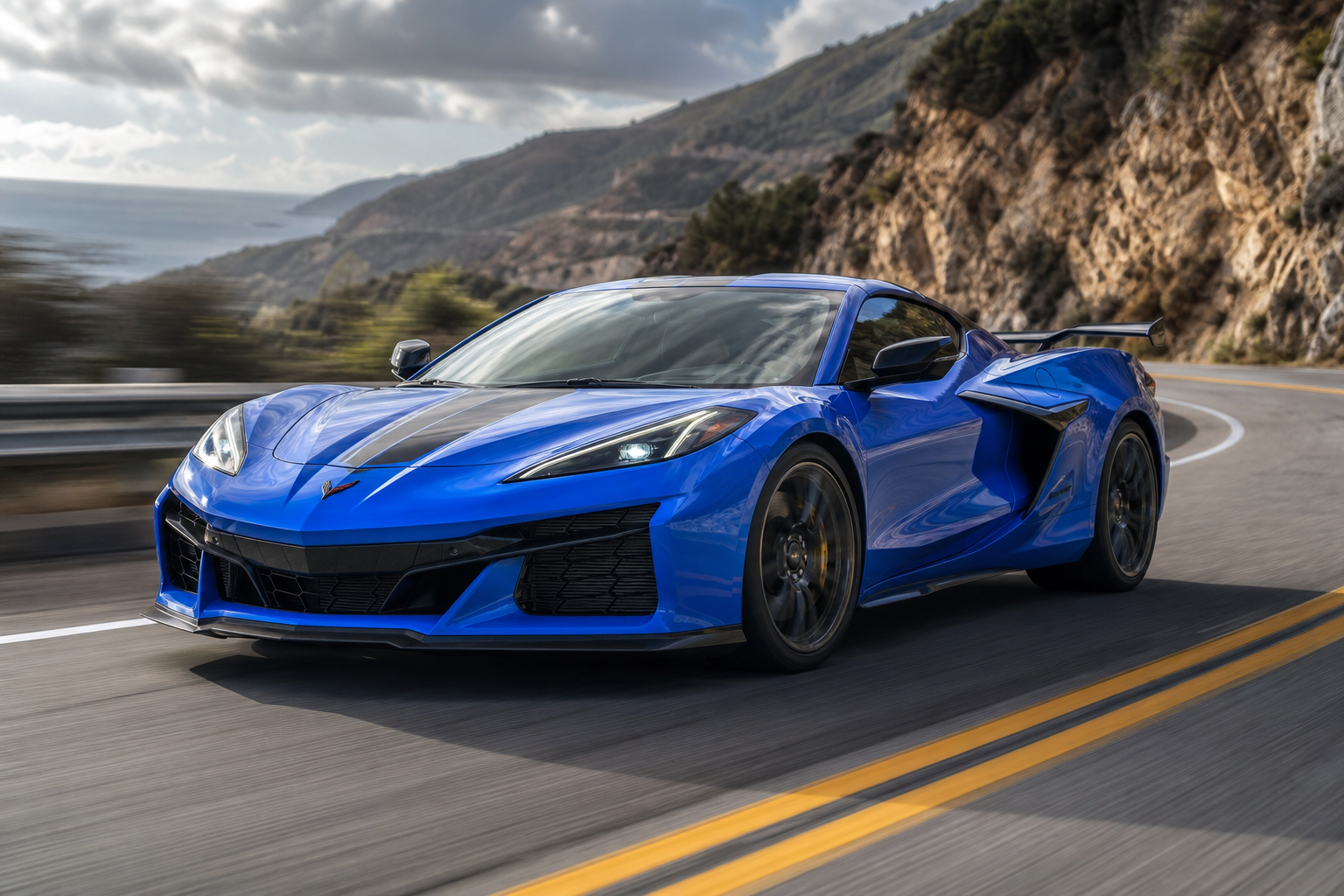

The Chevrolet Corvette Grand Sport has always occupied the useful bit of the performance-car spectrum: serious enough to make lesser sports cars nervous, but not so extreme that every trip becomes an expedition into unnecessary punishment. For 2027, that Goldilocks formula gets a considerably larger ingredient in the form of a new 6.7-liter V-8 mounted behind the occupants.
That single mechanical detail changes the character of the car before anyone has even started arguing about lap times. The current-generation Corvette’s mid-engine layout already gave Chevrolet a fundamentally different platform from the front-engine cars that came before it. Now the Grand Sport is being paired with more displacement, creating a version that sounds less like a lightly adjusted trim level and more like a deliberate answer to drivers who want the Corvette’s balance without stepping all the way into the most ferocious machinery in the range.
Why the Grand Sport Matters
Calling the Grand Sport the “middleweight” Corvette is not an insult. It is the entire point.
Performance-car lineups have a habit of becoming absurdly hierarchical. A base model is deemed insufficient, the next trim is marketed as the sensible choice, and then increasingly dramatic versions arrive wearing ever more aggressive bodywork and increasingly intimidating price tags. Before long, the supposedly usable sports car has become a rolling test of one’s tolerance for stiff suspension, loud exhausts, expensive tires, and the general inconvenience of being very fast.
The Grand Sport traditionally makes a more appealing argument. It offers extra attitude and capability without demanding that the owner live as though every road were a qualifying lap. Chevrolet’s description of it as a favorite “Goldilocks” trim is therefore rather apt. It is intended to sit between ordinary Corvette usability and the full-volume madness of the range’s sharpest performance variants.
That middle ground is difficult to get right. Too mild, and the car becomes an appearance package with a large marketing budget. Too extreme, and it loses the breadth that made the trim attractive in the first place. The new 6.7-liter engine suggests Chevrolet is trying to give the Grand Sport genuine mechanical authority rather than merely bolting on a few visual flourishes and calling it a day.
A Bigger V-8 in the Middle
The important number here is 6.7 liters. Chevrolet has not merely polished the existing formula; it has increased the engine’s displacement and retained the mid-engine arrangement that defines the modern Corvette.
Mounting the V-8 behind the passenger compartment places the car’s mass closer to its center, which can help the chassis respond more quickly to steering inputs and make the car feel more balanced when the driver leans on it. That layout also gives the Corvette a very different personality from earlier generations, whose front-mounted engines created a more traditional long-nose sports-car character.
There is an obvious emotional benefit, too. A large-displacement American V-8 in a mid-engine sports car is a wonderfully strange combination of old-school muscle and modern chassis engineering. It is a bit like putting a heavyweight boxer in a tailored racing suit: the underlying force remains obvious, but the surroundings are much more disciplined.
The available information does not establish the engine’s output, transmission details, acceleration, top speed, fuel economy, or chassis hardware. Those figures will matter, particularly when the Grand Sport is judged against more specialized Corvette variants. For now, the significant point is simpler: the Grand Sport is receiving an engine large enough to give the trim a clear identity of its own.
The Mid-Range Corvette That May Be the Smart Choice
There is a reason the middle trim often becomes the enthusiast favorite. It tends to preserve the things that make a car enjoyable while avoiding the expensive extremes that look terrific on a specification sheet and become rather less charming during ordinary ownership.
That logic applies neatly to the Corvette. A buyer who wants a sports car with real presence may not need the most uncompromising suspension calibration, the most aggressive aero package, or every piece of equipment designed to shave fractions from a racetrack lap. Equally, someone who finds the standard car a little too restrained may want more engine and more visual drama without turning the vehicle into a barely civil track project.
The Grand Sport’s challenge will be to make that compromise feel intentional. A larger engine alone does not guarantee a better sports car. The calibration of the chassis, steering, brakes, cooling systems, and tires will determine whether the added displacement produces a richer driving experience or simply a more forceful one. More speed is easy. More character is the tricky bit.
Why the New Engine Changes the Conversation
A 6.7-liter V-8 also gives the Grand Sport a useful point of difference in a segment increasingly obsessed with electrification, turbocharging, and smaller engines extracting heroic outputs. None of those approaches is inherently bad, but the Corvette has always carried a particular mechanical honesty. Large displacement, a strong visual identity, and a driver-focused layout remain central to its appeal.
That does not make the Grand Sport old-fashioned. The mid-engine platform is a major departure from Corvette tradition, and the combination of that architecture with a large naturally characterful V-8—assuming the engine follows the expected philosophy—creates an interesting blend of eras. Chevrolet is not merely preserving a familiar recipe; it is serving that recipe from a completely different kitchen.
There is also a business argument behind the trim. A well-positioned Grand Sport can widen the Corvette’s appeal within its own family. It gives buyers a reason to move up from the standard model without forcing them directly toward the most expensive and specialized versions. That creates a product with a clearer role, which is helpful in a lineup where performance labels can otherwise begin to resemble alphabet soup.
What We Still Need to Learn
The engine announcement establishes the Grand Sport’s central idea, but the test story will depend on the details still missing. How much power does the 6.7-liter V-8 produce? Has Chevrolet altered the suspension or steering to match it? Does the Grand Sport favor everyday compliance, track readiness, or some clever mixture of both? And how much will buyers pay for the privilege?
Those answers will determine whether the 2027 Corvette Grand Sport is genuinely the sweet spot or simply the trim that occupies the space between more clearly defined models. The promise is strong, though. A mid-engine Corvette with a larger V-8 and a deliberately balanced position in the lineup sounds like exactly the sort of machine that could be fast without becoming exhausting.
That is the Grand Sport’s appeal in one sentence: enough muscle to make every on-ramp feel faintly theatrical, but not so much extremity that the car forgets roads are used by other people. A 6.7-liter V-8 is hardly a whisper of restraint, of course. But in Corvette terms, this may be the sensible choice—which is a wonderfully suspicious thing to say about a car with an engine that large.

0 Comments