
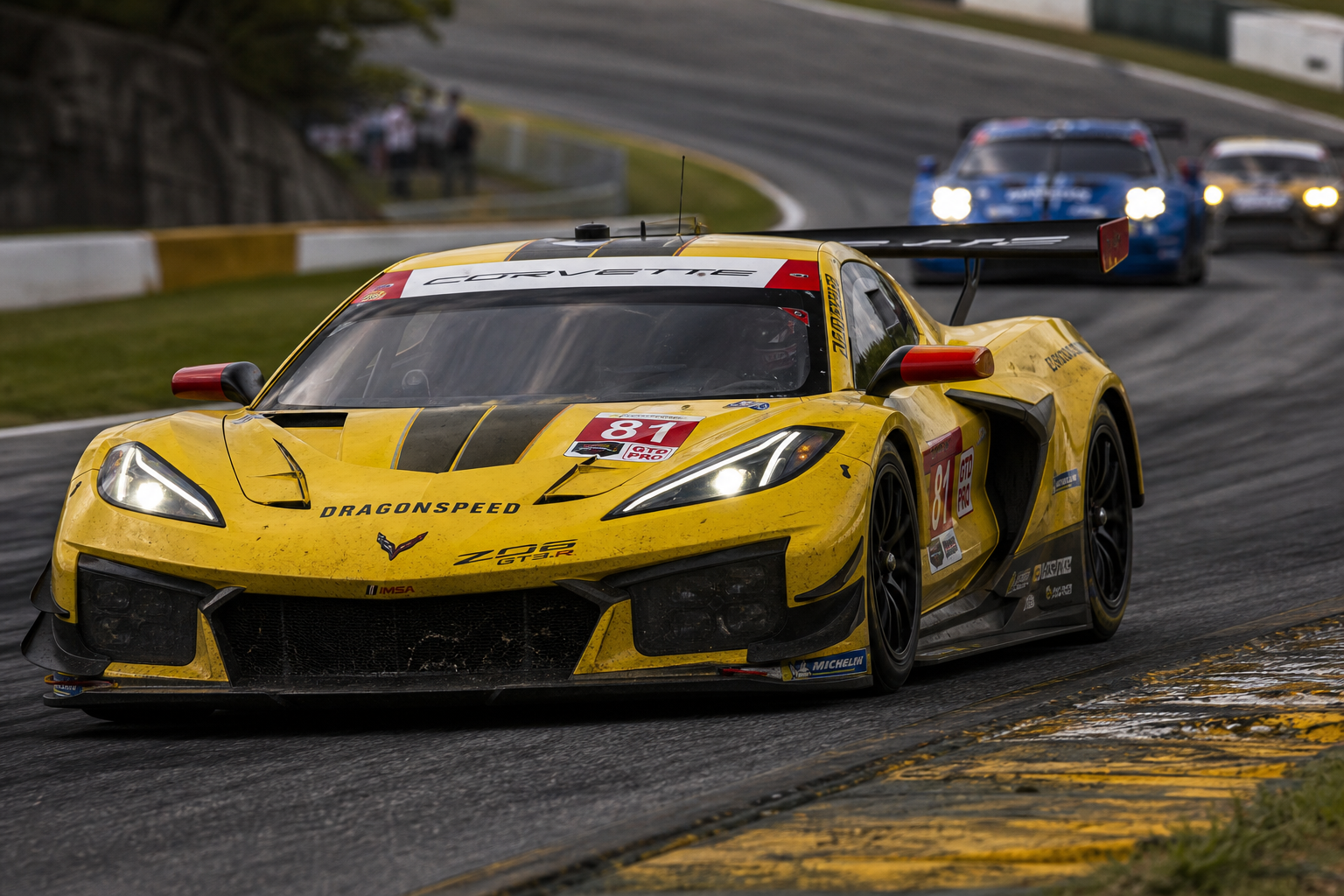

DragonSpeed’s return to the IMSA WeatherTech SportsCar Championship’s GTD Pro class was already worth watching. Adding Sebastien Bourdais to the Corvette lineup makes it considerably more interesting.
The team is scheduled to make its final IMSA appearance of the season at Motul Petit Le Mans, bringing its Corvette back into the highly competitive GTD Pro field for the endurance classic at Road Atlanta. Bourdais will headline the effort, adding a driver with deep experience in prototype racing, GT competition, and the particular sort of controlled chaos that arrives when a 10-hour race reaches its final quarter.
It is a smart appointment for DragonSpeed. Bourdais is not merely a recognizable name placed in a race entry to make the press release look cheerful. He is a Cadillac factory driver, a proven endurance racer, and one of the more adaptable professionals in modern sports-car racing. He has spent much of his career moving between different types of machinery without requiring an interpretive dance from the engineering department.
DragonSpeed Returns to GTD Pro for One More IMSA Appearance
DragonSpeed’s GTD Pro return is currently planned as a one-off, with Petit Le Mans representing the team’s final scheduled series appearance of the season. That makes the event both a competitive outing and an opportunity to put a proper exclamation point on the program.
GTD Pro is IMSA’s professional GT class, populated by factory-supported or manufacturer-linked entries using GT3-specification cars. The machinery is closely related to the cars seen in other major GT3 championships around the world, but IMSA’s long races, traffic patterns, pit-stop demands, and multi-class format give the category its own character.
At Road Atlanta, GTD Pro cars share the track with faster GTP prototypes and LMP2 cars, as well as the Pro-Am-oriented GTD field. That means a GT3 driver is rarely allowed the luxury of concentrating solely on the car immediately ahead. A prototype may appear in the mirrors at alarming speed, a GTD rival may be fighting for the same piece of asphalt, and the next corner may be arriving with all the subtlety of a thrown brick.
Petit Le Mans also tests more than outright pace. Drivers must manage tires, traffic, fuel strategy, changing track conditions, and the cumulative fatigue that comes with a long race. A quick lap is useful. A quick lap repeated at the right moment, while avoiding trouble and preserving the car, is generally more useful.
Why Bourdais Fits the Corvette Assignment
Bourdais brings the sort of resume that makes sense in an endurance-racing lineup. The French driver built his reputation in open-wheel racing, becoming a four-time Champ Car champion, but his career has also included major programs in sports cars and endurance competition.
That variety matters in a race such as Petit Le Mans. GT3 cars demand precision under braking, mechanical sympathy over long stints, and a clear understanding of how to position the car around traffic. The driver must know when to attack, when to leave a margin, and when an ambitious move is merely a stylish way of turning a healthy race car into expensive modern art.
Bourdais has also worked extensively with Cadillac in prototype competition. His Cadillac factory role gives him direct familiarity with the manufacturer’s wider endurance-racing operation, even though the Corvette represents a very different type of machine. The Corvette Z06 GT3.R is a front-engine GT3 racer derived from Chevrolet’s road-car sports-car family, while Cadillac’s prototype machinery is built around an entirely different aerodynamic and performance philosophy.
That does not make the switch effortless. A GT3 car produces less aerodynamic performance than a top-class prototype and places greater emphasis on usable mechanical grip, tire management, and close racing in traffic. The Corvette’s behavior under braking, its corner-entry balance, and the way its tires respond over a long stint all require their own approach. Bourdais’ experience should shorten that learning curve, which is rather handy when the event is already looming rather than sitting politely months away on the calendar.
The Corvette’s Role in IMSA’s GTD Pro Fight
Chevrolet’s Corvette Z06 GT3.R competes in a crowded GTD Pro environment alongside GT3 machinery from several major manufacturers. The category is built around cars that must be fast enough for professional competition but controlled by regulations designed to keep different platforms competitive through balance-of-performance adjustments.
That arrangement places a premium on execution. A manufacturer may have a powerful engine, excellent traction, or strong high-speed stability, but none of those advantages matter much if the car loses time in traffic, struggles to protect its tires, or spends an afternoon stationary in the pits.
The Corvette’s presence also carries significance beyond a single entry. Chevrolet has long treated sports-car racing as an important part of the Corvette identity, and the GT3 program gives the brand a modern platform for competing against Porsche, BMW, Ferrari, Lexus, Aston Martin, Mercedes-AMG, and other established GT manufacturers. GTD Pro is not a class in which a manufacturer can simply arrive, polish the bodywork, and expect the trophies to queue politely.
For DragonSpeed, running the Corvette at Petit Le Mans provides another chance to operate in that environment and measure itself against professional GT teams with much broader seasonal programs. A one-race return does not offer the same development mileage as a full campaign, but it can still reveal plenty about preparation, pit work, driver consistency, and the team’s ability to deal with a notoriously busy event.
Bourdais’ Next Chapter With Cadillac
The Petit Le Mans entry also arrives as Bourdais prepares to leave Hertz Team JOTA’s FIA World Endurance Championship program at the end of the season. That change gives the DragonSpeed appearance an extra layer of interest, particularly because Bourdais remains connected to Cadillac as a factory driver.
Endurance racing has become increasingly dependent on drivers who can move between programs, manufacturers, and classes without losing their technical sharpness. Factory drivers are expected to contribute more than speed. They provide feedback, help shape setup direction, work with engineers, and often serve as a reference point for less experienced teammates.
Bourdais’ background makes him particularly valuable in that role. He understands the intensity of single-seater racing, the patience required in multi-class endurance events, and the engineering demands of modern hybrid and GT machinery. That does not guarantee a result at Road Atlanta—racing remains stubbornly resistant to guarantees—but it gives DragonSpeed a driver capable of making useful progress quickly.
Petit Le Mans Is a Severe Test, Even for Experienced Teams
Road Atlanta is compact, fast, and unforgiving. The track’s elevation changes and blind sections leave little room for hesitation, while the narrow layout creates constant interaction between classes. A GT3 car may be fighting another car in its own category while trying to predict where a prototype will appear next. The traffic is not background scenery; it is one of the central strategic problems of the race.
Night running adds another complication. As daylight fades, reference points change, visibility drops, and the track surface can behave differently from the way it did during afternoon practice. A team that has looked strong in clean daytime running can find itself dealing with a very different race once the floodlights begin doing the work of the sun.
That is why DragonSpeed’s return deserves attention even if it remains a single scheduled appearance. The team is not entering a quiet club race with plenty of time to sort itself out. It is stepping into one of North America’s most demanding endurance events, with a professional GT driver at the wheel of a Corvette carrying the expectations that come with the name.
Bourdais gives the entry credibility, the Corvette gives it a familiar American racing identity, and Petit Le Mans supplies the usual cocktail of speed, traffic, fatigue, and strategic mischief. If DragonSpeed can keep the car clean and competitive through the long hours, the team will have made a convincing case for why its GTD Pro program remains worth watching beyond this final scheduled outing.

0 Comments