
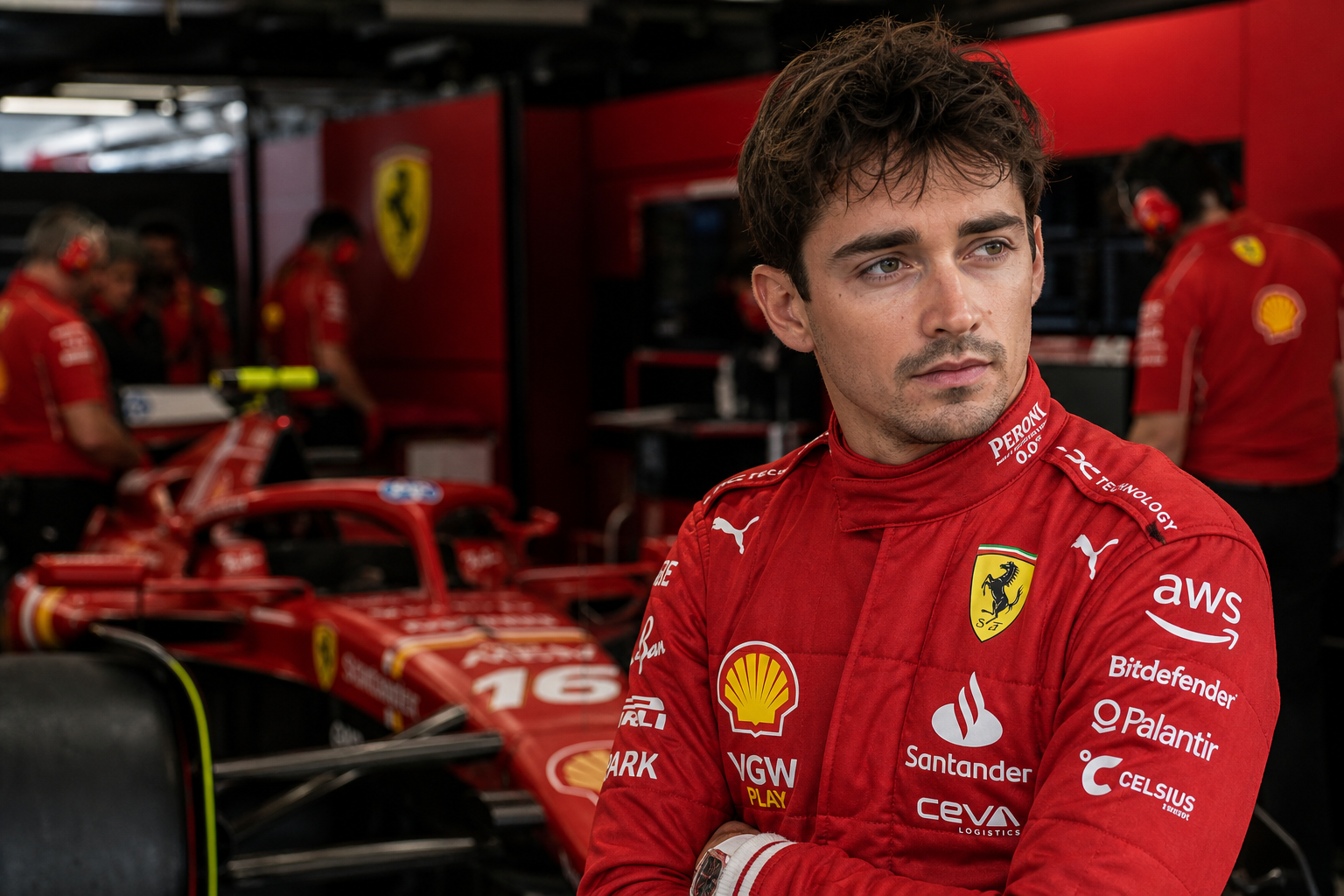

Charles Leclerc has signed another Ferrari deal, and once again the announcement arrived with a small cloud of intrigue attached. The Monegasque driver has repeatedly hinted that he had alternatives available to him, yet each time the red overalls remain the preferred option.
That is the curious part. Most Formula 1 drivers spend their careers trying to reach Ferrari. Leclerc got there early, established himself as the team’s unquestioned lead talent, and then discovered that staying can be almost as complicated as arriving. Ferrari is simultaneously the dream job, the most scrutinized seat in the sport, and a place where a competitive Sunday can occasionally be followed by a strategy meeting resembling a parliamentary inquiry.
Leclerc Says the Alternatives Were Real
Speaking on the Beyond the Grid podcast, Leclerc was asked how seriously he had considered a future away from Ferrari. His answer suggested that the choice was not merely theatrical loyalty for the cameras.
“For that, I’m also lucky to be in the position where I’ve got my manager,” he said.
That comment is revealing without being especially specific. Leclerc did not publicly name the teams involved in the supplied remarks, nor did he present a detailed list of offers. Instead, he acknowledged that his management team had helped assess opportunities outside Ferrari while he considered whether extending the relationship remained the right career decision.
In Formula 1, that distinction matters. A driver does not need a signed contract from another team for an alternative to influence negotiations. A potential opening, a conversation with a rival team, or evidence that another organization sees you as a future centerpiece can all change the balance of power. The paddock runs on contracts, rumors, lawyers, and people pretending not to know things they absolutely know.
Why Leclerc Has Had Leverage
Leclerc’s position is stronger than that of most Ferrari drivers who have come before him. He arrived from Sauber for the 2019 season after just one year in Formula 1, but Ferrari had already identified him as a long-term prospect. His promotion came at the expense of a more experienced driver in Kimi Räikkönen, an unmistakable sign that the team viewed Leclerc as part of its future rather than a short-term experiment.
He justified that faith quickly. Leclerc took Ferrari’s first pole position of the 2019 season in Bahrain and later secured his first Formula 1 victory in Belgium. He added another win at Monza, Ferrari’s home race, in front of a crowd that treats a successful Sunday with the emotional restraint of a person discovering a winning lottery ticket.
Those early performances gave Leclerc something every top driver needs when a contract comes up: proof that he can deliver at the front, not merely occupy a prestigious seat. His qualifying speed, technical feedback, and ability to produce exceptional laps under pressure have made him one of the most valuable drivers on the grid, even when Ferrari’s machinery has not consistently matched his talent.
That last point is central to the question of “other opportunities.” Leclerc has spent much of his Ferrari career waiting for the team to give him a car capable of sustaining a championship challenge. He has won races and taken poles, but Ferrari’s title campaigns have repeatedly been undermined by reliability problems, strategy errors, uneven development, or a combination of all three—the classic multi-course meal of Formula 1 disappointment.
The Ferrari Problem Is Also the Ferrari Attraction
Leaving Ferrari would be a rational career decision if another team could offer Leclerc a faster and more dependable route to the world championship. Staying is equally rational because Ferrari remains one of the few teams with the resources, technical depth, political influence, and historical weight to build a championship-winning operation around him.
That creates a dilemma rather different from the usual driver-market shuffle. Leclerc is not choosing between a famous team and an unknown one. He is choosing between Ferrari’s immense potential and the frustration of waiting for that potential to become a consistently effective racing program.
The appeal is obvious. Ferrari is not merely a constructor competing in Formula 1; it is a global racing institution with an unusually powerful identity. A Ferrari victory carries a different kind of cultural force from a victory by almost any other team. For a driver who grew up wanting to race for the Scuderia, walking away requires more than a spreadsheet showing which car was quickest over the previous 20 races.
But sentiment does not reduce tire wear, repair a failed power unit, or make a poorly timed pit stop look clever. Leclerc’s management therefore has to weigh the emotional value of Ferrari against the practical question every elite driver eventually faces: can this team give me the equipment to win the championship?
Why the Names Have Not Been Confirmed
There is a temptation to turn every vague reference to rival interest into a detective story. Formula 1 encourages this. A driver says “other opportunities,” and within minutes the paddock has developed a fictional seating chart, three anonymous sources, and a theory involving a motorhome door that was left open for too long.
Leclerc’s comment, however, does not establish which teams made approaches or how advanced those discussions became. It would be wrong to convert a general acknowledgment of alternatives into a confirmed account of negotiations.
Several teams could plausibly have been considered during different phases of his career, particularly whenever a major driver-market vacancy appeared. Yet plausibility is not evidence. The important fact is not the identity of a mystery suitor; it is that Leclerc was sufficiently valued outside Ferrari to have a meaningful decision to make.
That is also why the wording matters. Saying he had “other opportunities” is not the same as saying he rejected a guaranteed championship-winning car. Formula 1 drivers regularly evaluate possible moves that vary widely in certainty, timing, and competitiveness. A potential seat may look attractive in negotiations and rather less so once the stopwatch gets involved.
A Long-Term Bet on Ferrari
Leclerc’s latest extension keeps the central Ferrari relationship intact and gives the team continuity around its most important driver. That stability has technical value. Drivers who remain with one organization can shape development over several seasons, build working relationships with engineers, and give more consistent feedback as regulations and car concepts change.
It also places more responsibility on Ferrari. Leclerc is no longer merely the promising young driver learning how to handle the pressure of Maranello. He is the established star expected to convert speed into championships. Ferrari cannot keep presenting him as the future indefinitely; at some point, the future needs to turn up, put on a helmet, and start winning races.
For Leclerc, the new deal represents patience, ambition, or perhaps a highly calculated combination of both. He clearly understands the risks of staying. He also understands what Ferrari could become if the engineering and operational pieces finally work together.
The mystery surrounding his “other opportunities” may never be fully resolved, and perhaps that is deliberate. Drivers and managers rarely reveal every card when the next negotiation is always somewhere on the horizon. What we do know is that Leclerc had alternatives, considered them seriously enough to involve his management, and still chose Ferrari.
That choice is romantic in the most traditional Ferrari sense—and slightly mad in the most traditional Formula 1 sense. The only thing that will settle the argument is performance. If Ferrari gives Leclerc a championship-caliber car, staying will look like loyalty backed by excellent judgment. If it does not, those unnamed opportunities will become rather more interesting than they currently appear.

0 Comments