
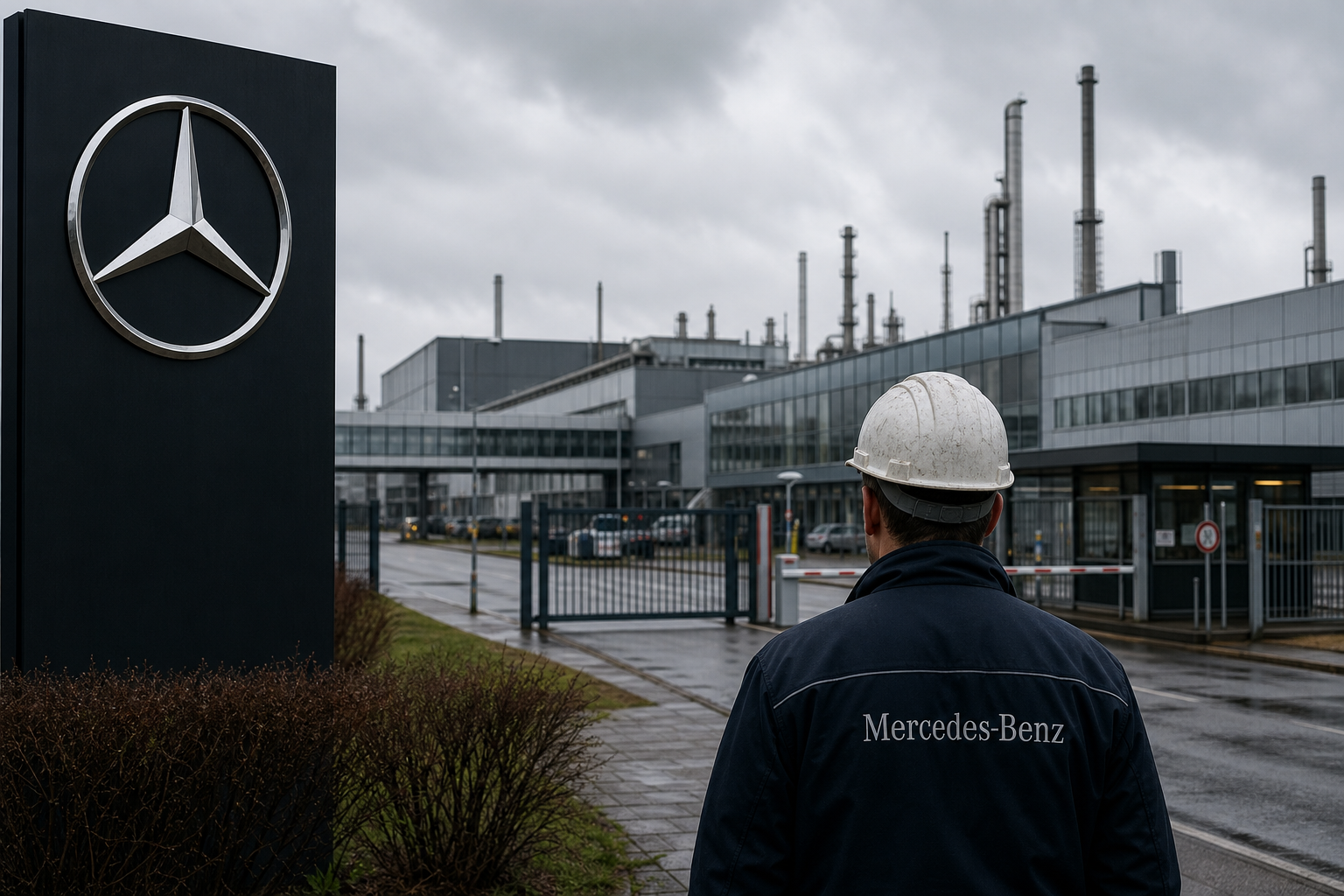

Mercedes-Benz has warned that two of its German facilities could face closure unless labor costs are reduced, putting an assembly plant and a powertrain site directly in the firing line of the company’s cost-cutting plans.
The wording matters. Mercedes-Benz has not announced that either facility will close, nor has it identified the plants involved in the available details. This is a conditional warning: unless costs fall, the future of one vehicle assembly operation and one powertrain facility could be at risk.
That is still a serious escalation. Factory closures are not the sort of thing manufacturers casually mention between discussions about office coffee budgets and slightly cheaper staplers. An assembly plant represents a substantial concentration of jobs, equipment, suppliers, logistics activity, and regional economic importance. A powertrain site carries a different kind of weight, because its workload depends on the engines and other propulsion hardware Mercedes-Benz chooses to build in Germany in the years ahead.
A Warning Tied Directly to Labor Costs
The central issue is labor cost reduction. The available information does not specify the exact savings Mercedes-Benz is seeking, the facilities involved, or the timetable for a decision. It does, however, make clear that the possible closures are being linked directly to the company’s ability to reduce employment-related costs.
That distinction is important. This is not a general announcement that two sites are unprofitable, nor is it a confirmed restructuring plan with a published closure schedule. Mercedes-Benz is presenting lower labor costs as a condition for keeping the facilities operating.
In practical terms, that could lead to negotiations over wages, working hours, staffing levels, shift patterns, productivity, or the amount of work assigned to each site. Without details from the company or employee representatives, it would be wrong to assume which of those levers is being considered. Industrial negotiations are rarely as tidy as a spreadsheet suggests, particularly when an entire town knows that the spreadsheet may decide its economic future.
Why the Two Types of Plants Matter
An assembly plant and a powertrain site are not interchangeable pieces on a corporate map.
The assembly facility is where vehicles are built, typically bringing together bodies, interiors, electrical systems, drivetrains, and final inspections. Its output depends heavily on product allocation: which models are assigned to the plant, how many are produced, and whether that work can be completed competitively against other Mercedes-Benz facilities.
A powertrain plant faces a more complicated question. Its future depends not only on labor costs but also on the propulsion systems Mercedes-Benz intends to produce, the volume required, and how quickly that product mix changes. Engines, transmissions, and electric drive components do not create identical manufacturing demands. A facility designed around one kind of hardware cannot always be repurposed overnight, despite the cheerful optimism of corporate presentations.
That makes the inclusion of a powertrain site especially significant. It suggests the cost discussion reaches beyond the final assembly of vehicles and into the industrial structure supporting Mercedes-Benz production in Germany.
What Closure Would Mean Beyond Mercedes-Benz
If either site were eventually shut down, the consequences would extend well beyond the plant gates. Direct employees would be affected first, but a modern vehicle factory also supports contractors, parts suppliers, transport companies, maintenance firms, restaurants, and other local businesses.
The impact would differ depending on whether the facility builds complete vehicles or powertrain components. An assembly plant can influence the production schedule of an entire vehicle line, while a powertrain site may supply components to multiple models or locations. The source material does not identify the sites or their functions in enough detail to measure those effects, but the distinction explains why both types of facility matter to Mercedes-Benz’s wider manufacturing network.
There is also a strategic question for the company. Keeping a plant open preserves industrial capacity and technical expertise, but it also leaves Mercedes-Benz carrying the fixed costs of a facility that must remain competitive. Closing one may reduce expenses, yet it can mean severance payments, restructuring costs, lost flexibility, and the permanent disappearance of skills that took decades to build.
Manufacturers do not close large factories because the process is simple. They do it when they believe the long-term cost of keeping them open is higher than the cost of walking away. That calculation is brutal, and it is usually made long before the final gates are locked.
The Next Step Is Negotiation, Not Demolition
For now, the key development is the warning itself. Mercedes-Benz has placed labor costs at the center of the plants’ future, but there is no confirmed closure, no named facility, and no published final decision in the available information.
The next stage will likely involve discussions between Mercedes-Benz and employee representatives over how much cost can be removed while keeping the sites viable. Those talks could produce revised working arrangements, investment commitments, changes to production assignments, or a compromise that avoids closure for the time being.
“For the time being” is doing a lot of work there. A plant that survives one cost review may face another if its product allocation, productivity, or labor structure remains uncompetitive. Conversely, a credible reduction in costs could give Mercedes-Benz a reason to retain both facilities and assign them future work.
Until the company provides the names of the plants and the scale of the savings required, the story should be treated as a serious threat rather than a completed shutdown plan. But the message from Mercedes-Benz is unmistakable: two German production sites now have to justify their costs, and sentiment alone will not keep the lights on.

0 Comments