
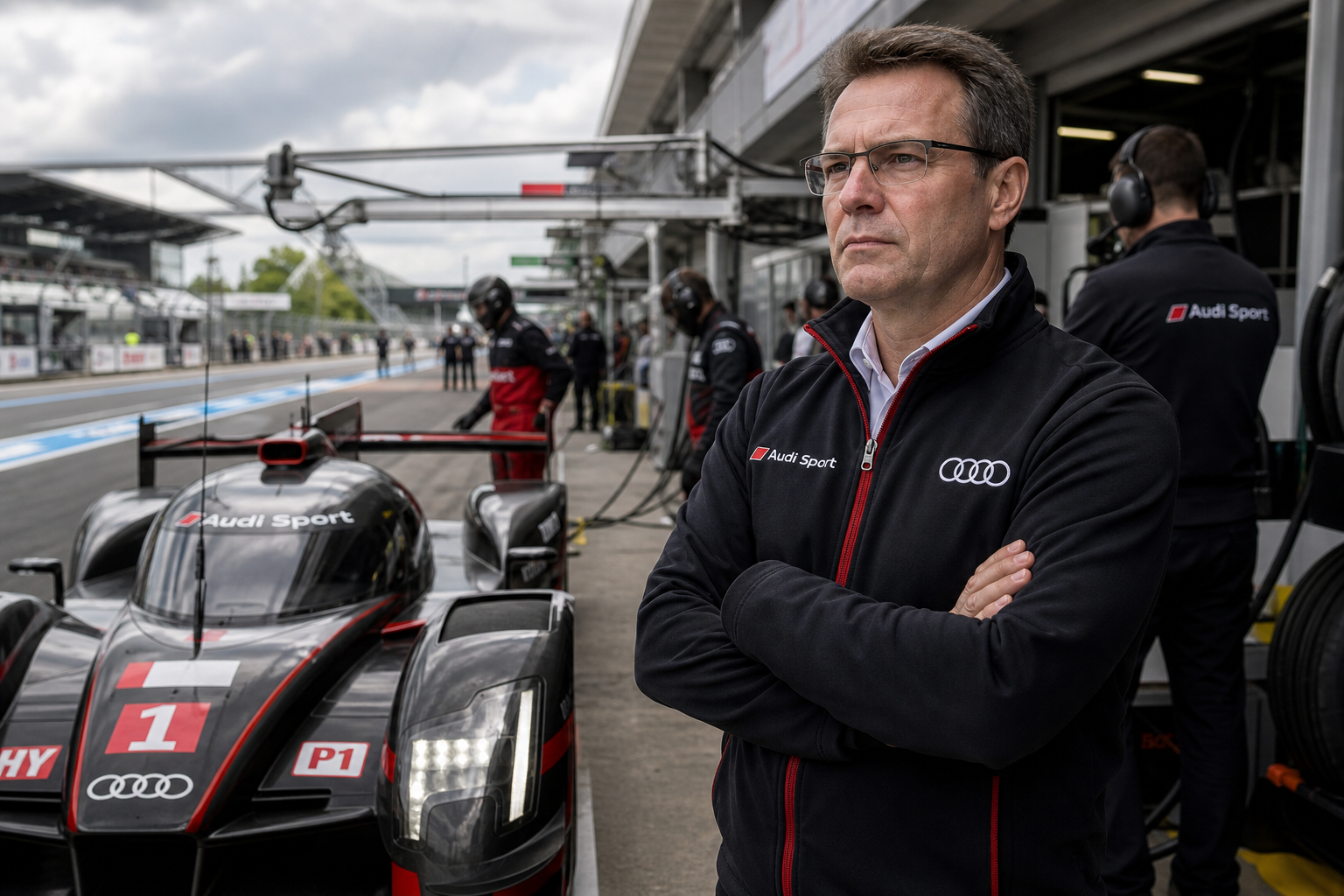

Audi Sport may soon be looking for a new person to steer one of the company’s most important performance and racing operations. Rolf Michl, the former Abt manager who became managing director of Audi Sport GmbH on September 1, 2022, is reportedly being transferred to China, according to a report from Motorsport-Total.com.
The move has not been formally confirmed by Audi, and that distinction matters. Corporate reshuffles are often discussed in the paddock long before anyone in a suit is willing to put a name, date, or job description on the record. Still, Michl’s possible departure would create a notable vacancy at a company juggling road-car performance, customer racing, and a major Formula 1 project.
Audi Sport’s Leadership Question
Michl’s current role is unusually broad. As managing director of Audi Sport GmbH, he sits at the intersection of Audi’s performance-car business and its motorsport interests. He joined the position after building experience at Abt, one of Audi’s closest and most familiar competition partners, and took over at a time when the manufacturer was preparing for several substantial changes.
His appointment in 2022 came during a period when Audi was reshaping its sporting identity. The company’s RS road cars remained central to Audi Sport’s public image, while racing programs were becoming increasingly tied to larger corporate decisions inside the Volkswagen Group. Audi was also moving toward its Formula 1 entry, planned for 2026 through its partnership with Sauber.
That makes any change at the top more than a routine personnel matter. The person leading Audi Sport has to understand the rather different demands of a road-car business, a customer-racing operation, and a factory program aimed at the most politically and technically demanding championship in the sport. It is not a job for someone who thinks a racing department is merely a collection of expensive engines and men with clipboards.
Why the Reported China Transfer Matters
According to the report, Michl is expected to move to a role in China rather than simply leave Audi. If that happens, it would suggest an internal reassignment rather than a clean break with the company. Audi has significant business interests in China, where local partnerships, market strategy, and the shift toward electric vehicles have become increasingly important to the brand.
That does not necessarily tell us what will happen next at Audi Sport. A transfer could be part of a planned management rotation, a wider restructuring, or an attempt to place an experienced executive in a strategically important market. The automotive industry is fond of calling these things “new opportunities,” usually after someone has spent three months pretending the old job was never under threat.
The immediate question is whether Audi intends to appoint a direct successor or divide Michl’s responsibilities among several executives. His position covers a wide range of work, so Audi could theoretically separate the road-car and motorsport functions. That would reflect the reality of modern manufacturer programs, where performance vehicles are developed inside one business structure while race projects answer to a different set of financial, technical, and corporate priorities.
No Replacement Has Been Identified
The more intriguing part of the report is the suggestion that Audi may not appoint a new motorsport chief at all. That possibility needs careful handling because there is no confirmed announcement naming a successor—or confirming that the role will disappear.
Audi could instead give existing executives responsibility for individual programs. That approach would be consistent with how large manufacturers increasingly manage racing. Rather than maintaining a single, highly visible motorsport boss, companies often distribute authority between technical directors, program managers, sporting directors, and senior executives responsible for corporate strategy.
There are obvious advantages. A distributed structure can place decision-making closer to the people actually running a program and may reduce overlap between road-car and racing departments. It can also make sense when several competition projects operate under different technical rules and commercial objectives.
There are drawbacks as well. Motorsport programs need a clear chain of command, particularly when a manufacturer is entering a new championship. Racing organizations make hundreds of costly decisions under pressure, and ambiguity at the top rarely improves the quality of those decisions. A structure that looks tidy on an organizational chart can become rather less tidy when a car is slow, a driver is unhappy, or a budget suddenly requires trimming.
Audi’s Timing Is Particularly Sensitive
Audi is not approaching an ordinary lull in its racing activities. Its Formula 1 project with Sauber is scheduled to become a full factory operation in 2026, bringing Audi into a championship where the political and technical stakes are enormous. The company will need to coordinate its power-unit development, chassis program, team structure, commercial plans, and driver lineup while competing against manufacturers and established teams with decades of F1 experience.
Audi’s motorsport history gives it plenty of credibility. The brand has won major endurance races, built dominant rally cars, developed successful touring-car programs, and used competition to establish technical themes such as all-wheel drive, turbocharging, and electrification. But historical success does not make a new Formula 1 entry straightforward. A manufacturer can have brilliant engineers, a famous badge, and a trophy cabinet large enough to require planning permission, then still discover that Formula 1 has its own special method of exposing weak decisions.
That is why leadership continuity will matter as the 2026 project approaches. Audi must maintain momentum without allowing the organizational structure to become unnecessarily complicated. If Michl does leave his current role, the company will need to make clear who controls motorsport strategy, who answers for results, and how the racing operation connects to Audi Sport’s road-car business.
Michl’s Background Makes the Change Notable
Michl arrived at Audi Sport with experience at Abt, a company deeply familiar with Audi competition programs. Abt has worked with Audi across multiple forms of racing and has long been one of the most recognizable private-sector partners associated with the brand. That background gave Michl a perspective shaped by the practical realities of running race cars, rather than only the internal logic of a major manufacturer.
It also made him a recognizable figure in Audi’s motorsport structure. Leadership changes are common in racing, but they can carry additional weight when a program is trying to align manufacturer resources, partner relationships, and long-term sporting ambitions. A new executive may bring fresh thinking, though every new arrival also has to learn which promises are achievable and which were written by someone in marketing after an especially optimistic lunch.
For now, the facts remain limited. Motorsport-Total.com reports that Michl is set to move to China, while rumors of his departure have been circulating for some time. Audi has not publicly confirmed the transfer or announced a replacement for his Audi Sport responsibilities.
That leaves two separate issues hanging over the company: whether Rolf Michl will remain in charge of Audi Sport GmbH, and whether Audi believes it still needs a single motorsport chief as its Formula 1 entry moves closer. The first question concerns one executive. The second concerns how Audi wants to run its sporting ambitions at a moment when clarity may be worth almost as much as horsepower.

0 Comments