
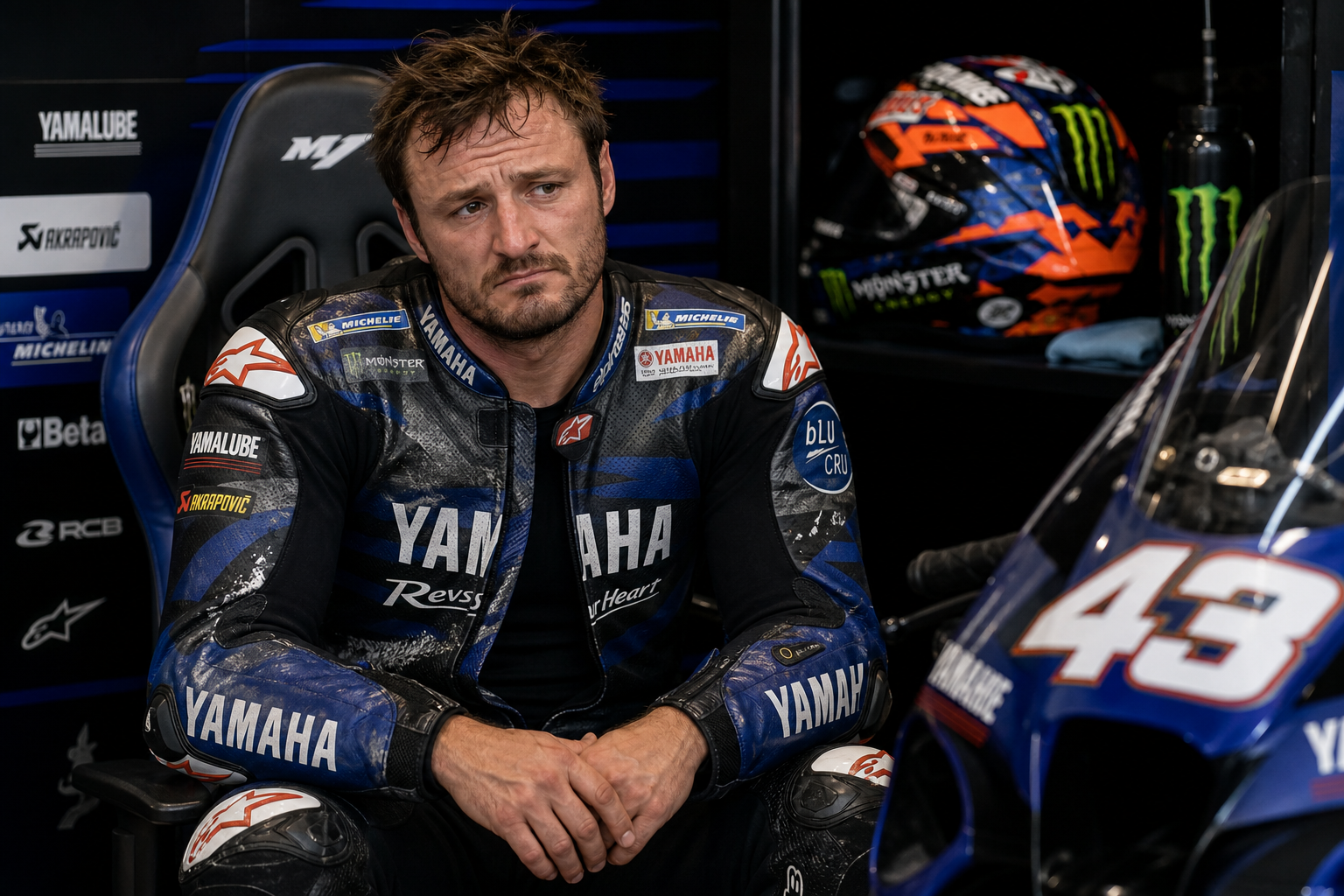

Jack Miller didn’t need a stopwatch to tell him the Austrian Grand Prix was going badly. The Yamaha rider could feel his race unraveling beneath him, with tire degradation dragging his lap times down to what he described as “Bagger Cup” pace. His verdict was unusually blunt: he felt “quite embarrassed.”
That kind of admission is striking in MotoGP, where riders and teams normally wrap disaster in language about data, potential, and “areas to improve.” Miller skipped the corporate insulation. His pace had fallen off a cliff, and the performance was poor enough for him to compare it with a much lower level of racing.
The Australian was not alone in struggling. Yamaha’s riders endured one of the Japanese manufacturer’s worst weekends of the season, but Miller’s situation became particularly painful because the performance loss was tied to extreme degradation from his Michelin tires. Once the rubber gave up, the race became less about attacking and more about limiting the damage.
A Race That Slipped Away in the Tires
MotoGP lap-time collapse is rarely caused by one isolated problem. A rider can lose grip from the rear tire, confidence from the front, or both at once. The difficult part is that tire wear changes the behavior of the motorcycle while the race is still unfolding. A bike that felt manageable during the opening laps can become vague, slow, and increasingly difficult to place on the track.
That was the shape of Miller’s Austrian GP problem. The Yamaha’s outright pace was already lacking, but the situation became considerably worse as the Michelin tires degraded. Every corner then demands more patience. Braking markers move backward, corner exits become less aggressive, and the rider has to avoid asking the tire for performance it no longer has.
At the Red Bull Ring, that matters enormously. The Austrian circuit is not a gentle test of mechanical sympathy. Its lap is built around heavy braking zones, sharp changes of direction, and long periods where engine performance and traction are exposed. A rider who cannot get the motorcycle stopped cleanly or drive it out of the slower corners loses time in obvious, expensive chunks.
Once the tire begins to overheat or lose its edge, those losses compound. A compromised exit compromises the following straight. More time spent accelerating means more pressure on the tire. The rider then arrives at the next braking zone with less speed, less confidence, and no realistic way to recover the time. It is a vicious little mechanical spiral, and it does not care how brave the rider feels.
Why Miller’s Comment Is So Damning
Miller has spent years operating at the sharp end of motorcycle racing, where small differences in grip and setup can determine whether a rider fights for a result or disappears into the pack. Calling his own pace “embarrassing” suggests the issue was not merely that Yamaha was slower than its rivals. It was that the rate of decline made the bike feel fundamentally uncompetitive as the race progressed.
The “Bagger Cup” comparison carries a particularly sharp sting because it reduces the problem to something any racer understands: lap time. Sophisticated electronics, carbon brakes, aerodynamic packages, and Michelin development tires are all rather less impressive when the stopwatch says the motorcycle is moving at club-racing speed. Racing has a wonderfully efficient way of stripping away the brochure language.
There is also a difference between being slow and becoming slow. A rider can manage a motorcycle that is consistently short of pace, at least in theory. A machine that loses performance dramatically over a stint forces the rider to keep recalibrating his approach. The corner that was safe five laps earlier may now punish the same input, while the throttle that once produced acceleration begins to generate wheelspin and heat instead.
That makes tire degradation both a performance problem and a confidence problem. The rider no longer knows exactly how much grip is available. At MotoGP speeds, uncertainty is not a charming character trait. It is a reason to leave a margin, and every extra margin becomes another tenth of a second surrendered.
Yamaha’s Wider Austrian Struggle
Miller’s ordeal also needs to be viewed within Yamaha’s broader weekend. The source of the problem was not presented as an isolated mistake by one rider. Yamaha’s riders struggled collectively, which points toward a deeper difficulty in extracting performance from the package at the Austrian circuit.
That does not make Miller’s tire problem irrelevant. Different riders can produce different degradation patterns even on the same motorcycle. Riding style, setup direction, tire choice, track position, and the way a rider manages the early laps all influence how long the Michelin rubber remains usable. But when the entire group is fighting for performance, the team has fewer places to hide.
A modern MotoGP motorcycle has to satisfy several competing demands at once. It needs strong acceleration without destroying the rear tire, enough braking stability to attack the circuit’s heavy stops, and the compliance to maintain grip when the track surface and tire temperature move away from the ideal window. Improving one area can easily damage another. More aggressive drive can produce better early-lap speed while leaving the tire in tatters later on.
That trade-off is especially cruel during a race. Qualifying pace can sometimes be extracted with a fresh tire and a short run. Race pace is a different animal. It asks whether the motorcycle can deliver repeatable performance after fuel load, heat, traffic, and tire wear have all taken their share. Miller’s comments suggest Yamaha did not have a satisfactory answer at the Austrian GP.
The Rider Can Only Manage So Much
Riders are often praised for conserving tires, and rightly so. Throttle control, corner entry speed, body position, and line choice can all influence degradation. But tire management is not magic. If the motorcycle is sliding too much or asking the tire to compensate for a lack of mechanical grip, the rider can only slow the rate of failure.
That distinction matters. Telling a rider to “look after the tire” is not a setup solution. It may preserve the rubber for a few extra laps, but it can also mean circulating at a pace that makes the result irrelevant. Miller’s reference to Bagger Cup times appears to capture precisely that trap: the tires may have survived longer if he had ridden even more cautiously, but the resulting pace would have been scarcely useful.
The rider is left choosing between two unpleasant options. Push harder and accelerate the collapse, or back off and turn the race into an exercise in controlled humiliation. Neither option belongs in the dream scenario prepared by a factory racing operation.
What Yamaha Must Take From the Weekend
The value of a bad race lies in how precisely a team can explain it afterward. Yamaha will need to separate the different parts of the failure: baseline speed, acceleration, braking stability, tire temperature, tire wear, and the setup decisions that shaped each one. Without that separation, “poor tire life” becomes a convenient label rather than a diagnosis.
Miller’s feedback should be useful because it describes the problem in a language engineers cannot misunderstand. He did not merely say the bike lacked potential. He said the pace collapsed badly enough to embarrass him. That points toward a motorcycle that was not giving its rider a sustainable platform over race distance.
There is no shortcut around that work. A new part might improve one corner or one phase of the lap, but a race motorcycle succeeds only when its systems remain useful together. An engine that delivers more acceleration is no help if it cooks the rear tire. A sharper front end is no help if the rider cannot trust the rear on corner exit. MotoGP is full of fast solutions that become slow problems six laps later.
For Miller, the Austrian Grand Prix was a particularly stark reminder that experience cannot defeat a tire that has simply run out of performance. He could manage the decline, explain it, and report it to Yamaha. He could not negotiate with the stopwatch.
And when a MotoGP rider starts talking about “Bagger Cup” times, the stopwatch has already delivered the harshest possible technical report.

0 Comments