
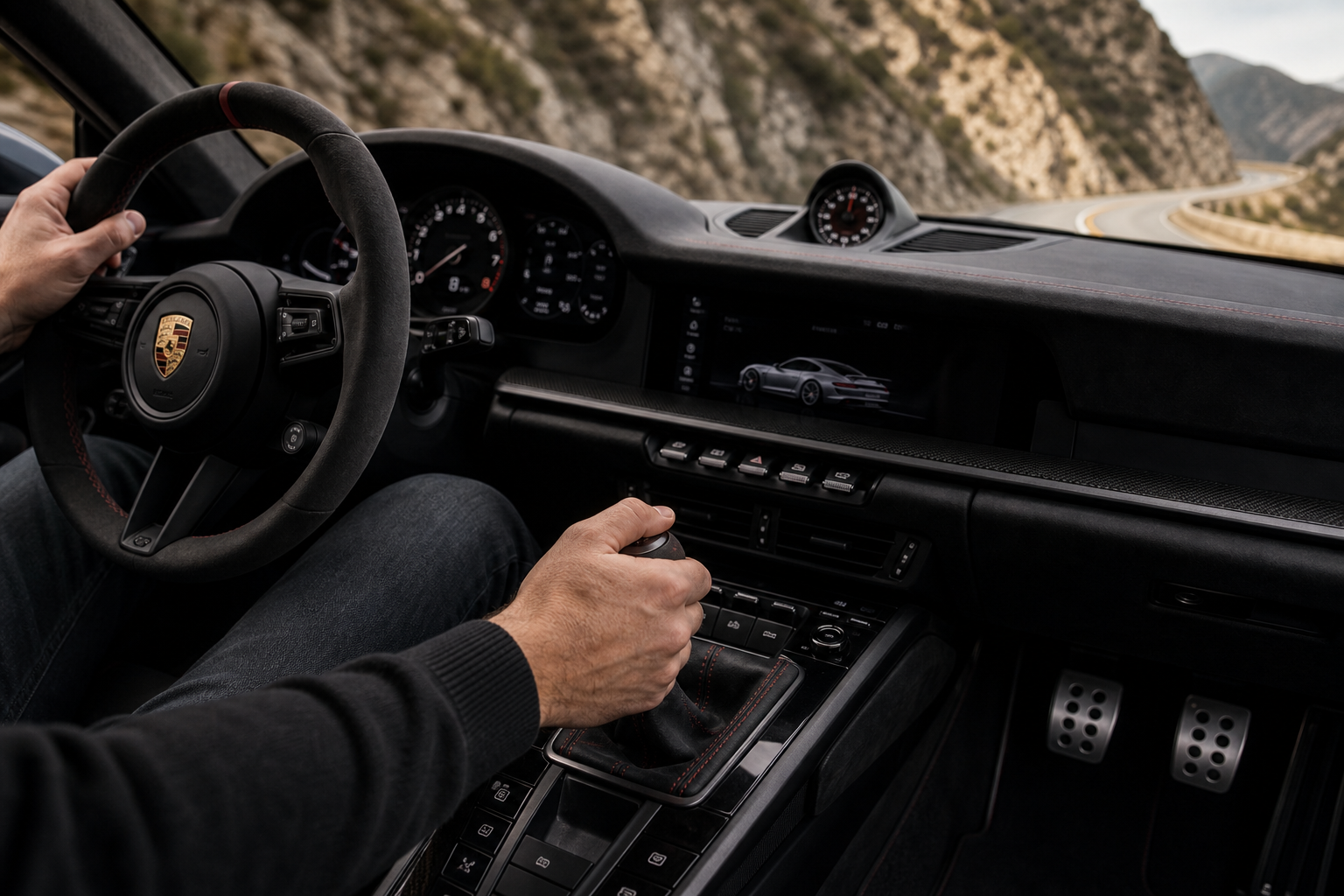

Porsche appears to be exploring a wonderfully strange idea: taking a dual-clutch automatic transmission and making it behave like a manual. Not merely giving the driver paddles and a suitably aggressive software setting, but recreating the involvement of a clutch pedal and gear lever while retaining the speed and mechanical efficiency of a modern automated transmission.
The idea comes from a new patent filing. As ever with patent documents, this is evidence that Porsche has considered the concept—not proof that a showroom car is on the way. Manufacturers patent all sorts of clever, eccentric and occasionally gloriously unnecessary ideas. Some reach production. Others remain safely locked in the filing cabinet, where they can do no harm.
Why Turn an Automatic Into a Manual?
A dual-clutch transmission already has much of the hardware needed to deliver quick, manually selected shifts. It uses two separate clutches, typically allowing one clutch to handle the odd-numbered gears while the other manages the even-numbered ratios. The next gear can be selected in advance, which is why these transmissions can change ratios so rapidly when the software is in the mood.
That makes a dual-clutch unit fundamentally different from a traditional automatic with a torque converter. It can provide direct, sharp gear changes and a degree of mechanical connection that suits performance cars. It can also operate without a conventional clutch pedal, leaving the computer to decide when and how to engage the clutches.
Porsche’s patent concept appears to ask a slightly awkward question: if a dual-clutch transmission can already shift quickly and efficiently, can it also imitate the physical involvement that makes a manual transmission appealing?
The answer would likely involve more than simply fitting a different shifter. A convincing manual simulation would need to reproduce the actions—and perhaps the consequences—of operating a clutch pedal and selecting each gear yourself. That could mean an additional control interface, software-managed clutch engagement, or a system that creates resistance and feedback to make the process feel less like issuing instructions to a washing machine.
Making the Driver Do the Work
The attraction is obvious to anyone who enjoys changing gears for the sake of changing gears. A manual transmission adds a layer of interaction to even an ordinary drive. Selecting the right gear for a corner, balancing clutch engagement during a launch and deciding when to shift are small tasks, but they give the driver something to do besides monitor the infotainment system’s increasingly confident opinions about nearby coffee shops.
Modern dual-clutch transmissions remove much of that work. They are fast, consistent and usually more efficient than a human driver. They also make it possible to concentrate on braking points, steering and throttle application without worrying about a missed shift. That is precisely why they are so effective on a racetrack—and precisely why some drivers find them a little sterile on the road.
A simulated manual mode could offer a compromise. The underlying transmission would retain its rapid shifts and electronically controlled operation, while the driver could engage with it through a more demanding interface. Porsche could theoretically allow the system to punish poor timing with a hesitant shift, a clumsy clutch release or even a stall-like event, although whether anyone paying sports-car money wants their expensive machine to behave like a nervous learner driver is another question.
There is a fine line between convincing simulation and theatrical nonsense. If the system always protects the engine, selects the correct gear in the background and smooths every mistake before the driver notices, it may feel no more authentic than a sound generator playing a recording of a manual transmission. If it genuinely allows awkward launches and imperfect shifts, some owners will love the involvement while others will wonder why they paid extra to reintroduce problems that automation solved decades ago.
The Dual-Clutch Advantage—and Its Complications
Keeping the dual-clutch layout would preserve several advantages. Gear changes could remain rapid, the engine could stay in its useful power band, and the transmission could still protect itself from abusive inputs. The car would also avoid some of the compromises associated with a conventional manual, including the need to package a large clutch pedal mechanism and a driver-operated clutch capable of surviving repeated high-load use.
But a system designed to imitate a manual transmission would need to account for more than the driver’s choice of gear. In a real manual, the clutch pedal gives a direct physical connection to the clutch mechanism. The driver can feel engagement through pedal movement, drivetrain vibration and the point at which the engine begins to pull the car forward. Reproducing that sensation electronically is possible in principle, but delivering feedback that feels natural is considerably harder than adding another driving mode to a touchscreen.
The shift mechanism would matter just as much. A traditional manual lever has a recognizable mechanical pattern, with resistance, spring loading and a clear relationship between the lever’s position and the selected gear. An electronic selector can imitate the pattern, but the engineering challenge lies in making it feel deliberate rather than decorative. Nobody wants a high-end Porsche with a gear lever that feels like a computer mouse mounted in a leather boot.
A Question of Porsche’s Manual Future
The filing also lands in a wider debate about the future of manual transmissions in performance cars. Automated transmissions are increasingly capable, while emissions rules, fuel economy targets and the demands of hybrid and electric powertrains make traditional manual gearboxes harder to justify. Porsche has continued to offer manual options in some of its sports cars, but the existence of a manual pedal set is no guarantee that the format will remain available forever.
A simulated manual could therefore serve as a bridge between two priorities. Porsche could retain the efficiency, speed and flexibility of an automated transmission while giving drivers a more involving way to interact with the car. It would be a technological answer to an emotional problem.
That may sound very Porsche: use an alarming amount of engineering to recreate something that already exists in simpler form. Yet the company has never been particularly shy about solving familiar problems in expensive and technically elaborate ways. The 911’s continuing evolution is built on that habit.
Patent Does Not Mean Production
For now, the filing should be treated as an intriguing engineering proposal rather than a confirmed future feature. Patent applications protect ideas and give manufacturers room to explore potential solutions. They do not tell us whether Porsche has approved the concept, tested it in a production-ready vehicle or decided that customers actually want it.
The most interesting question is not whether Porsche can make a dual-clutch transmission behave like a manual. It almost certainly can. The question is whether the result would deliver genuine driver involvement or merely cosplay as a three-pedal sports car.
If Porsche gets the feedback, timing and imperfections right, the idea could offer a clever way to preserve some of the manual transmission’s character in an increasingly automated world. If it gets them wrong, drivers may end up paying a premium for a remarkably sophisticated machine that spends its life pretending to be something less complicated.
0 Comments