
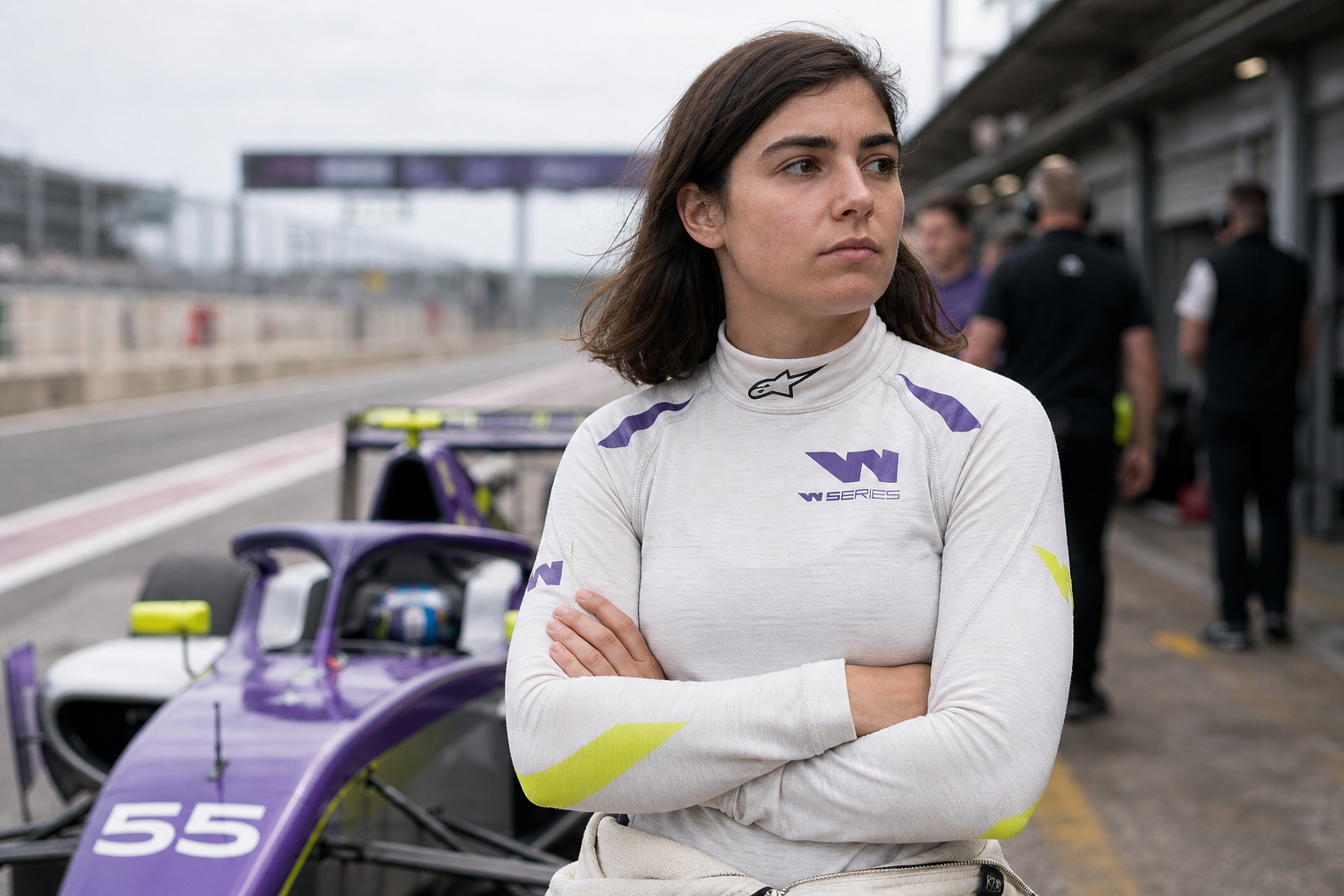

Jamie Chadwick knows what it feels like to be judged as a racing driver. She also knows what it feels like to be judged as a symbol, which is a considerably heavier piece of luggage to carry around a paddock.
The three-time W Series champion has spoken about the pressure that came with being one of the most visible women on the single-seater ladder. When she had a difficult weekend or simply lacked speed, the result was rarely treated as an ordinary off day. Instead, Chadwick felt that her performance could be examined as evidence about women in racing more broadly.
Speaking on the Significant Figures podcast, Chadwick described the uncomfortable burden of representation: when she was not fast, the disappointment did not always seem to belong solely to her. A male driver can have a bad weekend and be slow. Chadwick often felt that her bad weekend risked becoming a referendum on whether women belonged in the machinery at all.
When One Driver Becomes an Entire Argument
That is a familiar problem in sports where a group has historically been underrepresented. The first athlete through the door is rarely allowed to be merely human. Every mistake becomes symbolic. Every strong result becomes a breakthrough. The individual is expected to carry an entire argument on her back while also attempting to brake at 150 miles per hour with several hundred other concerns already occupying her brain.
Motorsport makes that burden particularly visible. A driver’s performance is reduced to lap time, qualifying position, race result and championship points. Those numbers look wonderfully objective, but they are not always interpreted objectively. A bad result may reflect tire preparation, traffic, a setup compromise, a technical problem, changing track conditions or simply the ordinary variance that makes racing rather less tidy than a spreadsheet suggests.
Chadwick’s comments point to what happens when those explanations are stripped away. Her slow days could be treated as confirmation of a prejudice that had nothing to do with that particular car, circuit or weekend. That creates a trap. A driver must perform at an exceptional level to be taken seriously, yet any slip can be used to question the entire premise of female participation in top-level racing.
Chadwick’s Results Made Her Impossible to Ignore
Chadwick was not handed visibility merely because she was a woman. She earned it through results. She became the first W Series champion in 2019 and went on to win the championship again in 2021 and 2022, establishing herself as the defining driver of the series’ early years.
W Series was created to give female drivers a dedicated route into single-seater competition without requiring them to bring the substantial budgets usually demanded by the junior formula ladder. The series placed women in identical machinery and gave its leading drivers a much larger platform than many had previously enjoyed.
That was important, but it also created a peculiar media dynamic. The championship needed recognizable stars, and Chadwick became one of them. Her success made her a natural reference point whenever the conversation turned to women in formula racing. Her wins helped demonstrate that female drivers could dominate a competitive championship. The downside was that she could not easily step away from the wider argument once she became its most visible participant.
There is a difference between being a leading driver and being asked to prove a proposition. Chadwick was expected to do both.
The Performance Standard Was Never Quite the Same
Racing drivers are accustomed to pressure. They are measured relentlessly, often from their first karting races onward. Teammates compare data, engineers analyze every corner and sponsors scrutinize every public appearance. Nobody reaches an international single-seater championship by being allergic to scrutiny.
But ordinary competitive pressure is not the same as representational pressure. The former asks whether a driver can be faster, more consistent or better prepared than the opposition. The latter asks the driver to disprove an assumption about an entire category of people.
That distinction matters because it changes the emotional cost of failure. If a driver believes a mistake will be interpreted as a personal mistake, the task is difficult but clear: understand it, correct it and move on. If the same mistake is treated as evidence that women lack the necessary speed or aggression, moving on becomes much harder. The driver has to fight the incident and the interpretation attached to it.
And the interpretation is often wildly disproportionate. A male driver can spend a season looking anonymous and still be described as a promising talent who needs the right opportunity. A woman can produce an excellent season and still be asked whether she has proved that women can race. The finish line keeps moving, which is a particularly tiresome way to run a championship.
Why Visibility Helps—and Complicates Things
The increased visibility of women in motorsport has been valuable. Young drivers now have more examples to point to, more series designed to support their progression and more evidence that a racing career is not automatically closed to them. Chadwick’s achievements are part of that change, whether she asked to become its public face or not.
Visibility, however, does not remove the pressure attached to it. In some ways, it intensifies it. A driver who is frequently used as proof of progress can feel obligated to perform perfectly, speak carefully and remain grateful even when the conditions around her are difficult. The expectation is not only to win, but to make the entire system look convincing while doing so.
That is an unreasonable demand. Drivers should be judged on their ability, preparation, racecraft and results. They should not have to produce an uninterrupted sequence of victories to justify the presence of other women in the paddock.
The Conversation Needs Better Questions
Chadwick’s experience also exposes the limitations of the way female drivers are often discussed. Coverage can swing between two unhelpful extremes: treating a woman’s participation as a novelty, or treating every result as a verdict on women generally. Neither approach is especially sophisticated, and neither tells readers much about the actual racing.
Better questions would focus on the same details applied to any driver. How did the car perform over a stint? Was the setup suited to the circuit? How did the driver manage tire degradation? What did the data show in qualifying? Where was time lost? Was the team’s strategy sound?
Those questions do not erase the importance of gender representation. They simply prevent representation from swallowing the sporting achievement. Chadwick can be an important figure for women in motorsport and still be assessed as a driver rather than a walking policy document.
That is the fairer standard, and it is also the more interesting one. Racing is full of detail: braking points, tire temperatures, setup compromises, traffic management and the tiny differences that separate a pole lap from a second-row start. Reducing a driver’s weekend to a symbolic success or failure throws away the very competition that makes the sport worth watching.
Chadwick’s admission is therefore less about asking for special treatment than asking for normal treatment. A slow day should be allowed to be a slow day. A lost race should be allowed to belong to one driver, one team and one set of circumstances.
Three championship titles made Jamie Chadwick a prominent figure in motorsport. They did not make her responsible for proving that every woman can be fast. That was never a reasonable job description in the first place.


0 Comments