
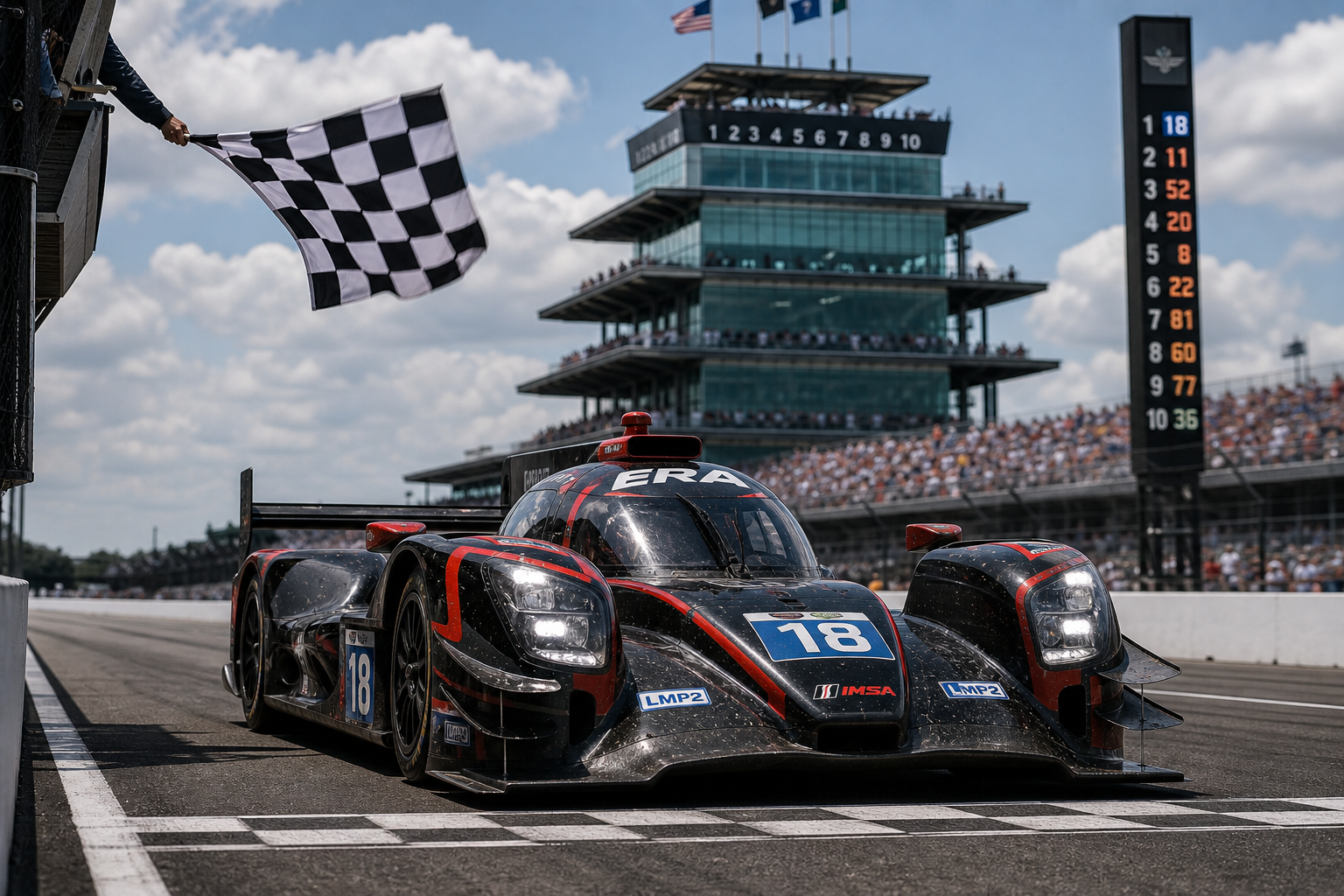

Era Motorsport didn’t win the LMP2 class at Indianapolis by simply charging harder than everyone else. It won by making fuel last when the race was asking every prototype to drink deeply.
Christian Rasmussen and Nick Boulle brought the No. 18 Oreca 07 Gibson across the line first in Sunday’s Battle on the Bricks, giving Era Motorsport its first LMP2 victory of the 2026 IMSA WeatherTech SportsCar Championship. Rasmussen finished 15.004 seconds ahead of the nearest challenger after the team committed to an aggressive fuel-saving strategy around Indianapolis Motor Speedway’s 2.439-mile, 14-turn road course.
That margin sounds comfortable. It probably didn’t feel comfortable from the cockpit.
Era Motorsport Wins the Race on Fuel Strategy
Fuel saving in sports-car racing is one of those jobs that looks faintly ridiculous until it wins you the race. A driver is expected to lap quickly, fight traffic, protect the tires, manage the car and hit every braking point correctly. Then the team asks for a little less throttle, a little earlier lift and perhaps a touch more patience while the competition continues behaving as though the fuel tank is connected to a small offshore pipeline.
Era’s approach at Indianapolis was built around making the available fuel stretch far enough to reach the finish without surrendering the LMP2 lead. That is a delicate calculation. Save too little and the car risks running dry or requiring an extra pit stop. Save too much and the advantage disappears while faster cars close in.
Rasmussen and Boulle had to keep the No. 18 Oreca moving quickly enough to stay clear while trimming the fuel burn lap after lap. The task is less glamorous than a late braking pass into Turn 1, but it demands the same level of precision. A driver cannot simply coast around looking thoughtful. The car still has to be placed accurately, traffic has to be managed and the pace must remain high enough to protect track position.
That 15.004-second winning margin is a useful indication of how well Era managed the compromise. The team did not merely survive a fuel gamble. It turned the gamble into a controlled victory.
Why the Indianapolis Road Course Makes Fuel Management Difficult
Indianapolis is best known for its enormous oval, but the Battle on the Bricks uses the circuit’s infield road course rather than the full speedway layout. The 2.439-mile configuration features 14 turns, creating a lap that mixes heavy braking, slower corners and faster sections where a prototype can properly stretch its legs.
That variety complicates fuel saving. A driver can lift earlier on a straight or moderate the throttle on corner exit, but every reduction in acceleration has to be weighed against traffic and lap-time loss. The road course also creates repeated opportunities for cars to bunch together, making clean air and track position valuable commodities.
There is no single magic switch marked “economy mode.” Fuel strategy is usually assembled from dozens of small decisions: lifting before the braking zone, avoiding needless wheelspin, using momentum through corners and making sure the engine is not working harder than necessary when a slightly calmer approach will do. The trick is to remove waste without making the car vulnerable.
That is where experienced endurance drivers earn their money. The fast lap is obvious. The efficient lap is much harder to spot, particularly when it still has to be fast enough to win.
The No. 18 Oreca 07 Gibson Delivers the Platform
Era Motorsport’s winning car was the No. 18 Oreca 07 Gibson, a purpose-built LMP2 prototype rather than a modified production car. LMP2 machinery is designed around a controlled technical formula, with teams working within defined chassis and powertrain parameters rather than developing an entirely new car for every season.
That makes execution especially important. The teams are not arriving with wildly different engineering philosophies or unlimited freedom to chase horsepower. Race results are shaped by preparation, pit work, traffic management, tire use, driver consistency and strategy. When the cars are closely matched, a decision made several laps before the finish can matter more than a tenth found in qualifying.
The Oreca 07’s role in this result was therefore more than simply providing a fast platform. The car had to remain predictable while the drivers altered their usual rhythm to conserve fuel. Fuel saving can change the way a prototype approaches corners and accelerates away from them, so a car that remains stable and manageable becomes a much more useful tool than one that only works at maximum attack.
That is the unromantic beauty of endurance racing. The winning car is not always the one that looks busiest. Sometimes it is the one whose crew has found the least waste.
Rasmussen and Boulle Share the Difficult Part
Rasmussen and Boulle shared the driving duties in the No. 18 entry, with Rasmussen completing the winning run to the checkered flag. A fuel-saving race places demands on both drivers because the strategy has to survive the whole event, not just the final stint.
One driver can’t spend the middle portion of the race saving fuel only for the next driver to attack every exit curb as though the race has suddenly become a qualifying session. Endurance teamwork is built around consistency. Pace targets, fuel numbers and tire behavior have to remain aligned across driver changes, even when the car is dealing with traffic, changing grip and the usual assortment of prototype-racing complications.
For the driver finishing the race, the final laps can be particularly awkward. The lead may look secure on the timing screens, but the pressure has not gone away. There is still a car behind, the fuel calculation still matters and every slow corner presents a chance to lose more time than planned. The winning driver must resist the temptation to answer every attack at full throttle.
Rasmussen’s 15.004-second advantage suggests Era had enough margin to manage that closing phase without turning the finish into a roadside refueling exercise. Boulle’s contribution was equally important in building the situation that made the final fuel call possible.
Era Motorsport Finally Gets Its 2026 LMP2 Breakthrough
The Indianapolis victory was Era Motorsport’s first LMP2 win of the 2026 IMSA WeatherTech SportsCar Championship. That detail gives the result more weight than a single trophy on a busy race weekend.
A season can contain quick cars, solid finishes and weekends where a team appears close without ever finding the complete package. A victory requires the pace to be present, but it also requires the strategy, execution and timing to line up on the same afternoon. At Indianapolis, Era got that combination right.
The result also shows why the LMP2 class remains such a compelling part of the WeatherTech SportsCar Championship. The cars are fast enough to demand proper prototype technique, yet the races can turn on decisions that have little to do with outright speed. A team willing to sacrifice a fraction of lap time in the right places can gain far more when the fuel window closes.
That is the sort of victory engineers enjoy and drivers remember. There is no dramatic new bodywork to point at, no ridiculous horsepower figure and no marketing department insisting that a slightly revised air vent has transformed the human experience. Just a race team, two drivers and a fuel number that had to remain on the correct side of zero.
At Indianapolis, Era Motorsport made it work. The No. 18 Oreca 07 Gibson reached the finish first, Rasmussen and Boulle earned their place at the top of the LMP2 results, and a careful approach proved faster than a reckless one. In endurance racing, that is not caution. It is speed with the unnecessary drama removed.
0 Comments