
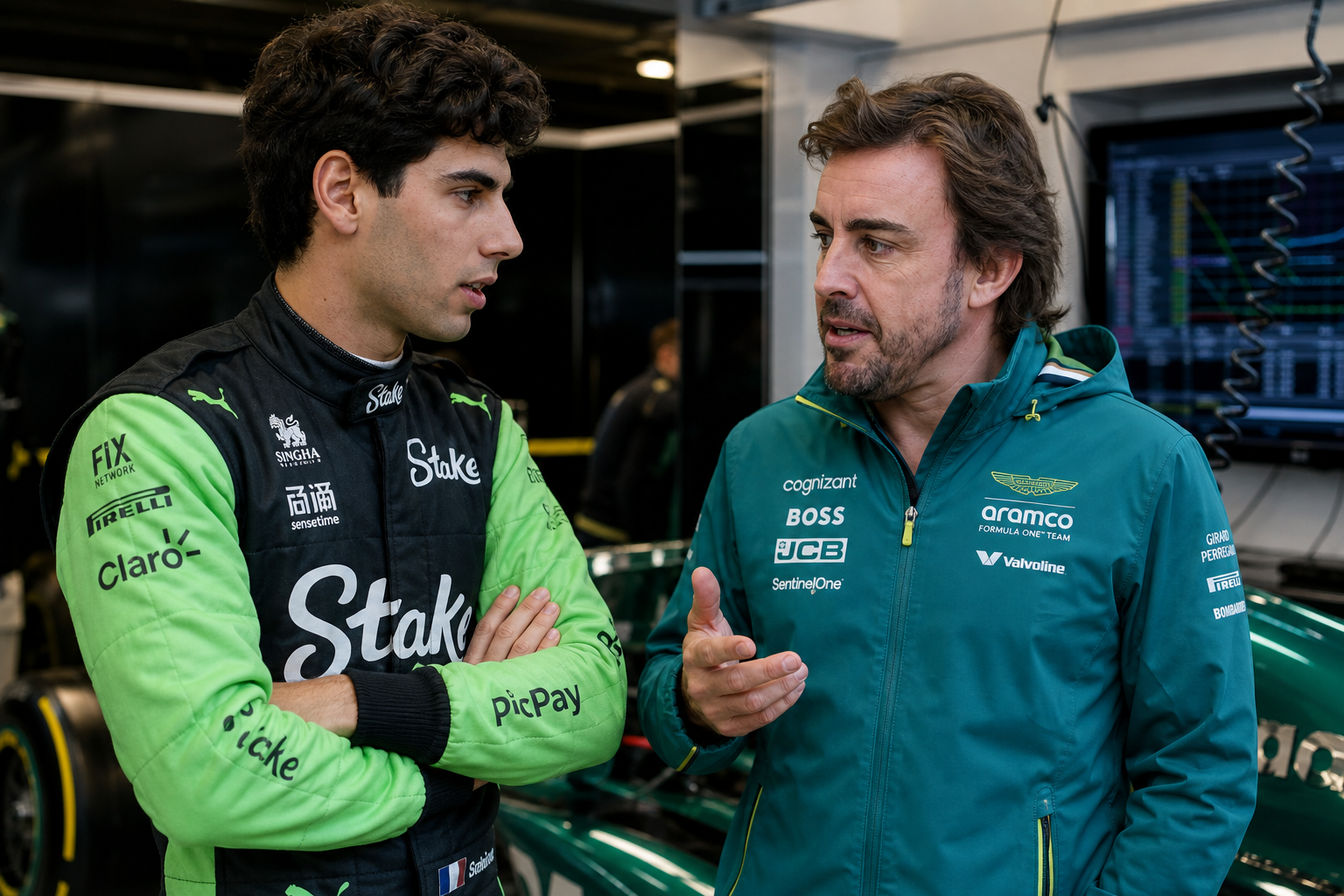

Fernando Alonso has spent two decades cultivating one of Formula 1’s most recognizable personalities: sharp, suspicious of nonsense, occasionally theatrical, and rarely inclined to let a microphone pass without giving it something useful to work with. According to Gabriel Bortoleto, that version of Alonso isn’t a media invention.
The Brazilian, now an Audi Formula 1 driver, says his manager behaves behind the scenes much as he does in front of television cameras. That is an intriguing endorsement from someone who has worked with Alonso away from the noise of a Grand Prix weekend, where every raised eyebrow can become a headline and every radio message is examined like an archaeological artifact.
Bortoleto Has Seen the Alonso Behind the Headlines
Bortoleto’s relationship with Alonso is not merely that of a young driver seeking advice from an experienced former champion. Alonso also manages the Brazilian, giving him a close view of the man away from the polished interviews, team briefings, sponsor commitments, and carefully edited television packages that make up the public side of Formula 1.
His conclusion is simple: Alonso is essentially the same person when the cameras are gone.
That might sound unremarkable, but Alonso’s public image is unusually strong. He is known for being direct, highly competitive, technically engaged, and willing to express frustration when he believes circumstances have worked against him. He can be funny, cutting, generous, or gloriously unimpressed, sometimes within the same interview. The suspicion with any major sports personality is that the public character has been polished for consumption.
Bortoleto’s assessment suggests otherwise. The intensity seen during a race weekend is not simply a performance designed to keep Alonso relevant between podiums. It is part of how he naturally approaches competition and the business of racing.
Why Alonso’s Management Role Is Interesting
Alonso taking a management role in Bortoleto’s career adds another layer to the story. Driver managers are expected to handle negotiations, career planning, contracts, and the politics that swirl around a young driver’s progression. In Formula 1, that requires more than spotting talent. It demands a clear understanding of how teams operate, how opportunities appear, and how quickly a promising career can be nudged off course by poor timing.
Alonso knows that environment intimately. He has raced for several of the sport’s major teams, won two world championships, and remained a significant figure across different technical eras. His career has included dominant machinery, difficult team situations, ambitious projects, and the occasional strategic decision that looked considerably better on paper than it did once the racing began. That experience gives him a rather more useful perspective than the usual collection of motivational posters and LinkedIn slogans.
For Bortoleto, the benefit is likely less about receiving grand speeches from a champion and more about having access to someone who understands the details that outsiders often miss. Formula 1 performance is shaped by driving ability, certainly, but also by team structure, political judgment, technical feedback, media handling, and knowing when to push for an opportunity.
From Sauber Debut to Audi’s Factory Project
Bortoleto made his Formula 1 debut with Sauber in 2025. The Swiss team then became Audi’s works Formula 1 operation at the start of the following season, placing the Brazilian inside a manufacturer-backed project with much greater long-term ambition and scrutiny.
That transition changes the nature of the job. A newcomer at an independent or transitioning team is already learning the rhythm of Formula 1: the travel, the engineering meetings, the relentless media schedule, and the unforgiving speed at which mistakes become public property. Doing so while a major manufacturer establishes its own identity adds another layer of pressure.
Audi’s arrival also means that Bortoleto’s development is being watched as part of a broader project. The team is not merely entering races; it is building a factory operation, shaping its technical direction, and trying to establish credibility in the championship. A young driver in that situation must develop quickly without being consumed by the expectations surrounding the badge on the engine cover.
That is where a manager with Alonso’s experience could prove particularly valuable. He understands the difference between a team’s public promises and the harder realities of building performance. He also knows that Formula 1 careers are rarely linear. A driver can look like a future champion one weekend, struggle with an awkward car the next, and find his reputation being debated by people who have never had to drive the thing.
The Public Alonso Is Not a Carefully Constructed Mask
Alonso’s appeal has always rested partly on the gap between his immense ability and his refusal to behave like a conventional corporate athlete. He is not naturally bland. He does not seem especially interested in pretending that every development is positive, every decision is logical, or every race weekend has been a delightful learning experience.
That candor can be divisive, but it is also why fans continue to pay attention. In an era when many sporting interviews are assembled from the same handful of approved phrases, Alonso tends to sound like a person who has actually been present for the events being discussed.
Bortoleto’s comments imply that this character remains intact away from the paddock spotlight. The sarcasm, intensity, and competitive edge are not switched on for the benefit of television. They are simply part of Alonso’s working personality.
A Useful Relationship for a Young Driver
There is an obvious danger in being managed by a famous driver. The older champion’s reputation can dominate every conversation, while the younger racer risks being viewed as an extension of the mentor rather than a competitor in his own right. Bortoleto will ultimately have to establish his identity through his results, not through his association with Alonso.
Still, a candid relationship can be an advantage. Bortoleto appears to value the fact that Alonso is consistent rather than performatively charming. Knowing that the advice-giver is the same person in private as in public may make difficult conversations easier, particularly when the message is not what a young driver wants to hear.
And Alonso has never seemed short of opinions.
The most revealing part of Bortoleto’s comments is therefore not that Alonso is intense or competitive. Nobody needed a fresh investigation to establish that. It is that the Brazilian sees those qualities as genuine, stable traits rather than a carefully managed Formula 1 persona. As Bortoleto begins his second season in the championship and adjusts to Audi’s new factory environment, having that kind of experienced, unvarnished guidance may be worth considerably more than another layer of polished public relations.


0 Comments