
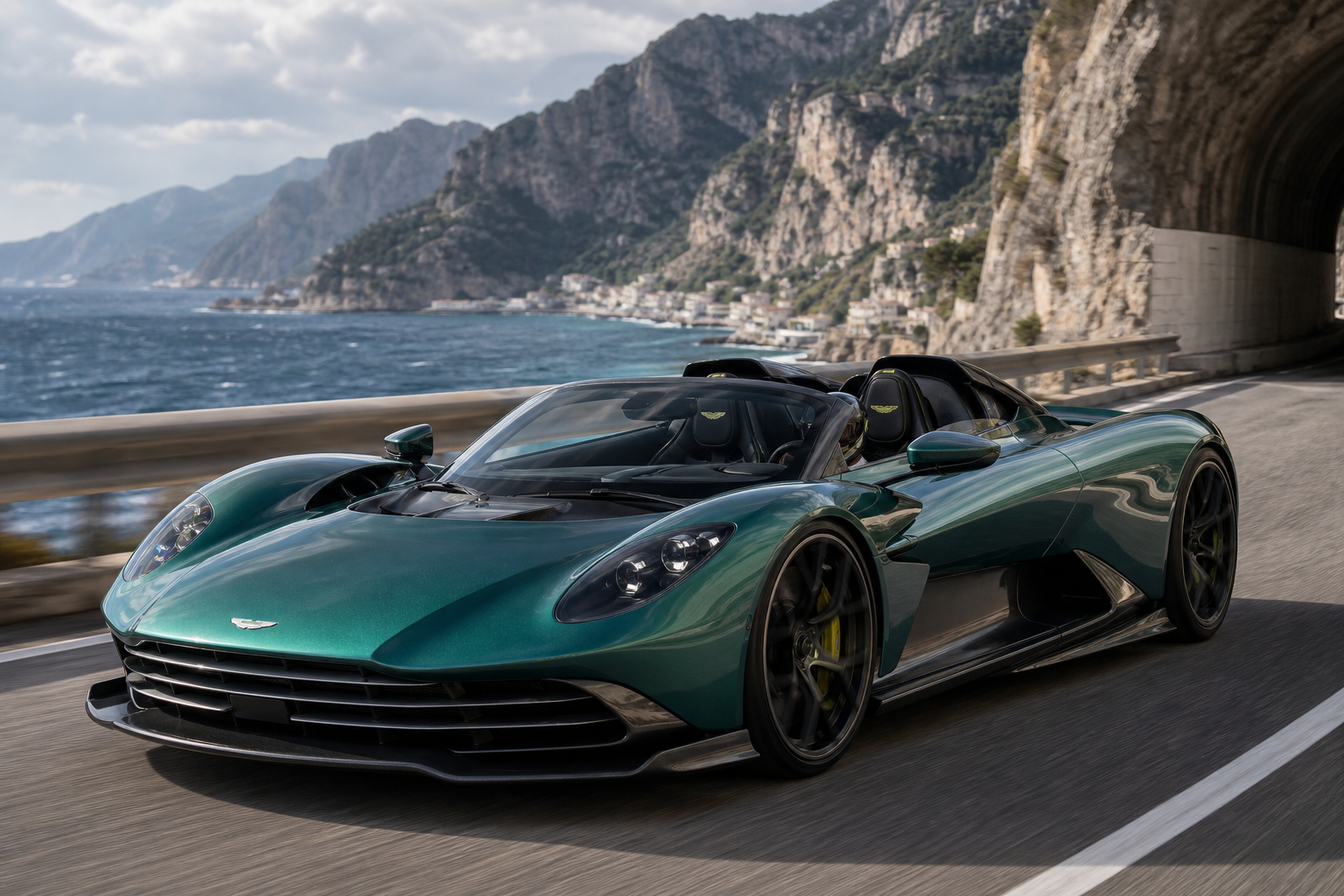

Aston Martin’s Valhalla is about to lose some of its roof, assuming the latest report proves accurate. The British manufacturer is expected to reveal a Valhalla Spider in November 2026, adding a targa-style roof to its mid-engine plug-in hybrid hypercar.
That may sound like a straightforward body-style expansion. It isn’t. Removing the fixed roof from a car built around extreme performance, hybrid power and serious aerodynamic intent is an engineering exercise with rather more consequences than simply finding somewhere to store two roof panels. Aston Martin will need to preserve the Valhalla’s structural rigidity, aerodynamic balance and cooling performance while giving collectors something the coupe cannot provide: open-air access to a powertrain capable of producing nearly 1,000 horsepower.
A Roofless Valhalla Would Be a Very Different Proposition
The reported Spider is expected to use a targa-style roof, rather than becoming a traditional soft-top convertible. That distinction matters. A removable center roof section can retain more of the visual drama and structural character of a fixed-roof hypercar, while avoiding the packaging, weight and sealing complications associated with a fully folding roof mechanism.
It also suits the Valhalla’s character. This is not meant to be a relaxed grand tourer with a removable lid and a heroic badge on the nose. The Valhalla is Aston Martin’s mid-engine performance flagship, developed to bring genuine track capability to a road-legal car. Its proportions, low cabin and aggressive bodywork are all part of that argument. A targa roof could add theater without turning the car into a particularly expensive beach toy.
That said, there is no such thing as a free roof removal. The roof normally contributes to the stiffness of the passenger cell, so the Spider may require additional reinforcement elsewhere. That can mean extra mass, and extra mass is the enemy of everything a hypercar is supposed to do: acceleration, braking, cornering and the increasingly sacred lap-time figure. Whether Aston Martin can keep those compromises modest will be one of the most interesting parts of the car.
The Valhalla’s Hybrid Hardware Is the Real Event
The roof is the new bit, but the Valhalla’s mechanical package remains the reason this car exists. The production coupe uses a mid-mounted twin-turbocharged 4.0-liter V8 supported by a plug-in hybrid system. Aston Martin has described a three-motor arrangement, with electric motors assisting the front axle and another integrated into the rear drivetrain.
Combined output is expected to sit at roughly 937 horsepower, giving the Valhalla the sort of performance normally associated with a racing program rather than a road car wearing license plates. The electric front motors also allow all-wheel drive when required and provide torque vectoring, giving the engineers another tool for managing the car’s considerable output.
Unlike a simple battery-electric hypercar, the Valhalla is designed around the interaction between combustion power and electrical assistance. The electric motors can deliver immediate response at low speed, while the V8 provides sustained performance once the car is moving quickly. That combination should make the car more flexible on the road than a highly strung track special, although the final driving character will depend heavily on how Aston Martin calibrates the hybrid system.
The battery is not there merely to make the specification sheet look modern. It can provide electric propulsion for short distances, reduce emissions during low-speed driving and fill in the gaps while the gasoline engine builds boost. In a car of this power, that instant electric shove is useful not just for environmental compliance but for making the throttle response feel properly sharp.
Track Ambition, Road-Car Compromise
Aston Martin has positioned the Valhalla as a car for both collectors and drivers who intend to use it on a circuit. That is a more demanding brief than it sounds. A garage queen can tolerate almost anything provided it photographs well beside a modernist house. A track-driven car cannot.
Track use brings heat, tire wear, repeated braking and long periods of sustained engine load. The Valhalla’s hybrid system, battery and electric motors all add performance, but they also add thermal-management requirements. A Spider version would have to deal with those same demands while accommodating the consequences of an altered roof structure.
That is why the targa approach could be a sensible compromise. A fully open convertible might require more extensive structural changes, while a removable roof section could preserve much of the coupe’s architecture. It may still add weight, but potentially less than a complex retractable mechanism. Hypercar engineers tend to spend their lives removing grams, so asking them to add some back is roughly like asking a chef to improve a soufflé by throwing a brick into it.
Aston Martin’s aerodynamic work will be equally important. The Valhalla is not shaped purely for decoration. Its bodywork is intended to manage airflow, generate downforce and keep the car stable at high speed. Changing the roof and upper body can alter the air reaching the rear wing, engine intake and cooling openings. The Spider therefore cannot simply be a coupe with a saw taken to it and a cheerful press release afterward.
Why the Spider Makes Commercial Sense
The Valhalla is aimed at a small, wealthy group of buyers, and those buyers do not necessarily want the same thing from a hypercar. Some will prioritize the cleanest possible lap-time package. Others will want exclusivity, technical drama and a car that feels distinct from anything else in the collection.
A Spider gives Aston Martin another way to make the Valhalla feel special without developing an entirely separate model. It also follows a familiar pattern in the high-end performance market: once a manufacturer has created a low-volume flagship, additional body styles and limited variants can extend the car’s commercial life and appeal to different collectors.
The challenge is avoiding the impression that the Spider is merely a softer, more decorative version. A roofless hypercar can be enormously entertaining, but it must still feel engineered rather than accessorized. Buyers paying this kind of money will expect the car to have a clear technical purpose, even if that purpose occasionally involves making a dramatic entrance outside a private members’ club.
What Remains Unconfirmed
The reported November 2026 debut does not yet answer the questions enthusiasts will immediately ask. Aston Martin has not, on the information currently available, confirmed the Spider’s final power output, acceleration, top speed, curb weight, roof-removal system or production allocation.
Those details will determine whether the Spider is a close mechanical match for the coupe or a more heavily revised derivative. The roof itself could be manually removable, electrically assisted or supported by a more elaborate storage arrangement, but there is no reason to assume the answer before Aston Martin provides it. With a car this compact and this mechanically busy, roof storage is not a trivial matter. There is no cavernous trunk waiting patiently to swallow half a house.
Pricing has also not been established for the reported model. Given the Valhalla’s positioning and limited-production nature, the Spider is unlikely to be the bargain alternative. It will probably be sold on its added rarity and open-air character rather than as a cheaper route into Aston Martin’s hybrid flagship.
Aston Martin’s Most Theatrical Hybrid Yet?
The Valhalla Spider could become one of Aston Martin’s most revealing cars. The company is trying to combine a high-output V8, serious electrification, mid-engine packaging and motorsport-flavored aerodynamics with the emotional appeal of an open cockpit. That is a difficult recipe, but it is also far more interesting than another oversized luxury SUV with a battery and a name chosen by committee.
If the reported November 2026 debut goes ahead, the key question will not be whether the roof comes off. It will be whether Aston Martin can remove it without dulling the qualities that make the Valhalla worth building in the first place. A successful Spider would preserve the coupe’s technical credibility while adding a layer of noise, weather and mechanical theater that no fixed roof can quite replicate.
That is a demanding brief. It is also exactly the sort of gloriously unnecessary engineering challenge that makes a flagship worth paying attention to.
0 Comments