
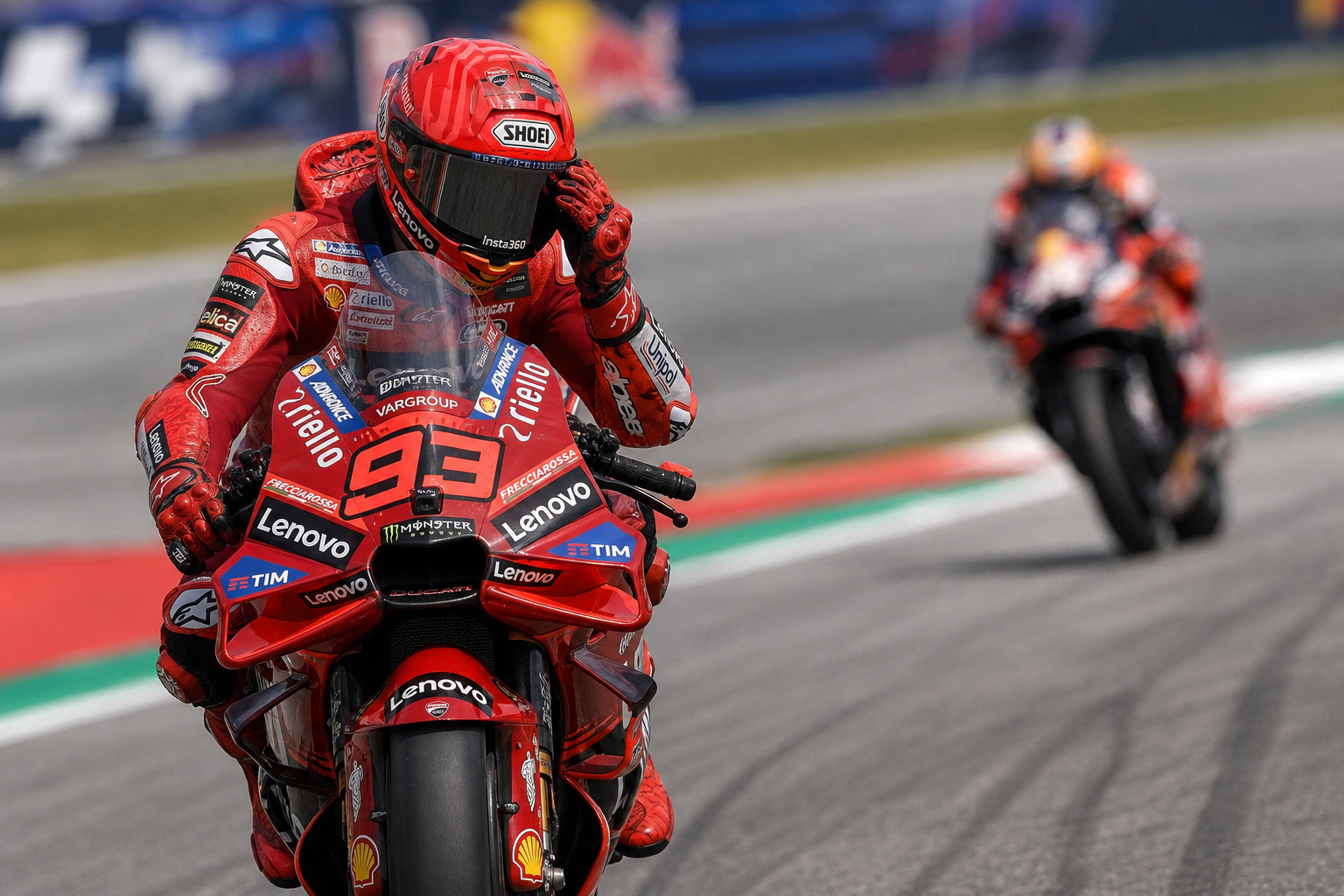

Marc Márquez had a front-row starting position and a Ducati capable of fighting at the sharp end of the Austrian Grand Prix. By the time the race was over, he had finished fifth and admitted that he had seriously considered pulling into the pits rather than continuing.
The reason was not a lack of pace in the usual sense. Márquez’s race was badly compromised by brake problems, an especially cruel issue at the Red Bull Ring, where stopping performance is central to almost every competitive lap. A MotoGP rider can tolerate a great many annoyances. An uncertain front brake is not one of them.
A Front-Row Start Turned Into Damage Limitation
The factory Ducati rider began Sunday’s race from the front row, giving him a clear opportunity to stay with the leaders during the opening laps. Instead, his difficulties were visible immediately as he fell from second position.
That early drop was more than a poor getaway or a momentary loss of rhythm. Braking problems affect the entire shape of a lap. They influence how late a rider can brake, how much pressure he can apply, how confidently he can release the lever, and how much speed he can carry into the corner. If the rider cannot trust the front end, every turn becomes a negotiation rather than an attack.
At the Red Bull Ring, that negotiation becomes particularly expensive. The circuit features several heavy braking zones separated by short bursts of acceleration, leaving little room for a rider to hide a problem. A bike that cannot deliver consistent braking performance will surrender time at the end of the straights and may also force its rider to compromise corner entry and exit.
Márquez’s eventual fifth place therefore tells only part of the story. A rider starting near the front and ending fifth will normally be judged against the result sheet. In this case, the more revealing detail was that he was contemplating retirement during the race.
Why a MotoGP Brake Issue Is So Serious
Modern MotoGP bikes use extraordinary braking systems, but extraordinary hardware does not make brake behavior any less important. Riders depend on a predictable relationship between lever input and deceleration. They need to know that the bike will respond in the same way from one braking zone to the next, particularly when they are arriving at high speed and trying to position the machine for a tight corner.
When that consistency disappears, the problem is not merely a few lost tenths. A rider may have to brake earlier, apply less force, or alter the release phase to keep the bike stable. Those changes then affect tire management, overtaking opportunities, and the ability to defend position. The rider is no longer choosing the ideal line; he is choosing the least troublesome version of it.
That is why Márquez’s consideration of retirement should not be dismissed as frustration after a disappointing result. Continuing with a brake problem carries an obvious safety concern, and it can also create a vicious cycle: reduced confidence leads to conservative braking, conservative braking costs positions, and traffic makes it harder to recover the time lost.
The sensible decision in such circumstances is not always to grit one’s teeth and finish. Sometimes it is to stop. Racing motorcycles at MotoGP speed is not an activity improved by heroic optimism when a primary control system is misbehaving.
The Red Bull Ring Punishes Hesitation
Austria’s circuit is compact, fast, and unforgiving of uncertainty. Its long straights put a premium on acceleration and top speed, but the lap time is also shaped by the ability to brake hard and turn the bike accurately at the end of those straights. A rider who has to sacrifice braking performance loses time twice: first while slowing down, then again while trying to recover the corner.
That makes the timing of Márquez’s problem particularly unfortunate. A brake issue at a flowing circuit might be managed with different lines or smoother inputs. At the Red Bull Ring, the repeated stop-start layout exposes it relentlessly. There is no convenient sequence of gentle bends in which to gather confidence while the problem is investigated.
It also helps explain why a front-row starting position offered no protection. Márquez had the track position needed to race at the front, but the race immediately became a matter of limiting the damage. Once he dropped back from second, the objective was no longer simply to convert qualifying speed into a podium. It was to keep the motorcycle under control and bring it home.
Fifth Place Does Not Reflect the Full Difficulty
A fifth-place finish is plainly below what Márquez and Ducati would have expected from a front-row start. Yet it is also a substantial recovery from a situation in which the rider was considering abandoning the race altogether.
The result suggests that Márquez managed the problem well enough to complete the Austrian Grand Prix, even if it prevented him from showing the pace that had put him near the front of the grid. That distinction matters. A rider can finish outside the podium because of a tactical mistake, tire trouble, a poor start, or simple lack of speed. Here, the central issue was confidence in the brakes from the opening phase of the race.
There is no need to dress the result up as a triumph. Fifth was not the target. But neither should it be read as a straightforward collapse in performance from the rider or the Ducati package. The race exposed a mechanical problem that compromised Márquez before he had a fair chance to use his starting position.
Ducati’s Focus Will Turn to the Cause
For the Ducati team, the important work begins after the checkered flag. The exact cause of the brake trouble will determine whether it was an isolated race-day failure, a component issue, a setup problem, or something that requires broader attention. The available account establishes the effect of the problem, but not its precise technical origin.
That investigation will matter because MotoGP braking systems operate under punishing loads, and a rider’s confidence can be damaged even after the immediate fault has been corrected. Márquez will need to know that the response is consistent before he can return to attacking the braking zones at full commitment. A data trace may show where the performance changed; restoring trust is the more human part of the repair.
The Austrian Grand Prix therefore became a curious sort of non-result for Márquez. The fifth-place finish will occupy the official record, while the more important lesson sits behind it: a front-row Ducati was capable of much more, but a brake problem reduced one of MotoGP’s most aggressive riders to survival mode.
At this level, the difference between fighting for victory and thinking about retirement can be one component behaving incorrectly at the end of a straight. It is a brutal reminder that even the fastest motorcycle on the grid is only as useful as the rider’s faith in it.
0 Comments