
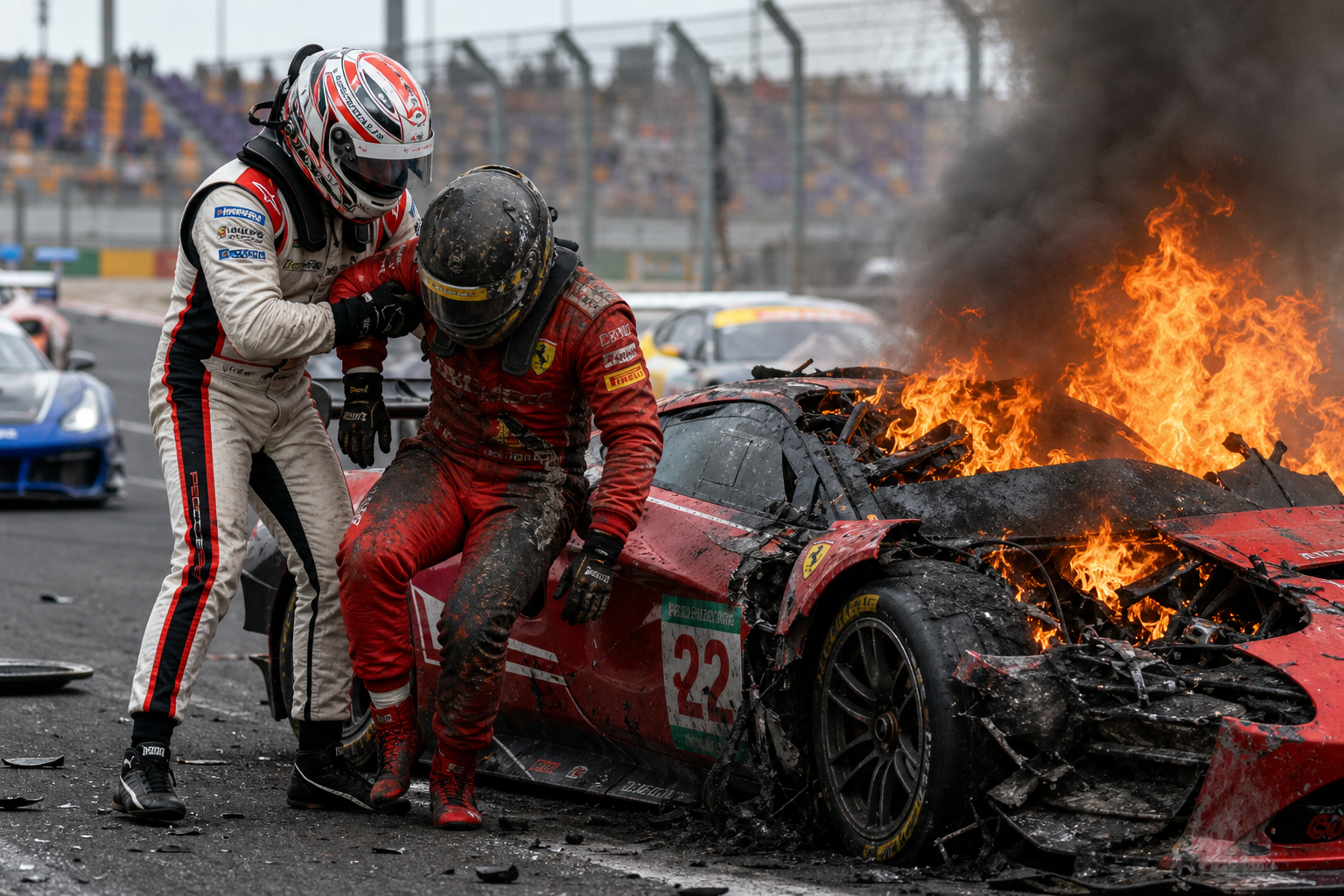

Ollie Millroy is back home and continuing his recovery after being discharged from the hospital two weeks after a frightening China GT crash in Shanghai. The British driver was caught in a multi-car pile-up during Race 1, with his Ferrari 296 catching fire in the incident.
The most important news is reassuringly simple: Millroy no longer requires hospital care. His recovery will now continue at home, although no further details about his injuries or the expected length of his rehabilitation have been provided.
A Race Incident That Turned Into an Emergency
Millroy was described as an innocent party in the Shanghai pile-up, an important distinction in a sport where the driver who suffers the worst consequences is not always the person who caused the initial contact. Multi-car accidents can develop in fractions of a second, leaving drivers with very little room to avoid cars, debris, or a rapidly closing escape route.
In Millroy’s case, the Ferrari 296 became engulfed in flames after the collision. A race car fire is one of the scenarios drivers, teams, marshals, and rescue crews prepare for most rigorously, but preparation does not make the sight any less alarming. Once fuel, hot mechanical components, bodywork, and electrical systems are involved, the situation can deteriorate remarkably quickly.
The incident also underlined the importance of what happens immediately after the crash. Loek Hartog stopped his Porsche and went to Millroy’s aid, helping pull the British driver from the Ferrari. Hartog’s decision to abandon the relative safety of his own car and intervene was a brave and instinctive response to a fellow competitor in serious danger.
Hartog’s Rescue Added a Human Element
Motorsport is often presented through lap times, tire strategy, qualifying margins, and the glamorous machinery lined up on a starting grid. Those details matter, naturally. They are the reason people watch racing in the first place.
But when a car catches fire, the polished competition disappears rather quickly. Drivers become the first people on the scene, and the instinct to help can take precedence over the race itself. Hartog stopping his Porsche to assist Millroy was a reminder that the relationships formed in racing are not limited to team garages or post-race handshakes.
There is also a practical point here. Drivers know that stopping at an accident can expose them to considerable danger, particularly when a vehicle is burning and other cars may still be approaching. Hartog nevertheless judged that Millroy needed immediate assistance and acted. The rescue does not erase the seriousness of the crash, but it is an important part of the story.
Why a Ferrari 296 Fire Is Such a Serious Event
The Ferrari 296 is a sophisticated modern race car, built around a high-performance twin-turbocharged V6 and hybrid technology in its road-going form. The competition version is designed for circuit racing, with the safety equipment, fire systems, restraints, and reinforced structure required of a contemporary GT machine.
That equipment exists for precisely this sort of emergency. A racing car’s safety cell, harnesses, helmet, fire-resistant clothing, onboard fire suppression system, and rapid-response procedures all have to work together when a crash becomes more than a straightforward impact.
Even so, no safety system makes a serious accident routine. Fire adds heat, smoke, poor visibility, and time pressure to an already violent event. Getting the driver out quickly is vital, which makes Hartog’s intervention and the work of the circuit’s emergency personnel especially significant.
It would be wrong to draw technical conclusions about the Ferrari or the crash without a full investigation. A vehicle catching fire does not, by itself, establish why the fire began or whether any particular component failed. Race cars can suffer extensive damage in heavy impacts, and the available information does not provide a detailed account of the sequence.
Recovery Comes Before Racing
Millroy’s discharge is welcome news, but it should not be mistaken for a declaration that the ordeal is over. Leaving the hospital is one stage of recovery, not necessarily the finish line. The next phase may involve medical follow-up, rest, rehabilitation, and the less glamorous business of allowing the body to recover properly.
Competitive drivers are accustomed to returning to work quickly. Racing calendars do not pause politely, and professional motorsport rewards availability almost as aggressively as outright speed. That pressure can make patience difficult. In this case, however, the sensible priority is Millroy’s health rather than a timetable dictated by the next event.
No information has been given about when he might return to competition. That is entirely understandable. After a crash of this severity, any decision should depend on medical advice and Millroy’s own recovery rather than speculation from outside the team.
The Race Can Wait
There will be time later to assess the Ferrari’s damage, review the pile-up, and examine whether any changes are needed in the way the incident was managed. Those questions matter to the China GT organizers, the teams, and the drivers who will return to the circuit.
For now, the central development is that Millroy has left the hospital and can recover at home. He was caught up in a crash that could have ended very differently, and he received immediate help from a rival driver who stopped when it mattered.
Racing is built around competition, but moments like this strip the sport back to its most basic principle: everyone wants to see the cars race, and everyone wants the drivers to come home.
0 Comments