
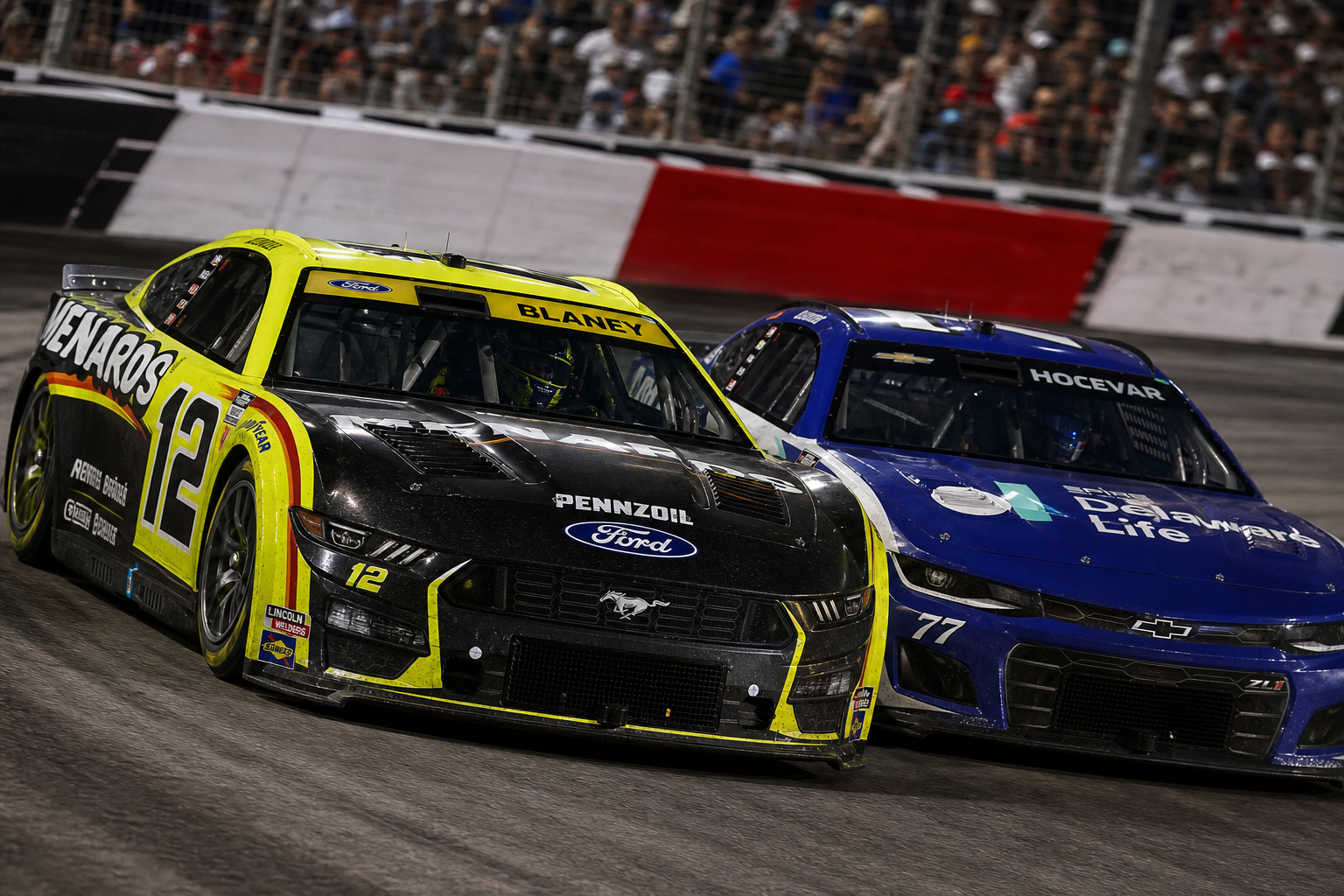

For three weeks, NASCAR’s playoff story had an obvious villain and an increasingly ridiculous supporting cast. Carson Hocevar kept finding himself at the center of the conversation, while the rest of the garage appeared to be waiting for somebody—anybody—to stop talking and start answering.
At Bristol, Ryan Blaney apparently decided that patience had run its course.
That is the significance of the latest flare-up involving Hocevar. It wasn’t merely another complaint on a driver’s radio or another irritated interview delivered with the carefully managed fury of a man who knows a television camera is nearby. This time, one of the sport’s established front-runners made it clear that Hocevar’s conduct had consequences.
NASCAR Had Already Framed the Fight
The tension did not arrive out of nowhere. When the championship playoff began three weeks earlier, NASCAR issued an unusually blunt press release titled “15 vs. 1.” The message was difficult to misunderstand: Hocevar had developed a reputation for irritating practically everyone around him, and the rest of the field was beginning to look like a collective opposition party.
That is not normal language for a sanctioning body. NASCAR is perfectly comfortable promoting rivalries, but it generally prefers them packaged neatly, with marketable names and a reasonable chance of producing a dramatic television segment. “Nearly the entire garage is fed up with one driver” has a slightly less polished ring to it. It sounds more like the setup to a schoolyard dispute than a championship press release.
Still, the phrase captured the mood. Hocevar had become the common denominator in a run of controversies, and the question was no longer whether other drivers disliked racing around him. The question was whether anyone would do anything about it.
Why Bristol Was the Place This Happened
Bristol is not a subtle racetrack. The Tennessee short track is a high-banked, tight bullring where cars run close together, mistakes arrive quickly, and there is very little room for a driver to pretend that contact was entirely accidental. At a place like Bristol, a small disagreement can become a major incident before the television producer has finished finding the replay.
The track also changes the emotional temperature of a race. Drivers spend lap after lap in close quarters, often within inches of one another, with the outside wall waiting to punish even a minor lapse in judgment. A driver who is already carrying a reputation for aggressive or unpredictable moves will not receive the benefit of the doubt there. He may not receive it anywhere else, either, but Bristol removes the final layer of politeness.
That made Blaney’s response particularly meaningful. He was not an anonymous backmarker settling an old score in a forgotten corner of the field. He is a championship-caliber driver, a prominent member of the modern NASCAR establishment and precisely the sort of competitor who usually has more to lose by turning a disagreement into a physical confrontation.
When a driver in that position decides the conversation needs to move from the microphone to the garage, the paddock notices.
The Problem With Letting “Hard Racing” Explain Everything
NASCAR has always had a complicated relationship with aggressive driving. Contact is part of stock-car racing. Short-track racing, in particular, has never been a gentle exercise in cooperative lane management. Drivers lean on each other. They move cars out of the way. They remember incidents for longer than most people remember birthdays.
That is part of the appeal. A completely sanitized NASCAR race would be about as compelling as watching two office elevators arrive at the same time.
But there is a difference between forceful racing and behavior that repeatedly leaves other drivers convinced they have been treated as disposable obstacles. The distinction matters because “that’s just hard racing” can become a remarkably useful excuse. It allows a driver to present every incident as someone else’s misunderstanding, even when the same complaints keep appearing from different competitors.
Hocevar’s problem is not necessarily one isolated move. The broader issue is the accumulation of incidents, reactions and resentment. Once enough drivers begin describing the same pattern, the argument changes. It is no longer simply a question of whether one maneuver was defensible. It becomes a question of whether the driver has earned the lack of trust now following him from track to track.
Trust is a practical asset in NASCAR. Drivers depend on one another to hold a line, leave room and behave predictably at high speed. A competitor who is considered difficult to read will eventually find that other drivers stop offering generous interpretations of his actions. That is not a formal penalty. It is the social one.
Blaney’s Role in the “15 vs. 1” Story
Ryan Blaney stepping into the dispute changes its shape. This was not simply another member of the field adding his name to a growing list of complaints. Blaney’s response suggested that the patience NASCAR had been talking around had finally run out in a very visible way.
That helps explain the Ric Flair comparison. Professional wrestling has never been shy about turning conflict into theater, and Flair’s famous demand that competitors take their helmets off and fight is the perfect exaggerated soundtrack for a NASCAR garage boiling over. The phrase is ridiculous, theatrical and oddly appropriate. After weeks of drivers appearing to circle the same issue without directly confronting it, somebody finally delivered the motorsport equivalent of throwing a folding chair into the ring.
There is a serious point beneath the spectacle. Drivers are competitors, not merely performers. They accept substantial risk every time they climb into a Cup car, and frustration becomes particularly sharp when one driver believes another is creating unnecessary danger. The helmet is not just a prop in this story. It represents the boundary between racing conduct and personal confrontation.
NASCAR still has to decide where that boundary sits.
What NASCAR Does Next Will Matter
The sanctioning body created extra attention with the “15 vs. 1” release, whether deliberately or not. Once NASCAR publicly framed Hocevar as the driver standing against the rest of the field, every subsequent incident became part of the same narrative. That is useful promotion until the narrative demands an answer.
If the organization wants hard racing, it has to define what falls outside that description. If it wants drivers to settle disagreements without escalating them, it must make clear that physical confrontations will not be treated as harmless entertainment. And if it believes Hocevar’s driving has crossed a line, the response must be based on conduct and evidence rather than the popularity of the people complaining.
That last part is important. A driver being unpopular does not automatically make every accusation against him correct. NASCAR cannot officiate by taking a garage-wide vote, however satisfying that might be after a long night at Bristol. The rules still have to apply consistently.
At the same time, consistency cannot become an excuse for inaction. Competitors do not need the sanctioning body to settle every personal disagreement, but they do need confidence that dangerous or blatantly retaliatory behavior will be addressed before it becomes normal.
A Rivalry NASCAR Did Not Need to Manufacture
The remarkable thing about this feud is that NASCAR barely had to create it. The organization’s “15 vs. 1” announcement gave the conflict a headline, but the resentment was already present. Hocevar’s reputation did the rest, with the rest of the field providing the testimonials.
Blaney’s involvement gives the story a new edge because it suggests the issue has moved beyond grumbling. The drivers have noticed. The television audience has noticed. NASCAR has noticed. Now the sport has to decide whether this is a useful dose of old-fashioned short-track hostility or a warning that the competitive environment is becoming needlessly combustible.
There is nothing wrong with drivers disliking one another. In fact, a little genuine animosity is healthier than the sterile rivalries manufactured by a marketing department with three weeks to fill. But the best feuds are settled through racing, not repeated damage and escalating personal confrontations.
At Bristol, Ryan Blaney made it clear that the Carson Hocevar question was no longer going to sit quietly in the background. The helmets may have stayed on for most of the race, but NASCAR finally got the fight its own headline had been promising.


0 Comments