
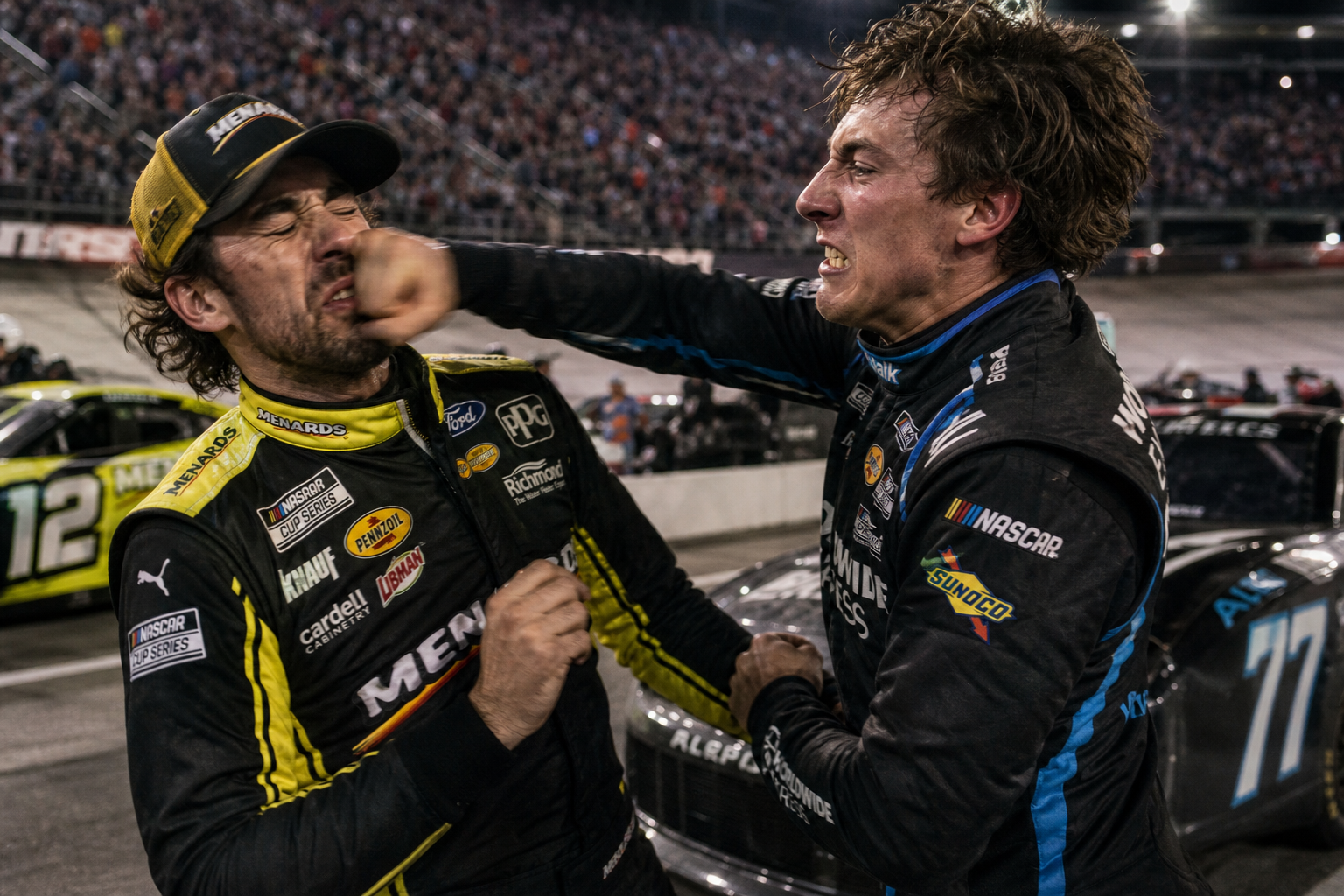

Bristol Motor Speedway has a way of turning ordinary racing incidents into matters of personal honor. On Saturday night, a late battle for second place between Ryan Blaney and Carson Hocevar ended not with a stern interview or a pointed social-media post, but with Hocevar punching Blaney.
Quite a way to settle a disagreement over corner exit.
A Second-Place Battle With Very Little Room for Politeness
The incident began when Blaney passed Hocevar late in the race to take second place. At a normal circuit, the move might have created an opportunity for a conventional switchback. Bristol, however, is not a normal circuit. The Tennessee short track is only 0.533 miles around, with steep banking and barely any spare real estate once two stock cars are committed to the same piece of asphalt.
Hocevar immediately attempted to cross back underneath Blaney. That crossover move is a familiar short-track tactic: allow the leading car to move ahead, then use the better exit line to regain momentum and return the favor before the next corner. Blaney anticipated it and tried to block.
Hocevar, whose driving style has earned him a reputation for aggression, did not lift. The two cars made contact, and the late-race fight for position became the sort of Bristol incident that tends to outlive the race itself.
At a track where cars run inches apart for hundreds of laps, drivers often speak about respect as if it were a limited-edition component. The trouble is that respect becomes rather flexible when second place is on the line and the next lap is arriving at roughly the speed of a bad decision.
Why Bristol Produces These Disputes
Bristol’s layout magnifies small disagreements. Its concrete surface, tight corners and high banking allow the NASCAR Cup Series field to run in close quarters, but they leave almost no room for a driver to recover from a missed judgment. A car does not need to be dramatically out of control to cause trouble. A block that arrives a fraction too late, or a driver who refuses to back out, can be enough.
The track also creates a peculiar rhythm. Drivers repeatedly circle the same short lap, often encountering traffic almost immediately after completing a pass. There is no long straightaway in which to cool down, rethink the situation and decide that perhaps the other driver’s family is perfectly nice after all. The next corner is always waiting.
That intensity is why Bristol has long carried its “Last Great Colosseum” nickname. The venue’s history is built around close racing, damaged sheet metal and rivalries that occasionally escape the confines of the cars. Saturday night followed the script with almost suspicious accuracy.
Hocevar’s Aggression Meets Blaney’s Defensive Instinct
Hocevar’s decision not to lift is central to the story. A driver in that situation has several options: abandon the crossover, accept losing the position, or commit to the inside and trust the other car to leave enough space. Hocevar chose the third option. Blaney, meanwhile, tried to protect his position by moving down.
Neither choice is unusual at Bristol. That is precisely why the outcome is so combustible. Both drivers were using tactics that make sense in the moment, yet the combined result left little margin for either car. Short-track racing is full of moves that look clever when they work and deeply insulting when they end with another driver’s fender in the wall.
From Hocevar’s perspective, the block could be viewed as an invitation to contact. From Blaney’s perspective, Hocevar’s refusal to back out transformed a defensive move into a crash. Racing drivers are generally very skilled at identifying the exact point at which another driver became responsible for everything. They are less enthusiastic about locating their own contribution.
The Punch Changes the Conversation
Contact on the track is part of Bristol’s vocabulary. A physical confrontation afterward is another matter.
Hocevar punching Blaney ensured the incident would not be remembered merely as a late-race disagreement over a crossover move. NASCAR has always had feuds, confrontations and the occasional exchange of opinions beside the haulers, but a punch gives an argument a much longer shelf life. Video clips travel quickly, and a driver can spend far more time answering questions about one swing than explaining an entire race.
The physical reaction also reveals how highly charged the moment had become. Drivers climb from cars hot, tired and often convinced that the other party has just ignored one of the unwritten rules of racing. At Bristol, those emotions have been compressed into a few frantic seconds of wheel-to-wheel combat. Add a lost position, a defensive block and contact at high speed, and the post-race meeting was hardly destined to resemble a polite committee hearing.
That does not make the punch wise. It makes it understandable as a product of the environment, while still being entirely avoidable. There is a difference between explaining why tempers flare and pretending that a fist is a sound conflict-resolution strategy.
A Familiar NASCAR Argument: Hard Racing or Over the Line?
The dispute will inevitably be reduced to a familiar question: was it hard racing, or did one driver go too far?
There is no shortage of room for disagreement. Hocevar’s aggressive approach is hardly a secret, and his refusal to lift fits the personality that has made him such a forceful presence in close quarters. Blaney’s attempt to block the crossover is also a standard defensive response when a driver has just completed a pass and wants to keep the position. The problem is not that either maneuver exists. The problem is how little space Bristol provides when both are attempted at once.
Short-track racing depends on drivers accepting some risk. If everyone lifted at the first hint of danger, the show would become a slow procession around a concrete bowl. But the same aggression that produces spectacular racing can also create a chain reaction of blame. One driver calls it a block. Another calls it a dive-bomb. The fans call it entertaining until the favorite’s car is the one with the missing front end.
Why This Bristol Incident Will Stick
Many NASCAR incidents disappear into the weekly churn. A bump here, a damaged fender there, and by the next race the field has found a new grievance. This one has more staying power because it contains every ingredient Bristol tends to serve: a late-race position fight, a crossover attempt, a defensive block, contact between recognizable drivers and a confrontation afterward.
It also places Hocevar and Blaney on opposite sides of one of NASCAR’s oldest arguments. How much aggression is acceptable before a driver owes the other competitor a lift? There is no universal answer, particularly at a track where the difference between a clean pass and a spectacularly bad evening can be measured in inches.
What is clear is that the battle for second did not end when Blaney completed the pass. It continued through the attempted crossover, the contact and finally the post-race punch. Bristol did what Bristol does best: it turned a few seconds of racing into a full evening’s worth of drama, then left everyone to argue about who started it.

0 Comments