
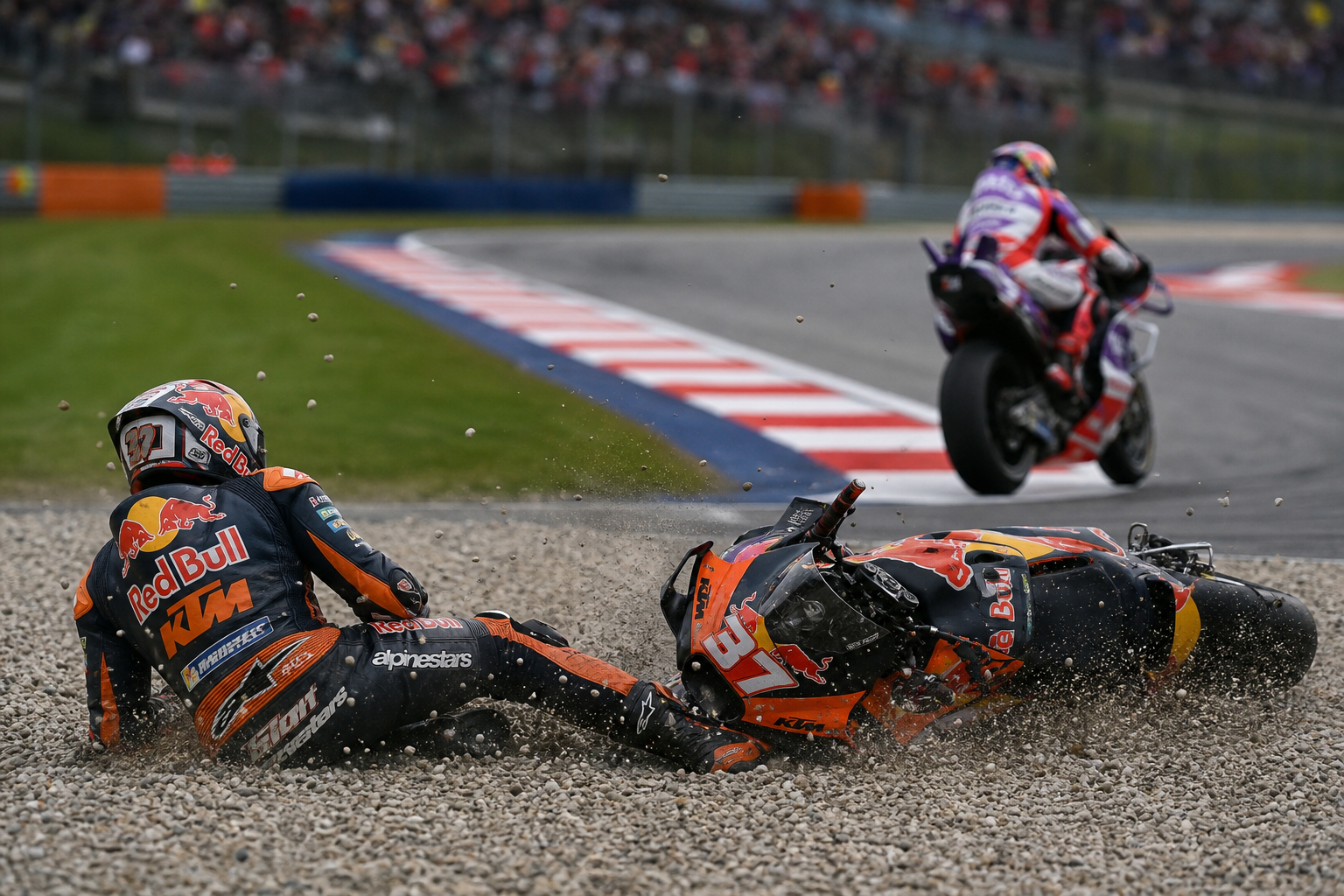

Pedro Acosta didn’t need a replay, a data trace, or a committee meeting to identify the reason his Austrian MotoGP sprint race disappeared. With a comfortable lead and only three laps remaining, the KTM rider arrived at the Turn 2/2A chicane far too quickly, lost control, and handed victory to Jorge Martin.
It was the sort of mistake that makes a rider stare at the floor while everyone else reaches for the obvious question: how on earth did that happen? Acosta’s answer was refreshingly direct. He accepted full responsibility.
A Lead That Vanished in One Braking Zone
Acosta had put himself in the ideal position at Spielberg. The KTM rider was not scrapping over the final podium place or gambling on a desperate last-corner pass. He was out front, clear of the immediate pressure, and appeared to have the sprint under control.
Then came the Turn 2/2A chicane.
The section is a particularly awkward part of the Red Bull Ring lap. Riders brake hard for the first part of the complex, change direction almost immediately, and then accelerate away. It rewards precision and punishes optimism with remarkable efficiency. Carry too much speed into the opening turn and the second part of the chicane becomes less a corner than an administrative consequence.
Acosta arrived with more speed than the corner could accept. The KTM ran wide from the intended line before the crash ended his sprint, leaving the race lead vacant with three laps still to run. A comfortable advantage became zero points in the time it takes a MotoGP machine to travel through a gravel trap.
There was no suggestion that a rival forced the error or that a mechanical issue caused the fall. Acosta owned it himself, which is about as clear as post-race accountability gets in a sport where blame is occasionally distributed like complimentary airport peanuts.
Jorge Martin Takes the Prize
Martin was the immediate beneficiary, claiming the sprint victory after Acosta’s crash. The result turned what had looked like a controlled KTM performance into another example of how brutally short a MotoGP sprint can be.
The sprint format leaves very little room for recovery. Riders have fewer laps to work with, tire management is less dominant than in a full-length Grand Prix, and track position carries enormous value. A rider who builds a lead can control the tempo, but a mistake near the finish is not softened by another half-hour of racing. There is no time to rebuild momentum. There is barely time to collect the motorcycle.
That made Acosta’s error especially expensive. Had the crash come early, he might at least have had the opportunity to limit the damage or understand the bike’s behavior over a longer distance. With three laps remaining, the advantage was already his to lose. The race simply waited for him to do it.
Why the Spielberg Chicane Is So Unforgiving
The Red Bull Ring is not a long circuit, but its short lap concentrates several demanding features into a very small package. Heavy braking zones, rapid changes in direction, and long acceleration runs make the Austrian track a place where a rider can gain time in one corner and lose the entire race in the next.
The Turn 2/2A complex is particularly easy to misjudge because the approach encourages commitment. Riders arrive at speed, brake aggressively, and must still make the motorcycle change direction cleanly. The first part of the chicane does not merely require slowing down; it dictates the line through the second section. Get the entry wrong and there is no graceful rescue waiting on the exit.
That does not make Acosta’s crash mysterious. It explains why the consequences were so immediate. A MotoGP rider can be only a fraction too late on the brakes and suddenly be asking the front tire to perform a small miracle while changing direction. Tires, sadly, remain less interested in miracles than journalists are.
A Costly Lesson for KTM’s Young Star
Acosta’s willingness to accept the mistake matters because the crash was not the product of an obvious tactical gamble against a faster rival. It was a self-inflicted error while leading. Those are painful, but they are also among the clearest mistakes for a rider to analyze.
The useful questions are brutally specific: Was the braking marker missed? Did Acosta carry too much entry speed after feeling comfortable in the preceding laps? Did he attempt to protect too much pace into the chicane rather than prioritize a clean exit? The available information does not answer those questions, and there is no reason to invent a diagnosis from a single incident.
What is clear is that the crash came at the worst possible moment. Acosta had already done the difficult work of creating the lead. The final requirement was not spectacular speed but disciplined execution. That is the slightly cruel distinction between looking like the winner and actually reaching the checkered flag first.
For KTM, the result will sting even more. Spielberg is the Austrian manufacturer’s home event, and a KTM rider leading the sprint deep into the race was precisely the sort of scenario the team would want in front of its home crowd. Instead, the defining image became a yellow-and-orange machine departing the racing line at the chicane while Martin inherited the victory.
The Sprint’s Harsh Arithmetic
Acosta’s crash also captures the peculiar tension of the modern MotoGP sprint. The shorter race creates immediate drama, but it gives mistakes a sharper edge. A rider can spend most of the event building an apparently decisive advantage, only to lose everything in a single corner with the finish line almost visible.
That is excellent television and miserable work for the rider involved.
There is no need to turn the incident into a verdict on Acosta’s ability. A rider who is willing to push hard enough to build a comfortable MotoGP lead will occasionally exceed the limit. The important distinction is whether the mistake becomes a repeated habit or a clearly understood lesson.
Acosta’s response at least began in the right place. He did not hide behind traffic, tire behavior, another rider, or an ambiguous reference to “circumstances.” He went too fast into the chicane, crashed, and lost a race he had been positioned to win. In a sport built around fractions of a second, that is the whole story.
Martin gets the victory. Acosta gets the data, the embarrassment, and the unpleasant task of trying to make sure the next comfortable lead survives all the way to the flag. At Spielberg, the difference between those two outcomes was one braking zone and three laps.
0 Comments